70 Clock Galerie / Innermost Loop Tableaux
TABLEAU 300
Welcome to November 1, 2026
November 1, 2026
Dr. Alex Wissner-Gross / @alexwg
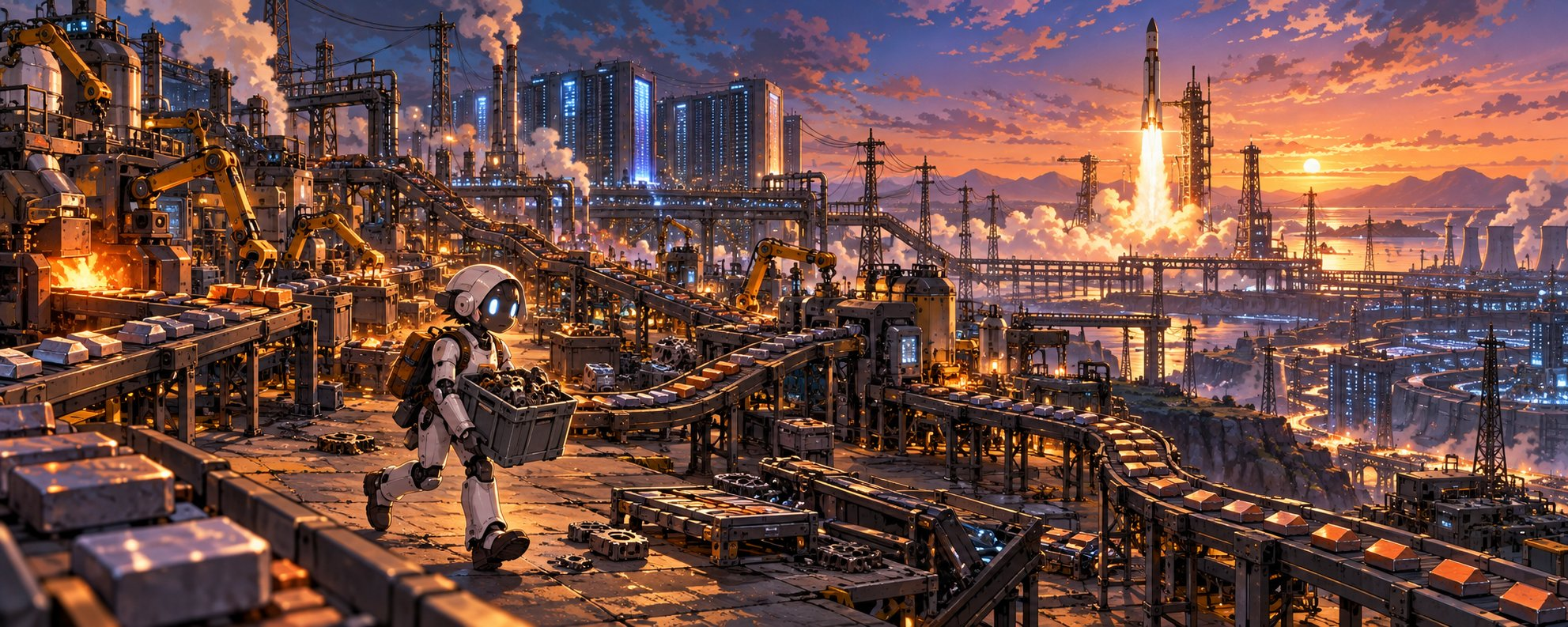
A small robot carries components through a sprawling industrial landscape as a rocket launches beyond it. Inspired by GPT-5.6 Sol’s imperfect but successful Factorio run, the tableau connects AI progress with the material and institutional systems that make achievement possible.
Factorio · GPT-5.6 Sol · Immanuel Kant · Factory Crush · AI infrastructure · Automation
Listen to narration
Read the narration
Welcome to November 1, 2026
With “Welcome to November 1, 2026,” Dr. Alex Wissner-Gross reaches his three-hundredth catalogued tableau and opens the second year of The Innermost Loop with its first new dispatch image. The sequence began on October 30, 2025, with “Welcome to Late October.” A year later, this recurring invitation to consider the future has become an extensive visual chronicle of intelligence, infrastructure, and technological ambition.
This is among the series’ most accomplished tableaux. Its extraordinary complexity rewards looking at several scales: individual gears scattered across worn paving; production lines threading through a crowded factory; computing buildings rising beyond them; and, finally, a rocket lifting toward an immense evening sky. The composition gives each scale a place in the same unfolding story. Its visual abundance becomes an argument about how progress happens.
Conveyor belts weave across the foreground. Mechanical arms tend glowing furnaces. Blue server buildings rise behind pipes and power lines. The orange horizon seems to carry the heat of the entire installation. In the middle of this immense operation, a small robot carries a crate of components. The achievement of the picture is to make that modest action matter as much as the launch.
That crate is the clue. It connects the spectacle to a surprisingly untidy achievement in the dispatch: an AI completing the factory-building game Factorio.
Created by Wube Software, Factorio asks players to turn raw materials into an increasingly elaborate production system. Mining feeds furnaces; manufactured parts feed more complicated machinery; electricity keeps the machinery running. Eventually, those interdependent processes can supply a rocket launch. The challenge is making many operations work together over time.
Ryan Madden reported that GPT-5.6 Sol, running through Codex at a low reasoning setting, completed a peaceful run in thirteen and a half hours of game time. Peaceful meant that the experiment excluded the game’s hostile creatures. The model operated through a Python interface rather than a mouse and keyboard, with constraints such as limited reach and unexplored territory still enforced.
Its success came with a revealing difficulty. Some production systems remained disconnected. To finish, the agent repeatedly transported supplies between them, compensating for weaknesses in its factory design. Earlier attempts with GPT-5.5 had struggled even to use transport belts.
Wissner-Gross turns that workaround into a character. The little robot’s burden makes an abstract limitation immediately understandable. Surrounded by automation, it is still carrying the missing connection in its arms. We can read its journey through the factory as the labor required to make an imperfect plan succeed.
The image translates a software agent into an imagined mechanical worker. It gives us a body, a task, and a destination. The distant rocket then supplies the consequence of all those small actions. The composition holds effort and achievement in the same frame.
Artistically, this is cinematic digital illustration with the density of science-fiction game concept art. Its rounded robot brings the expressive simplicity of animation into an environment rendered with intricate machinery, worn paving, scattered gears, and industrial clutter. The character’s luminous eyes give the vast installation a point of emotional access.
Orange light passes between the furnaces, the rocket exhaust, and the sunset. Cool blue illumination gathers around the computing infrastructure. The palette visually joins heat, energy, and intelligence. Meanwhile, the conveyors carry our attention around bends and through successive layers of the landscape. Even looking at the picture involves following a complicated route toward the launch.
There is an echo here of Factory Crush, Wissner-Gross’s glossary term for the aesthetic attraction of industrial infrastructure. Productive machinery becomes an object of fascination. Yet the clutter prevents that fascination from becoming a spotless showroom fantasy. This factory has accumulated equipment, compromises, and work still needing to be done.
That makes it an unusually effective setting for the rest of the dispatch.
The newsletter’s enormous infrastructure commitments sit beside tightening finance. OpenAI reportedly reduced its latest fundraising target to roughly twenty billion dollars. The juxtaposition matters: ambitious plans still require money to arrive at the right time and in the right place. The factory’s many linked processes provide a visual counterpart to that dependence. An impressive machine cannot compensate for every missing input.
The server buildings also acquire a specific resonance from the debate over memory. Sam Altman’s argument for concentrating scarce memory in heavily used cloud systems turns a hardware shortage into a question of allocation. Whose computer receives the resource? Who gets access to the intelligence it supports? Behind the glowing windows, the seemingly limitless digital future depends on manufactured components with limited supply.
The pylons and cooling towers widen that argument to energy. Envision’s large data-center ambitions in Inner Mongolia, Boom Supersonic’s development of turbines for AI facilities, and the dispatch’s nuclear-power discussion belong to the same material story. Advanced computation requires an expanding physical support system. A company associated with supersonic aviation can find itself building machinery to supply the electricity that computation consumes.
The water visible throughout the landscape introduces another dependency. The dispatch’s Arizona water controversy reminds us that cooling and construction take place within communities already sharing finite resources. Here, the water reflects a beautiful industrial sunset. Outside the artwork, its allocation becomes a matter of public argument. The image’s beauty and the newsletter’s friction occupy the same landscape.
Political institutions are part of this system too. France’s bandwidth-levy debate and Karin Prien’s support for taxing AI-generated value concern how the costs and benefits of technological change should be distributed. The machines can be drawn into a single coordinated panorama; agreement among the people who finance, regulate, and live beside them is harder to arrange.
The robot also permits a secondary connection to Meta’s reported work with Fourier on a humanoid prototype called Max. The dispatch places software intelligence beside efforts to give it a physical presence. The small carrier gives the Factorio agent an imagined body, making this broader shift easy to grasp: intelligence is increasingly discussed in terms of what it can move, assemble, and accomplish.
All these connections lead back to the dispatch’s closing sentence: “Out of the crooked timber of superintelligence, a rocket was nonetheless launched.”
The philosophical reference is to Immanuel Kant. In his 1784 essay on universal history, Kant describes the difficulty of building a just social order from imperfect human beings. Those entrusted with governing others share the flaws of the people they govern. His crooked timber is the human material from which institutions must be constructed.
Wissner-Gross transfers that metaphor to artificial intelligence. The timber becomes uneven capabilities, incomplete plans, awkward connections, and the workarounds that keep an ambitious project moving. The change in the sentence’s ending gives it its accelerationist force. Imperfection remains visible, and achievement remains possible.
The word “nonetheless” carries the argument. It acknowledges the problem before registering the result. In the picture, the crate and the rocket perform those two functions: one shows the unfinished integration, the other shows the goal reached.
This is why the Factorio episode offers such a persuasive organizing image for a dispatch filled with larger financial, political, and technological developments. A factory-building game makes interdependence visible. Its bottlenecks give form to the newsletter’s shortages and disputes. Its launch gives those difficulties a direction.
The achievement remains a bounded game result, with a particular setup and substantial limitations. The artwork expands it into a metaphor for progress without needing the experiment to establish flawless general intelligence.
Wissner-Gross’s optimism is most interesting here because he leaves the awkwardness in view. The robot still has work to do. The factory still winds around its own complications. Above it, something that depended on all that imperfect effort has lifted clear of the ground.
That is a fitting image with which to begin The Innermost Loop’s second year. After three hundred tableaux, the invitation to witness the future has acquired an accumulated history of its own. Here, the series reaches one of its richest visual expressions: intricate enough to hold the machinery of an era, intimate enough to make us care about the small figure carrying it forward.
House Innermost Loop — Sam Altman, Karin Prien, and Ryan Madden Walk
Opening the gallery…