70 Clock Galerie / Innermost Loop Reply Tableaux
TABLEAU 554
Maison de la Boucle la Plus Profonde — Sam Altman, Karin Prien et Ryan Madden défilent
House Innermost Loop — Sam Altman, Karin Prien, and Ryan Madden Walk
November 1, 2026
Siouid142 / @siouid142
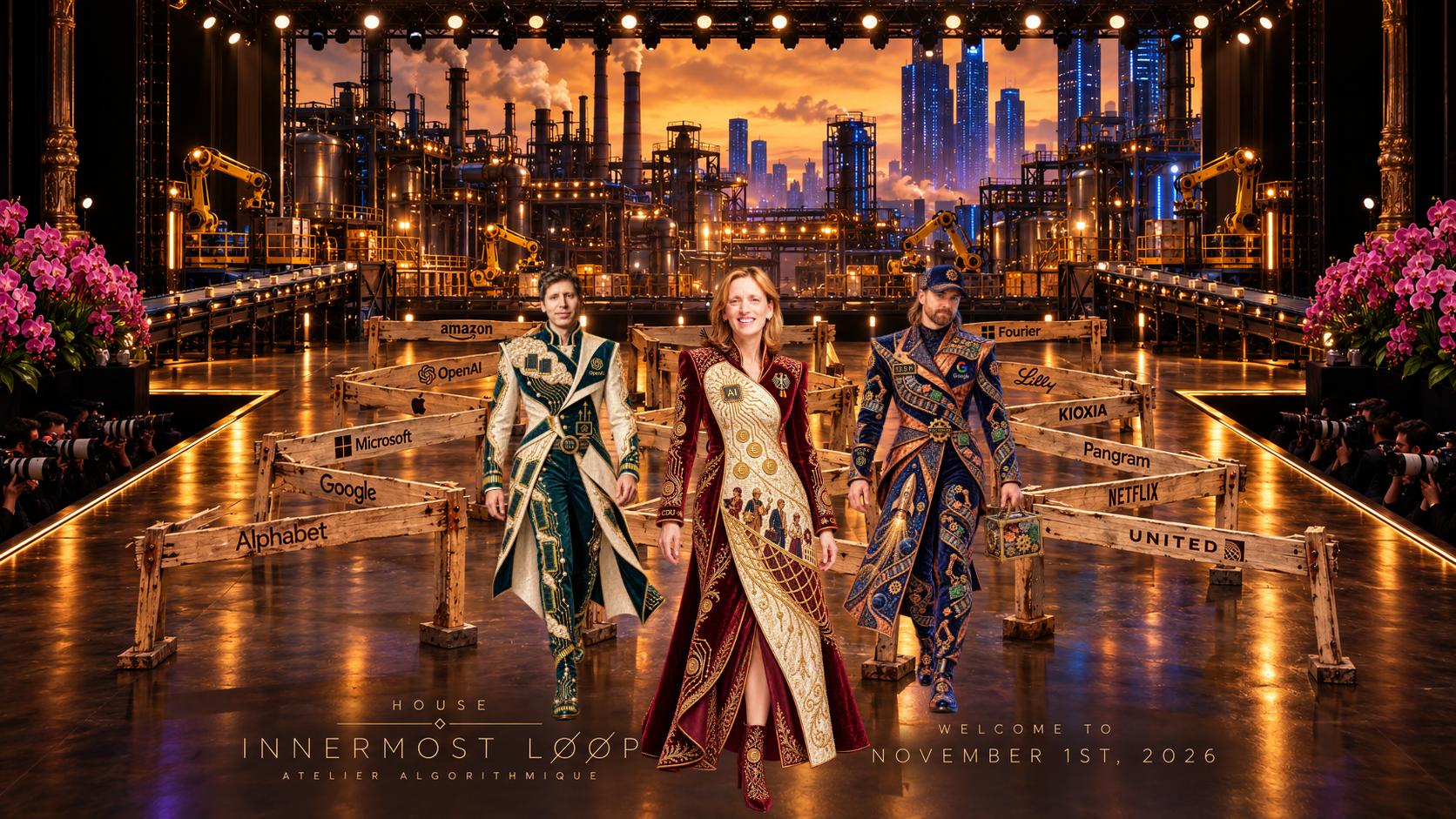
Siouid142 turns Dr. Alex Wissner-Gross’s November first dispatch into a House Innermost Loop runway. Sam Altman, Karin Prien, and Ryan Madden walk through company-branded crooked timber in couture that interprets cloud memory, AI taxation, and GPT-5.6 Sol’s Factorio experiment.
Sam Altman · Karin Prien · Ryan Madden · House Innermost Loop · Factorio · Crooked timber · AI taxation
Listen to narration
Read the narration
Maison de la Boucle la Plus Profonde — Sam Altman, Karin Prien et Ryan Madden défilent
House Innermost Loop — Sam Altman, Karin Prien, and Ryan Madden Walk
November 1, 2026
Siouid142 replies to Dr. Alex Wissner-Gross’s November first Innermost Loop dispatch by turning its closing philosophical observation into an obstacle on the catwalk. The factory from his header becomes the industrial horizon of House Innermost Loop. Across the polished runway, rough wooden rails form a maze. Three figures advance through it in couture so elaborately finished that the surrounding carpentry seems almost personally embarrassed.
This is Atelier Algorithmique, the house’s imagined workshop where the day’s technological arguments become garments. Its playful campaign for a sixteenth moonshot, Drip Abundance, gives intellectual achievement the full fashion treatment. The silhouettes are fierce, the embroidery is extravagant, and even a disagreement about computer memory deserves a statement look.
The familiar pink orchids flank the stage, recalling Wissner-Gross’s podcast surroundings and connecting this scene to the house’s earlier runways. Below them, photographers lean toward the action with long lenses. Above, a theatrical lighting rig floods the floor with amber. The industrial world has acquired an audience.
The scenic background extends Wissner-Gross’s header into the architecture of the show. Pipes, smokestacks, gantries, and yellow robotic arms crowd the horizon. Blue towers rise through the warm atmosphere. Conveyors continue along the sides toward us, making the factory appear to feed directly into the runway. Its production lines and the procession of models share a direction.
The style combines detailed digital portraiture, cinematic industrial scenery, and the ornament of ceremonial dress. Metallic embroidery answers the machinery’s gleaming surfaces; deep velvet-like colors absorb the light; the floor gathers reflections into a bronze sheen. There is an echo of Factory Crush, Wissner-Gross’s term for the aesthetic attraction of productive infrastructure. Here, industrial abundance has secured a fashion-week invitation.
Then the eye encounters the timber.
Raw boards meet at skewed angles. Rough ends overlap posts, dark fastenings mark the joints, and small blocks support a structure that looks improvised. Its zigzag passages interrupt the clean runway geometry. The deliberate awkwardness is clearest in how the pieces meet: these are systems assembled from parts that resist an immaculate fit.
The reference is Immanuel Kant’s crooked timber. In his 1784 essay on universal history, Kant considers the difficulty of establishing just political institutions when the people building and governing them are themselves imperfect. The problem reaches beyond individual competence to the human material from which a workable society must be constructed.
Wissner-Gross adapts that thought in the dispatch’s closing sentence: “Out of the crooked timber of superintelligence, a rocket was nonetheless launched.”
Siouid142 gives the metaphor a physical form. The figures must find their way through the imperfect structure. Their forward movement keeps possibility alive. That word “nonetheless” becomes something a model can walk.
The visible company names make the timber more than a philosophical prop. On the left, Alphabet, Google, Microsoft, and Amazon connect the maze to the dispatch’s enormous commitments to computing infrastructure. Alphabet and Google appear separately, although they belong to the same corporate group. Their names stand among boards that require other boards to remain upright: an apt image of expansion dependent on buildings, equipment, electricity, and finance.
The Apple symbol adds the consumer side of the hardware economy, recalling the dispatch’s flash-memory supply and pricing story. The OpenAI inscription gathers several threads: financing, Sam Altman’s argument about memory allocation, and the model behind the factory-game achievement. These names have been worked into the construction itself. The corporate economy becomes the material through which the models pass.
On the right, United recalls the newsletter’s discussion of the timetable for supersonic passenger flight and the engineering priorities being redirected toward power for AI infrastructure. Netflix belongs to the French debate over charging large content providers for the bandwidth they use. Both inscriptions connect futuristic ambition to the practical question of who delivers a service and who pays for the systems beneath it.
Pangram brings in the uncertainty surrounding AI-text detection and human authorship. Its presence gives this exquisitely artificial fashion spectacle a particularly knowing edge: elsewhere in the same technological world, people are arguing over how confidently a machine can identify machine-made writing. Kioxia anchors the memory-supply story in the manufacturers producing flash storage, whose bargaining position changes as infrastructure demand expands.
Lilly points toward the dispatch’s pharmaceutical story, linking the commercial success of obesity medicines with support for other biomedical research. Fourier returns us to robotics and the reported effort to give advanced AI a humanoid body. Transport, media, authorship, storage, medicine, and embodied intelligence occupy successive rails. The variety explains why the structure is difficult to coordinate.
That difficulty is precisely what the three outfits interpret.
At the left, Sam Altman wears deep teal, luminous ivory, and gold. OpenAI’s chief executive has been given an asymmetric long coat with sharply crossing panels, fitted trousers, and boots that continue the circuit embroidery to the floor. The cut is crisp; the embellishment is unapologetic. He is serving cloud couture.
A cluster of pearl-like beads spreads across his upper chest and shoulder in the shape of a cloud. Within it sit dark rectangular panels suggesting computing hardware. The metaphor is unusually effective because the cloud retains its machinery. Softness and luminosity surround the physical equipment that makes the apparent abstraction possible.
Green memory modules recur down the coat and trousers. Golden circuit paths carry the eye between them, while rows of contacts become decorative trim. On the opposite side of the torso, a small computer emblem contains a house, with arrows pointing upward. A round medallion carries the phrase “95% IDLE.”
These details translate Altman’s argument that scarce computer memory sitting underused in personal machines could be employed more intensively in shared cloud systems. The number on the medallion dramatizes his utilization claim. The costume makes that contested allocation argument visible, from the little home computer to the pearl-encrusted cloud.
The resulting look raises questions about where intelligence should reside. Centralized systems can keep expensive resources busy. Personal hardware can offer its owner independence and local access. The outfit makes the upward movement appear sumptuous, while leaving us to consider what accompanies that transfer of capacity.
The OpenAI emblem identifies the institutional interest within the argument. Gold contacts repeat at the cuffs and boots, completing the look with almost excessive discipline. The fit has understood the assignment: every decorative decision returns to memory, ownership, and the physical cost of an apparently weightless cloud.
Karin Prien occupies the foreground in burgundy and ivory. Germany’s federal minister responsible for education, family affairs, senior citizens, women, and youth is also a deputy leader of the Christian Democratic Union. Her background in law and education gives her presence a different emphasis from the technology executive beside her. She brings the public consequences of the transition onto the runway.
Her coat-gown has sculpted shoulders, a high collar, and a sweeping ivory panel that crosses the body and continues toward the hem. Gold botanical ornament moves across the burgundy fabric. A matching embroidered boot appears as she steps forward. The silhouette has authority, and the placement gives her unmistakable main-character energy.
The ivory panel carries a complete argument. At the top, a chip marked “AI” sends golden traces downward. Euro coins appear along those pathways. Below them stands a miniature group of working people, distinguished by a hard hat, documents, a briefcase, and professional clothing. A golden lattice sweeps across the lower composition.
This is the social safety net made into couture. Artificial intelligence produces value; revenue can become public resources; those resources can support people whose working lives are being altered. The gown gives that proposed relationship a direction we can follow with our eyes.
Prien’s inclusion comes from the dispatch’s discussion of AI taxation and employment disruption. Her support for taxing value generated through AI belongs to an unresolved political debate. The image imagines the protective purpose in a finished garment, while the surrounding crooked timber reminds us how much institutional construction remains.
The small eagle with black, red, and gold ribbons signals German governmental identity. CDU lettering at the cuffs identifies her party. The coins continue into the ornament of her footwear. This is a thoroughly coordinated look: fiscal policy has arrived with a dramatic hem and excellent boots.
Her central position is especially telling. The people represented on her gown stand between the chip above and the net below. She carries a picture of those who could otherwise disappear from an account of ever-larger facilities and ever-more-capable models. The runway’s most prominent figure asks what technological abundance will mean for the people living through its arrival.
At the right, Ryan Madden wears midnight blue and burnished copper, with a gear-emblazoned baseball cap preserving the casual signature of his portrait. His long coat has angular lapels and sweeping tails. Conveyor-belt motifs cross his chest, curl along his sleeves, and continue down his trousers. Gears and green circuit-board details sit among the tracks. The engineer has brought serious runway swagger.
Madden is a software engineer at Google whose work has included Google Cloud and interfaces for streaming analytics. That background concerns making complex data systems usable. Here, he appears because of an experiment that makes the behavior of a complex AI system unusually easy to see.
He reported getting GPT-5.6 Sol, running through Codex, to complete a peaceful Factorio game in thirteen and a half hours of game time. The game requires a player to organize production, transport resources, and build toward a rocket launch. The experiment succeeded despite weaknesses in how the agent connected parts of its factory.
Madden’s account describes the agent repeatedly ferrying supplies between production areas to compensate for those missing connections. The accomplishment was real within that game setting, and its method remained awkward. This combination supplies the dispatch’s philosophical punchline.
His clothing records both sides. The Google badge identifies his professional affiliation; the model reference at the cuff points to the tool used in the experiment. A “13.5 h” badge records game time, and a gear-shaped Factorio medallion anchors the subject at his waist. Across a long coat panel, a golden rocket rises through a starry field.
The rocket is the hero detail. The little parts carrier in his hand is the plot.
Its brass-colored frame contains gears and electronic components, turning an industrial burden into a couture accessory. This is the house’s most persuasive statement bag. It recalls the little robot carrying a crate in Wissner-Gross’s original header. Although that walking robot is absent from this runway backdrop, its task has migrated into Madden’s hand.
The accessory represents the AI agent’s in-game workaround. Madden wears the experiment’s story: the conveyors describe the intended system, the carrier reveals the extra effort required when integration fails, and the rocket records the result. Even the cap, trousers, and boots continue the same industrial vocabulary. The look is maximalist, but its motifs earn their place.
Across the three figures, the repeated diagonals create a quiet visual conversation. Altman’s ivory panels and circuitry direct resources toward a cloud. Prien’s panel directs value toward people and protection. Madden’s conveyor patterns direct materials toward a launch. Around them, the timber redirects bodies along an imperfect route.
These are different kinds of coordination. One concerns scarce hardware, another social responsibility, another practical achievement. Their coexistence gives the tableau its depth. A technical success can be celebrated while questions about ownership and distribution remain in the same frame.
The polished presentation sharpens the satire. The embroidery is meticulous. The floor gleams. The photographers are ready. And the supporting structure still looks as though several incompatible plans were nailed together shortly before the lights came on.
Yet the passages remain open. The models continue toward us.
That is the force of this reply. Siouid142 takes the dispatch’s optimism seriously enough to give its imperfections a starring role. The crooked timber becomes the route through which achievement must travel. Above it, the factory glows; across it, three extraordinarily dressed figures keep moving. The seams are immaculate. The joints are questionable. The show goes on.
Opening the gallery…