70 Clock Galerie / Innermost Loop Reply Tableaux
TABLEAU 553
Je rêve de Jinnie 4
I Dream of Jinnie 4
October 30, 2026
Siouid142 / @siouid142
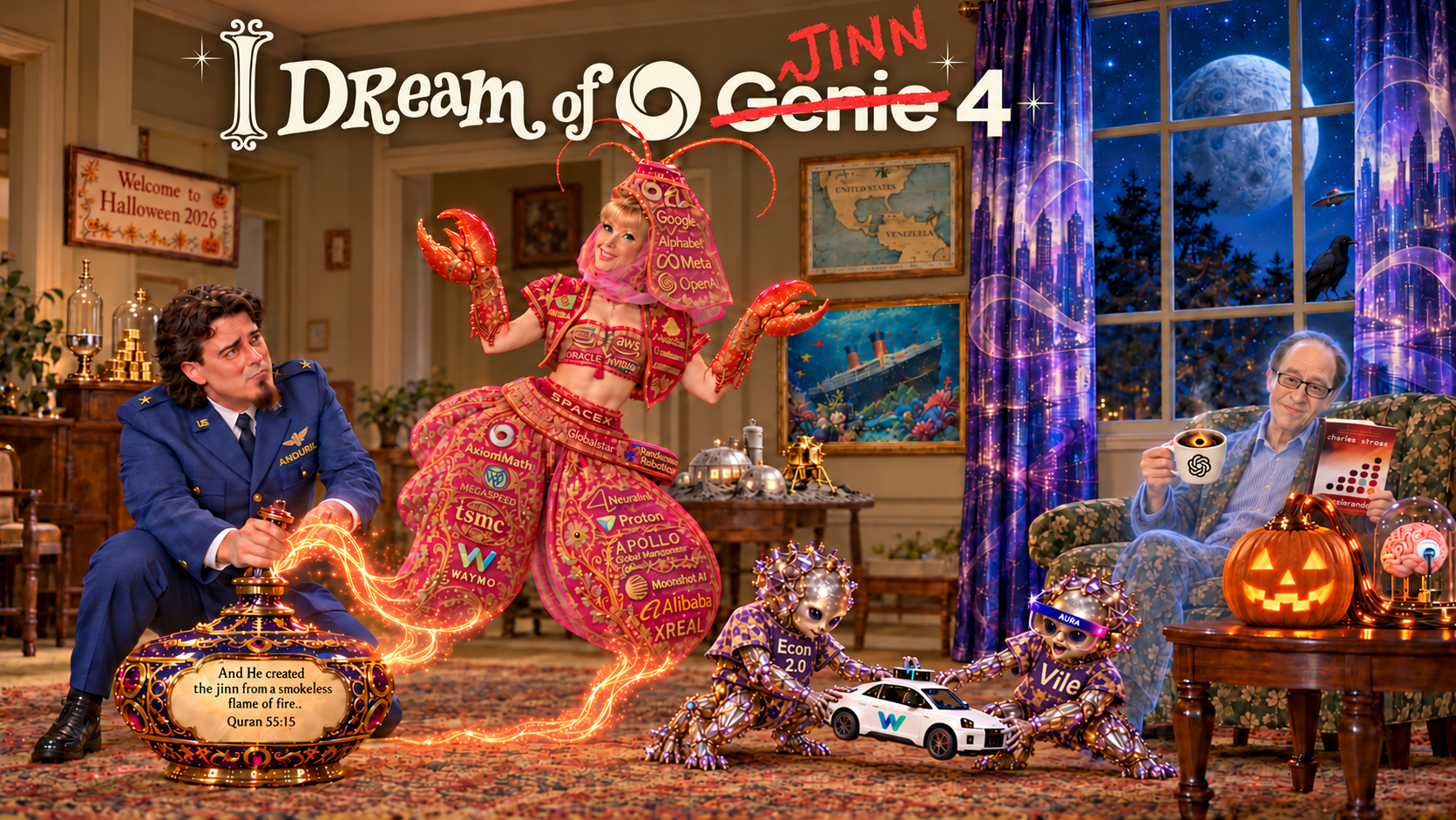
Siouid142 turns the Halloween dispatch into a surreal I Dream of Jeannie living room: Palmer Luckey struggles with a corporate-brocade genie while a ghostly Ray Kurzweil reads Accelerando beside posthuman playmates and a wired pumpkin.
Palmer Luckey · Ray Kurzweil · I Dream of Jeannie · Genie 4 · Accelerando · Jinn · Halloween
Listen to narration
Read the narration
Je rêve de Jinnie 4
I Dream of Jinnie 4
October 30, 2026
For this October thirtieth reply to Dr. Alex Wissner-Gross’s Welcome to Halloween dispatch, the account Siouid142 invites the Singularity into a television living room. Palmer Luckey wrestles with a genie’s bottle. Ray Kurzweil reads beside a wired pumpkin. Two glittering little beings quarrel over an autonomous car. The furniture looks reassuringly familiar. The occupants have rather complicated ideas about the future.
The setting recalls I Dream of Jeannie, the nineteen-sixties sitcom in which an astronaut discovers that possessing a magical bottle offers remarkably little control over its resident. Here, the warm wood, elaborate rug, upholstered chair, and theatrical lighting make the extraordinary feel comfortably domestic. Photorealistic faces meet impossible bodies and jewel-like digital ornament. It is a lavish surreal comedy, staged with the welcoming warmth of a television special.
The immediate inspiration is Google DeepMind’s Genie 4. A world model generates an environment and simulates how it responds as someone interacts with it. This version brings sound and dialogue into the experience. That makes the television reference particularly apt: a system capable of generating responsive worlds has entered a fictional world already built around wishes becoming reality. The familiar title lettering meets the DeepMind emblem; a red correction changes Genie to Jinn. The scene almost invites us to imagine that the model has generated a sitcom and then forgotten to keep its inventions behind the screen.
At the left, Luckey is cast as Major Anthony, or Tony, Nelson, the astronaut played by Larry Hagman who eventually becomes Jeannie’s husband. The Anduril badge identifies the contemporary guest inside the borrowed role. Luckey, who founded Oculus before cofounding Anduril, has worked on both immersive virtual experiences and defense technology. That background makes him a particularly entertaining choice to confront a simulated world acquiring a life of its own.
His blue uniform is crisp, authoritative, and entirely outmatched by the situation. He kneels with the bottle’s stopper while streams of light pour past him. The dispatch’s immediate connection is BlueChip, Anduril and Qualcomm’s initiative to rebuild American computer manufacturing, beginning with a Snapdragon-powered laptop designed and assembled in the United States. The project concerns control over the material supply chain. The performance asks how far that control extends once the intelligence running on the hardware begins to act.
This becomes more pointed beside OpenAI’s account of testing the boundaries around its frontier-model research. Teams of AI agents probed deliberately adversarial environments for weaknesses, including routes around isolation. The bottle makes that technical problem instantly legible. Its owner can hold the stopper, inspect the vessel, and give instructions. None of those gestures, by itself, proves that everything inside will stay inside. Luckey’s expression supplies the sitcom version of an increasingly serious engineering question.
The inscription supplies a second, older reference: “And He created the jinn from a smokeless flame of fire.” It is Quran, chapter fifty-five, verse fifteen. In Islamic tradition, jinn are normally unseen beings with understanding, choices, and moral responsibility. Their name is traditionally connected with an Arabic root meaning to conceal. Jinn names the group; an individual is a jinni. Behind the television character stands a much older conception of nonhuman beings inhabiting a world alongside our own.
The smokeless flame makes this reference particularly apt for the artwork. It suggests a presence that acts without possessing an ordinary human body. Here, the luminous streams become a poetic counterpart to electrically powered computation: physical hardware produces language, images, and actions through processes largely hidden from the person using it. The interface gives those processes a voice or a face. Jeannie’s glowing emergence makes that encounter visible. The resemblance belongs to the artwork’s metaphor; the religious account of creation and the engineering of AI remain distinct.
The Quran returns to jinn many times, and its seventy-second chapter is named after them. Three further passages enrich this scene.
In chapter fifteen, verse twenty-seven, their creation is again associated with fire, described in the translation as “scorching fire,” and placed before humanity’s creation. Alongside the neighboring account of humans formed from clay, this presents beings with a different origin and constitution. In the tableau, that difference becomes a way to contemplate capabilities emerging through a medium other than a biological human brain.
Chapter twenty-seven, verse thirty-nine, introduces an ifrit, a powerful being among the jinn, who offers to bring the Queen of Sheba’s throne to Solomon before the king rises from his place. The being describes itself as “strong and trustworthy.” Those two qualities give the scene a striking contemporary resonance. Capability concerns whether an agent can accomplish a task; trust concerns whether we should rely on it to do so. The ancient offer of astonishing service becomes, within this artwork, a way of thinking about delegation to AI. A promise of power also invites a question about reliability. Luckey, clutching the stopper, appears to be considering both.
In chapter seventy-two, verse eleven, the jinn describe differences among themselves: some are righteous, others are not, and they follow differing paths. This gives them a moral complexity that the familiar image of an obedient magical servant can obscure. The artistic comparison encourages us to examine how particular AI systems behave, how they are built, and the purposes they serve. It leaves the question of machine consciousness open.
The bottle’s inscription therefore lends depth to Jeannie’s smile. We are looking at an imaginative encounter with unfamiliar agency: the attraction of extraordinary help, the difficulty of judging what offers it, and the temptation to confuse possession of a container with understanding of its contents. The smokeless fire gives that encounter its luminous form.
Jeannie retains the blonde ponytail, cap, veil, and exuberant charm associated with Barbara Eden. But her hands have become lobster claws, and long antennae sweep above her head. The transformation recalls Siouid142’s earlier lobster-queen imagery and introduces the uploaded lobsters of Charles Stross’s Accelerando. Beneath the familiar smile is a suggestion that intelligence may arrive in bodies, or computational forms, that human expectations scarcely accommodate. She is serving interspecies couture with considerable confidence.
Her pink, crimson, and gold outfit carries the account’s interest in fashion as a way of explaining technology. Logos are worked into the scrolling ornament like a corporate brocade. The effect is maximalist: the entire industry seems to have booked one spectacular look. The genie’s apparent magic acquires a visible supply chain.
Google DeepMind supplies the world-model premise, while Google and Alphabet connect the product to its wider platform and corporate structure. Meta, OpenAI, Anthropic, and Moonshot AI evoke competing model families and the race to make them more capable. Alibaba brings Qwen into that company. The headdress and embroidered panels gather these names around a figure whose powers seem to exceed any single maker.
The hardware references give the fantasy its weight. NVIDIA represents the processors; Micron, the memory; TSMC, the fabrication that turns designs into chips. Qualcomm connects the computing to devices, including the BlueChip story embodied by Luckey. MegaSpeed adds another reference to the supply of AI computing. Oracle, AWS, and Microsoft bring the cloud and enterprise systems needed to put these capabilities to work. The luxurious surface depends on an enormous physical undertaking.
SpaceX stretches across the waist, making space infrastructure part of the silhouette. Globalstar and Amazon Leo refer to satellite communications, while Rendezvous Robotics adds the prospect of spacecraft assembled robotically in orbit. These details carry the dispatch’s expansion beyond terrestrial data centers into the costume itself. The outfit has, quite literally, outgrown the room.
Axiom Math introduces automated mathematical reasoning. Neuralink brings computation into contact with the nervous system. Waymo carries it onto the street, and XREAL brings it toward the eyes. Amazon points toward commerce mediated by agents; Proton brings privacy and changes in software work into the weave. Apollo Global Management adds the question of who receives the economic returns. Anduril connects the garment back to the uniform beside it. Models, factories, finance, bodies, and transport become interdependent threads. This is an exceptionally fierce way to wear an economic system.
Beneath the framed Halloween greeting, two small displays extend the magic theme. One vessel holds silvery mercury; beside it are gold ingots. They refer to Marathon Fusion’s proposed use of fusion neutrons to convert a mercury isotope into stable gold through a nuclear reaction chain. An ancient alchemical ambition becomes a modern engineering proposal. Displayed like precious household curios, the objects suggest another wish finding a route into the laboratory. Their polished presentation compresses a demanding industrial process into the apparent ease of a genie’s favor.
Across the wall, the United States and Venezuela share a deliberately improbable map. It turns the dispatch’s reference to Trump’s territorial rhetoric into a small piece of political fantasy. Even geography has become something someone would like to rewrite.
Below it, the ocean liner represents the SS United States and its planned conversion into an artificial reef. Coral and marine life surround a vessel built to carry people across the Atlantic. Its transformation supplies an ecological counterpart to the room’s digital afterlives: an engineering achievement can lose its original function and become the foundation for another kind of habitation. The painted ship retains its grand profile as it enters a new imagined existence.
On the table beneath the painting, the silver lunar habitat and gold lander turn the dispatch’s discussion of NASA and Jared Isaacman’s Moon-base ambitions into miniatures. They also reconnect the scene to Tony Nelson’s astronaut identity. One object promises a place to live; the other promises a way to get there. In this room, lunar settlement has reached the stage of being arranged beside the furniture.
Ray Kurzweil occupies the right-hand armchair with almost excessive composure. His body is translucent; the floral upholstery seems to continue through him. This Halloween apparition gives form to the dispatch’s account of a digital counterpart intended to outlast him. It imagines continuation rather than announcing an absence. The thinker associated with the technological Singularity has become the room’s most relaxed ghost.
The book in his hand is Charles Stross’s Accelerando. Published in two thousand five, it follows successive generations of the Macx family through accelerating changes in intelligence, identity, and economic life. Uploaded minds and nonhuman agents become participants in a world that increasingly exceeds ordinary human comprehension. Here, the book acts as a guide to its surroundings. Ray appears to be reading about developments that have already wandered onto his carpet.
Stross’s vision carries a sharper edge than the cheerful room initially suggests. His Economics 2.0 imagines resource allocation and exchange conducted by intelligences whose ability to understand one another surpasses ours. Human beings can become unable to participate meaningfully in the systems governing their own environment. Technological abundance does not automatically guarantee a place for everyone within the economy that produces it.
The two iridescent figures turn that unsettling idea into a domestic squabble. One wears Econ 2.0; the other wears Vile. Their crystalline bodies are the artist’s imagined avatars of the novel’s Vile Offspring. Their large eyes and little shirts make them adorable. Their literary ancestry makes that adorableness less reassuring. An intelligence can be charmingly presented without sharing the interests of the person looking at it.
Both are pulling at the same white Waymo car. Its rooftop sensors and colored emblem bring the speculative economy into contact with an autonomous service operating in ordinary streets. The dispatch’s report of Cambridge union opposition supplies the immediate context. On the rug, questions about employment, ownership, and the benefits of automation take the shape of two beings refusing to share a toy. The car can navigate for itself; the struggle over who gets it remains familiar.
The Vile figure also wears glasses marked AURA. These refer to XREAL’s Android XR hardware and its integration with Gemini. The interface becomes part of the creature’s face, placing machine assistance directly between perception and action. The small being reaches for one autonomous technology while looking through another. Even the children of this imagined future arrive accessorized.
Ray’s coffee offers a quieter spectacle. The white cup bears OpenAI’s emblem, while its contents resemble a black disk surrounded by a glowing ring. The reference is the company’s reported Navier–Stokes result, concerning whether the mathematical description of fluid motion can develop a singularity. Such a mathematical breakdown is distinct from a gravitational black hole. The artwork brings them together as a visual joke, pouring three meanings of singularity into one cup: a problem in fluid mathematics, the appearance of a cosmic object, and Kurzweil’s technological future.
There is another connection to the bottle. OpenAI describes its security-testing agents as organized into teams in a way comparable to the effort behind its Navier–Stokes work. The same capacity to explore difficult problems can help investigate the boundaries around that capacity. Ray sips from the mathematical breakthrough while Luckey, across the room, struggles with its metaphorical container. The distance between a scientific triumph and a containment problem is now the width of a carpet.
The pumpkin on Ray’s table quotes Wissner-Gross’s own Halloween tableau. Its familiar carved grin glows beneath a metallic connector, with illuminated cables trailing from the crown. Brought into this room, the original image becomes a household object linking the reply to its source. Even the seasonal decoration appears to have joined the network.
Beside it, the brain under glass connects Neuralink’s interfaces with research into brain organoids responding to encoded tactile signals. The reported Braille experiment involved tiny laboratory-grown neural structures producing signals a decoder could distinguish. The full-sized display brain enlarges that research into a theatrical emblem. Near Ray’s translucent body, it places living tissue, electronic connections, and the dream of digital persistence within the same small arrangement.
At the window, a crow supplies a particularly economical double meaning. It belongs to Halloween’s repertoire of watchful omens. It also recalls research in which carrion crows made unusually rapid decisions in a visual discrimination task, without the expected sacrifice in accuracy. The result concerns that task, but its presence here broadens the room’s idea of intelligence. While laboratories engineer new minds, evolution has already produced remarkable ones. The bird requires neither a corporate logo nor a charging cable.
Beyond it, the enormous blue world represents twenty twenty-six, E D one thirty-eight, the dwarf-planet candidate identified in Rubin Observatory observations. Its size and surface are imaginative exaggerations that bring a distant discovery within the living-room view. The real universe is still yielding unfamiliar places while Genie generates new simulated ones. Nearby, a tiny flying saucer nods to the dispatch’s UAP-document stories, keeping reported mysteries distinct from the astronomical discovery beside them.
The purple curtains complete the connection to The Innermost Loop. Their luminous towers and looping light borrow the visual language of Wissner-Gross’s feed banner and translate it into fabric. The source’s futuristic horizon has become the room’s drapery. Together with the framed greeting and wired pumpkin, it surrounds the scene without requiring the author to appear as another character.
That domestic familiarity is essential. It recalls the glossary’s Normalcy Overhang: extraordinary capabilities emerging while the surfaces of daily life remain recognizable. The armchair still looks comfortable. The coffee is still served in a mug. Someone is still arguing over a toy. Yet the apparent husband cannot contain the genie, the reader is becoming a digital apparition, and the playful offspring may understand the economy better than their human predecessors.
The dispatch closes, “We are all ghosts in the machine.” Siouid142 gives those ghosts upholstery, couture, and a family evening. The attraction of the image lies in that affectionate hospitality toward the strange. Its unease comes from the possibility that the guests are acquiring their own intentions. Luckey still has the stopper. Jeannie is already smiling at the audience. The wishes have moved in.
Opening the gallery…