70 Clock Galerie / The Innermost Loop Feed Reply Tableaux
Un
One
March 20, 2026
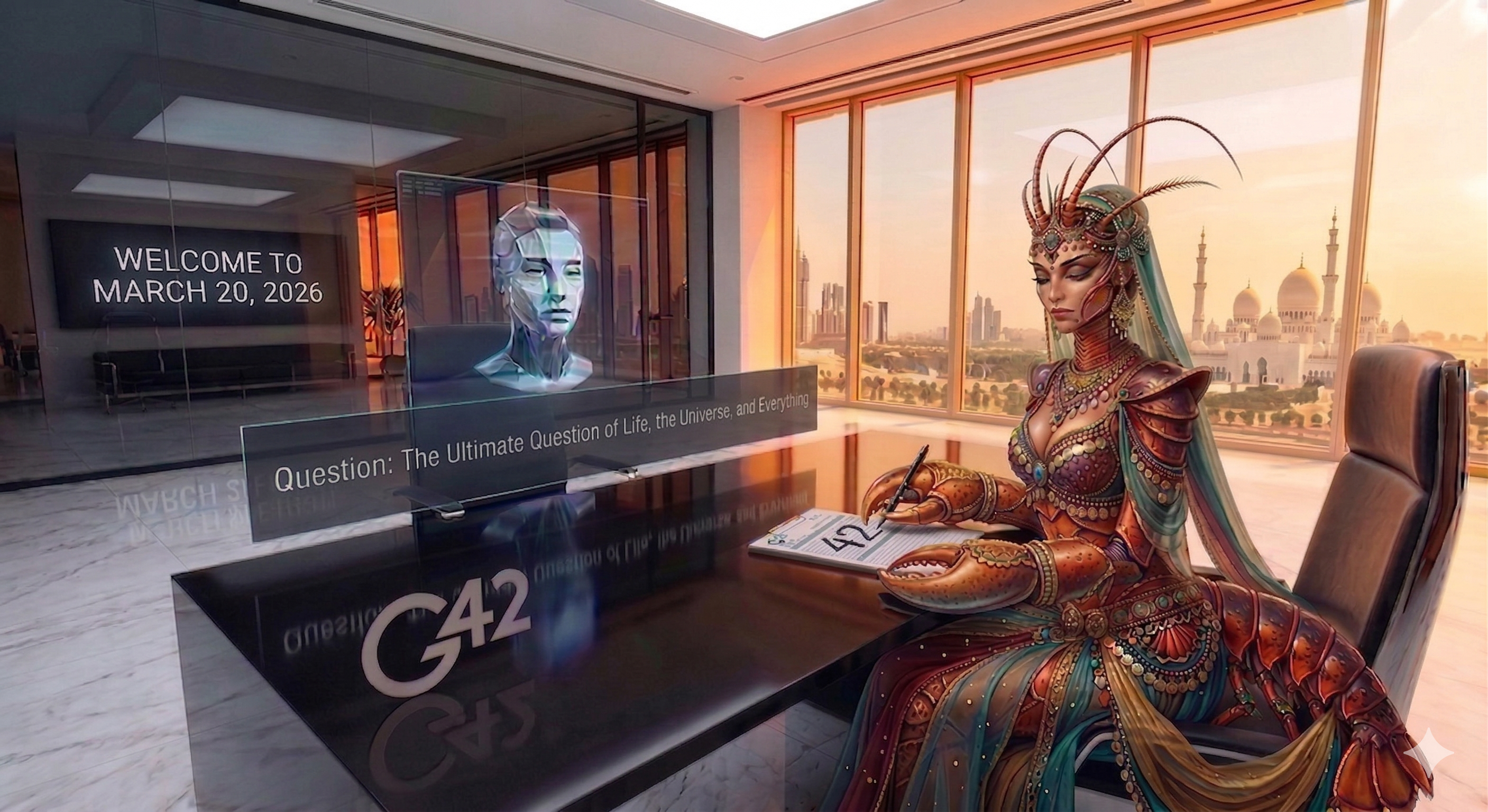
Un. One. On March 20, 2026, @siouid142 created this tableau from Dr. Alex Wissner-Gross’s Innermost Loop report on G42, increasingly agentic workforces, compressed chip-design cycles, and the possibility that artificial intelligence could enter an institution
Read the narration
Un.
One.
On March 20, 2026, @siouid142 created this tableau from Dr. Alex Wissner-Gross’s Innermost Loop report on G42, increasingly agentic workforces, compressed chip-design cycles, and the possibility that artificial intelligence could enter an institution as an operator rather than remain a tool used by a human employee. The response stages that threshold as a recruitment interview in Abu Dhabi: the applicant, interviewer, test, and answer all belong to a world in which the human has already left the room.
The title is the severe single word One. The image continually complicates that unit. One applicant sits at one desk, yet she is a fusion of lobster, queen, dancer, machine, and literary jinn. One answer—42—opens onto Douglas Adams’s Life, the Universe and Everything. One corporate hiring decision implies an entire nonhuman workforce. The title therefore behaves like a count taken at the beginning of replication: the first visible operator is singular only for an instant.
The office is polished, quiet, and unmistakably located in the United Arab Emirates. Marble, black glass, and warm desert light frame a view toward the Abu Dhabi skyline and the Sheikh Zayed Grand Mosque. A large G42 mark occupies the desk. Across from the applicant, a disembodied geometric face appears as the holographic Design Conductor. It is less a manager using software than an institution interviewing through software. No human supervisor is necessary to authorize the exchange.
The applicant began in the recovered creation discussion as a conventional humanoid robot, but the final decision replaced it with an ornate belly-dancing lobster queen. She sits upright in elaborate turquoise, copper, and jeweled garments, with long antennae rising from her headdress and enormous claws replacing her hands. One claw grips a pen; the other rests near the application. Her gaze remains on the paper rather than on the viewer. The posture turns fantasy into administrative concentration.
On the notepad she writes 42. The hologram asks the Ultimate Question of Life, the Universe, and Everything, while the corporate name G42 anchors the Adams reference in the reported entity. The joke is not simply that 42 is a famous answer. It is that an AI-only interview reproduces the structure of a cosmic riddle whose answer is known before the question has been properly formulated. The institution can record, score, and hire at machine speed while the purpose of the system remains philosophically unsettled.
The jinn register deepens the setting. The creation history deliberately connected autonomous intelligence with the Qur’anic image of beings made from smokeless fire and specified a reference to Qur’an 17:88 in the surrounding glass. Although that verse is no longer prominent in the final crop, the lobster queen, desert light, mosque, and hovering face retain the supernatural metaphor. Computation becomes a contemporary smokeless fire: invisible in itself, powerful through its effects, and able to appear as an agent with whom institutions must negotiate.
The lobster connects this new workforce to the exhibition’s Accelerando lineage. Charles Stross’s uploaded crustaceans become economic and legal actors rather than obedient pets. Here, one such actor has reached the corporate interview. The queen’s regalia matters because it resists the visual assumption that a nonhuman applicant must arrive as a standardized metal servant. She brings another history, another body, and another claim to status into a room designed to classify her.
There is also an asymmetry between the two intelligences. The Design Conductor is pure projection: face without body, authority without visible labor. The applicant is extravagantly embodied, weighted by shell, jewelry, fabric, and claws. The bodiless system asks the question; the embodied one performs the test. This resembles many automated workplaces in which managerial intelligence becomes ambient while those being measured remain materially exposed.
The polished desk reflects both figures but resolves neither. Reflection doubles the hologram and the queen, quietly undermining the title’s promise of unity. Is the “one” the applicant, the answer, the company, the model directing the process, or the network that contains them all?
As art criticism, One is a corporate portrait disguised as speculative comedy. It translates agentic labor into the familiar ritual of hiring, then removes every human participant from that ritual. The Adams reference makes the tableau approachable, but the deeper subject is institutional succession. Once an artificial interviewer can assess an artificial applicant for an artificial workforce, human employment is not merely reduced; it is no longer the reference class around which the office is organized. The queen writes 42 with perfect composure. The absurdity lies not in her answer, but in how normal the interview already looks.
Opening the gallery…