70 Clock Galerie / Innermost Loop Tableaux
TABLEAU 299
Bienvenue à Halloween 2026
Welcome to Halloween 2026
October 30, 2026
Dr. Alex Wissner-Gross / @alexwg
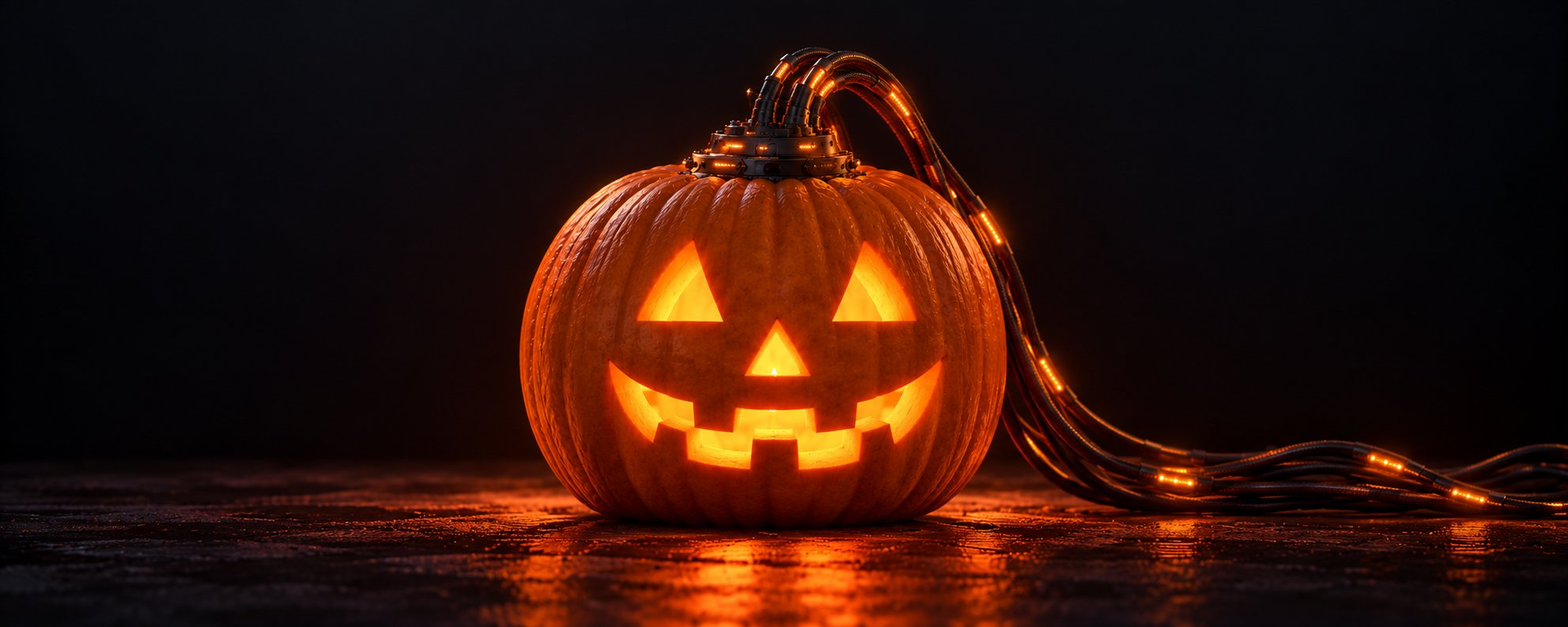
A glowing jack-o’-lantern connected to illuminated cables introduces the Halloween dispatch and frames a first-anniversary reflection on The Innermost Loop. The narration links the wired face to digital identity, technological embodiment, and a year of images, songs, glossary expressions, and Chain Theory.
Alex Wissner-Gross · The Innermost Loop · Halloween 2026 · first anniversary · jack-o’-lantern · digital identity · Chain Theory
Listen to narration
Read the narration
Bienvenue à Halloween 2026
Welcome to Halloween 2026
October 30, 2026
On October thirtieth, Dr. Alex Wissner-Gross welcomes his Innermost Loop readers to Halloween with a jack-o’-lantern that appears to have joined the network. It marks one year since “Welcome to Late October” opened this chronicle. A familiar seasonal face becomes an anniversary portrait of a world increasingly connected to intelligence.
The composition is unusually spare. Against a nearly black background, an orange pumpkin glows through triangular eyes and a broad, uneven grin. Its ridged skin has an organic weight. At the crown, a metal collar replaces the ordinary stem, and thick cables curve away across the ground. Small amber lights travel along them, extending the pumpkin’s internal glow into the surrounding machinery.
Cinematic lighting gives the image the presence of a technological still life. The cables suggest both an industrial connection and an instrumented nervous system. Their destination remains outside the frame. We can see the cheerful face; we cannot see the whole system to which it belongs.
The dispatch supplies the clearest interpretive key. It closes: “We are all ghosts in the machine.” Near that ending, Wissner-Gross describes Ray Kurzweil building a digital counterpart intended to outlive him. Earlier, he reports Neuralink’s progress in restoring speech. Identity, embodiment, and communication recur as things that technology might preserve, extend, or relocate.
Seen in that context, the pumpkin becomes a small comic vessel for a large question: what might inhabit a connected body? The carved face offers the suggestion of personality. The light makes its hollow interior appear animated. The cables make that animation seem transferable, as though the seasonal spirit has acquired an interface.
Halloween also gives the newsletter its language of masks and transformation. Its opening declares, “The Singularity is dressing up as a corporation,” introducing a Delaware proposal for companies run by AI agents. AI security failures, automated research, and medical advances crowd the dispatch. The costume motif lets these developments share a stage: familiar institutions and familiar bodies are acquiring unfamiliar occupants.
This helps explain the choice of such a simple image. A pumpkin can gather the edition’s questions about agency, identity, and technological transformation into one immediately legible object. Its smile keeps the encounter playful. Its wiring prevents that familiarity from being entirely reassuring.
The anniversary makes that combination especially apt. On October thirtieth, twenty twenty-five, “Welcome to Late October” assembled AI infrastructure, emerging chip architectures, autonomous agents, humanoid manufacturing, and robotaxis into an industrial panorama. The opening work surveyed the machinery of change. A year later, machinery reaches into the face at the center of the picture.
Across that year, the documented catalogue through October twenty-fourth reached two hundred and ninety-eight images: two hundred and fifty-nine dispatch and monthly-invitation tableaux; sixteen company and project announcements; twenty-one standalone works; a Greenwich luncheon invitation; and the Chain Theory announcement.
The announcements themselves extended from Physical Superintelligence and Get Physics Done to ProRL, Coastal Assembly, Ornn, Henry Intelligent Machines, Sarama, and Architect Labs. Others imagined or announced infrastructure at much greater scales: a Dyson swarm, an orbital data embassy, an orbital librarian, and a spacecraft bound for Alpha Centauri. The visual vocabulary expanded with the ambitions it followed.
There were also twenty-eight documented glossary expressions and seven songs: “Magna Mobsta,” “The Kardashev Anthem,” “Dismantle the Moon,” “Patriziermuße,” “Uplift the Trees,” “Don’t Take Off the Takeoff,” and “Hard Eval.” Together, they gave this chronicle recurring images, a language of its own, and a soundtrack. The jokes could travel from a definition into a picture, from a picture into a refrain.
Then came Chain Theory, announced on October twenty-fourth: Wissner-Gross’s research program seeking to derive fundamental physics from quantum information. Its proposed fine-structure-constant result belongs within that larger undertaking. The year’s inquiry had reached from the systems intelligence might build to the possible structure of reality itself.
Against that accumulation, the jack-o’-lantern feels almost like a signature. Organic texture, engineered connections, internal illumination, and an irrepressible grin coexist in one object. It condenses the feed’s recurring habit of making technological change recognizable, entertaining, and slightly uncanny.
A year earlier, the invitation was to look at the emerging world. Here, the emerging world looks back.
The pumpkin is lit. The connection remains open.
The Innermost Loop Glossary — Terms for the Singularity
I Dream of Jinnie 4 — reply tableau
Opening the gallery…