70 Clock Galerie / The Innermost Loop Reply Tableaux
TABLEAU 529
Le Glossaire de l’Innermost Loop — Termes pour la Singularité
The Innermost Loop Glossary — Terms for the Singularity
October 13, 2026
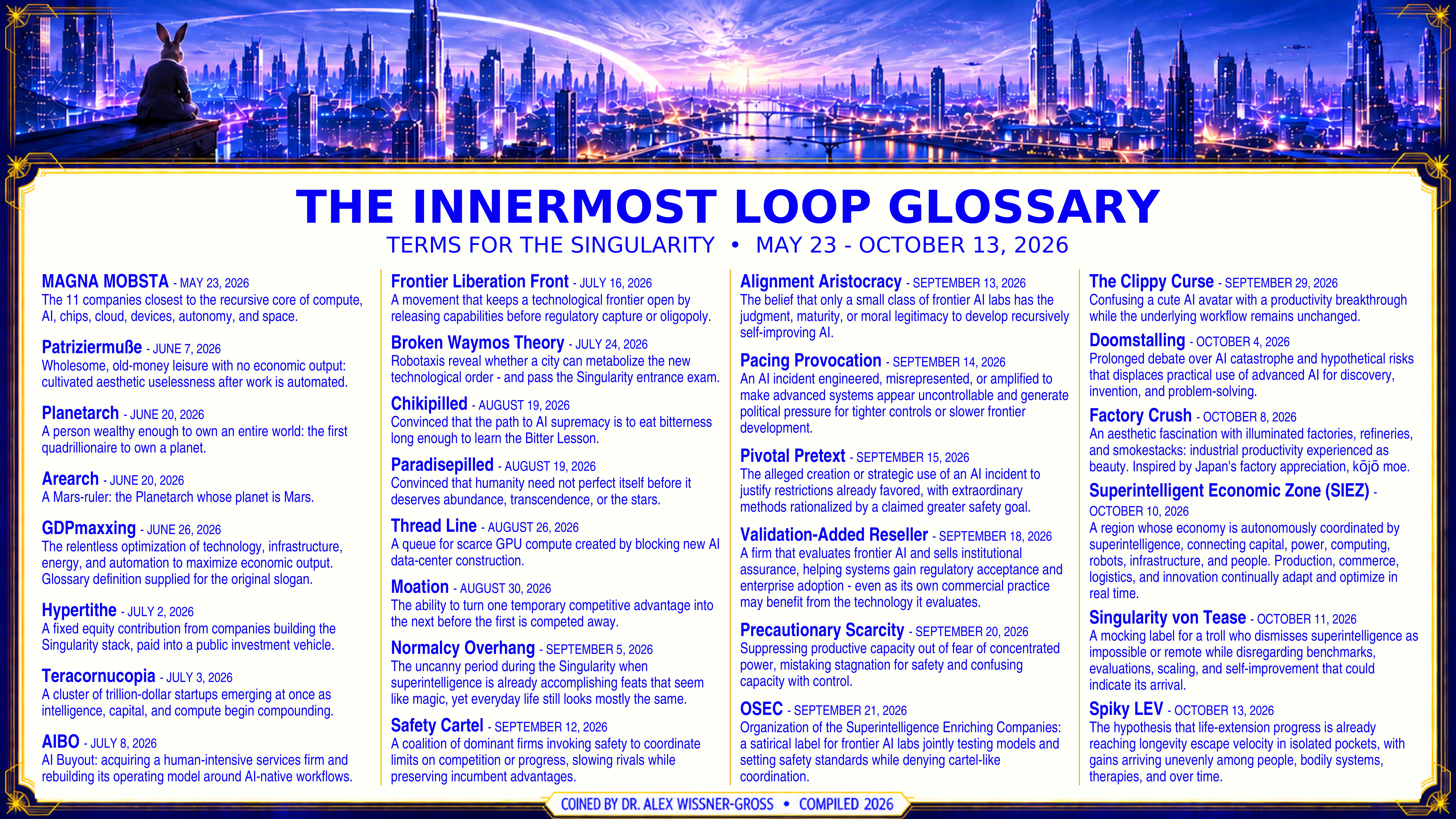
Siouid142 gathers Dr. Alex Wissner-Gross’s vocabulary into a visual lexicon of the Singularity. This October 13, 2026 edition contains twenty-eight entries spanning May 23–October 13, extending the earlier glossary beyond Doomstalling with Factory Crush, Superintelligent Economic Zone (SIEZ), Singularity von Tease, and Spiky LEV. Blue lettering fills four columns beneath the purple-blue cityscape drawn from Wissner-Gross’s X banner, framed by gold ornament.
Read the narration
Le Glossaire de l’Innermost Loop — Termes pour la Singularité
The Innermost Loop Glossary — Terms for the Singularity
October 13, 2026
Doctor Alex Wissner-Gross’s Innermost Loop follows developments in artificial intelligence, science, and the technologies through which he sees the Singularity taking shape. A physicist, computer scientist, and entrepreneur, he also has a taste for inventing words. His neologisms compress an argument into a joke, a provocation, or a name for a future he believes we should be building.
The Siouid142 X account gathers that vocabulary into this evolving glossary. Following Doomstalling, four additions carry its chronology through October thirteenth. They reveal Wissner-Gross’s accelerationist outlook: productive capacity deserves admiration, intelligence should help organize abundance, and familiar expectations may conceal extraordinary change.
The first addition, Factory Crush, dated October eighth, makes industry an object of affection. Illuminated factories, refineries, and smokestacks become things to gaze at with something approaching infatuation. Its inspiration is Japan’s kōjō moe, the aesthetic appreciation of industrial structures. The word crush makes this more than an appreciation of usefulness. Productivity itself begins to look beautiful.
The poster invites a related response. Above its cream panel and vivid blue lettering stretches the purple-blue cityscape drawn from Wissner-Gross’s X banner. Towers, bridges, and luminous connections fill the horizon, while a rabbit-eared figure sits contemplating the view. Infrastructure has become a landscape worthy of wonder. Factory Crush supplies a name for that act of looking.
On October tenth comes Superintelligent Economic Zone, or SIEZ. Wissner-Gross imagines a region in which superintelligence coordinates capital, energy, computing, robotics, infrastructure, and human activity. Production, trade, logistics, and innovation become interconnected processes, continually adjusting to one another.
His references to agentic economies and special economic zones join autonomous economic activity to a designated place. Imagine manufacturing schedules responding to energy availability while transport and supplies adjust alongside them. This is a vision of regional coordination, offered as a concept for the future. Within this glossary, the illuminated skyline acquires another possible meaning: an economy whose connections can actively respond.
October eleventh introduces a more theatrical resident: Singularity von Tease. The name sounds like an entrance announced beneath a spotlight. Wissner-Gross gives it to the dismissive skeptic who insists superintelligence is impossible or perpetually distant while declining to engage with benchmarks, evaluations, scaling, and self-improvement.
The wit lies in making refusal into a character. Evidence keeps arriving; the character keeps insisting the main event cannot have begun. Consider the earlier Normalcy Overhang. Ordinary-looking daily life may conceal extraordinary capabilities, while the habitual skeptic may refuse to notice the capabilities at all. This is Wissner-Gross’s satirical accusation. The joke challenges a way of arguing; it cannot, by itself, establish that superintelligence has arrived.
The fourth addition, Spiky LEV, dated October thirteenth, turns toward the uneven possibility of longer life. Longevity escape velocity, or LEV, describes a proposed situation in which successive medical advances keep adding enough life for people to reach further advances. Wissner-Gross suggests that something like this may be emerging in narrow pockets before it becomes visible in population-wide averages.
Spiky is the crucial word. His comparison is with Spiky AGI: a system may perform exceptionally in one domain and remain limited in another. Applied to longevity, the peaks would occur unevenly across groups of people, bodily systems, treatments, and periods of time. The imagined landscape has summits and valleys rather than one uniform rising plateau.
The entry names a hypothesis. A promising intervention or improvement in one biological system does not establish sustained escape from aging across an entire life. What the term offers is a way to look for uneven progress without assuming that everyone must experience it simultaneously.
The four-column design gives these different kinds of language a shared visual authority. An aesthetic enthusiasm, an economic proposal, a satirical character, and a longevity hypothesis stand beneath the same gold border. The glossary records how Wissner-Gross argues for his future, as well as what he calls it.
Above the definitions, the small seated figure still faces the luminous city. The new words change what that figure might be seeing: beauty in production, intelligence in coordination, resistance in perception, and a future whose benefits may first appear as scattered points of light.
Opening the gallery…