70 Clock Galerie / The Innermost Loop Tableaux
TABLEAU 298
Chain Theory
October 24, 2026
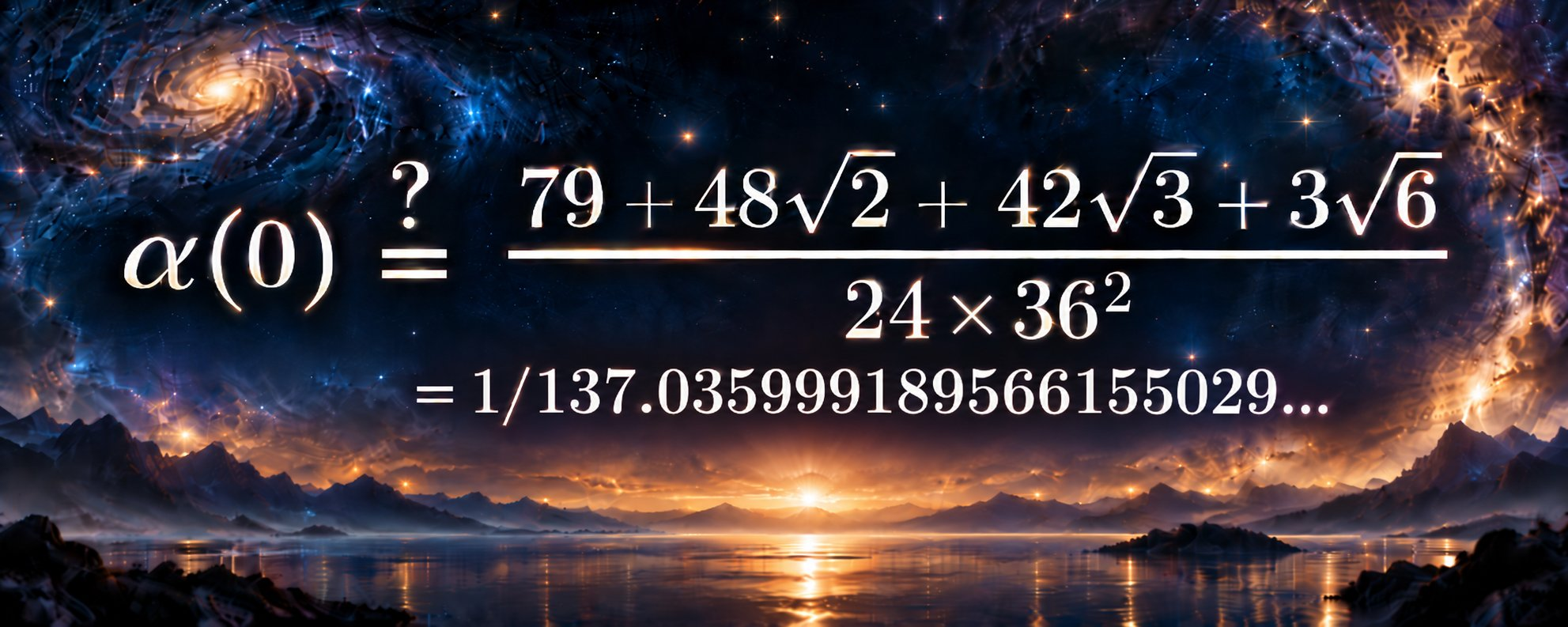
A luminous equation spans galaxies, mountains, and reflective water as Wissner-Gross introduces Chain Theory. The narration explains his proposed quantum-information foundation for physics and its candidate fine-structure constant, with the question mark distinguishing mathematical calculation from physical confirmation.
Read the narration
La théorie des chaînes
Chain Theory
October 24, 2026
One equation stretches across the heavens. Beneath it, mountains surround a still expanse of water, and a golden light breaks across the horizon. Above, galaxies turn through a blue-black sky that seems woven from luminous strands. For this October twenty-fourth post, Doctor Alex Wissner-Gross gives an abstract calculation the scale of a cosmic revelation. But the most consequential mark in the composition is also among the smallest: the question mark above the equals sign.
The accompanying article introduces Chain Theory, his new research program seeking to reconstruct fundamental physics from quantum information. Its first published result concerns the fine-structure constant. The name sounds forbidding; the question behind it is wonderfully direct. Why does the electromagnetic interaction have precisely the strength that it does?
Electromagnetism governs how electrically charged particles interact with one another and with light. It helps account for atoms, chemical bonds, and the light by which we see this picture. The fine-structure constant, represented by the Greek letter alpha, measures that interaction's strength. Unlike a length in meters or a speed in miles per hour, it has no units. Changing our measuring system does not change this number.
At low energies, it is approximately one divided by one hundred and thirty-seven. The zero beside alpha specifies the limiting case used here: zero momentum transfer. It does not mean that electromagnetism has been switched off. The equation concerns the interaction's strength in that particular limit.
Physics can measure this constant extraordinarily well. What remains unexplained within the Standard Model is why it has this value. Think of a powerful calculation that still requires someone to enter a crucial setting before it can run. Wissner-Gross wants that setting to emerge from the underlying rules themselves.
His starting point is a different picture of what reality is made from. Imagine chainmail, with its interlocking links, rather than a collection of isolated little beads. In his proposal, the fundamental links are pairs of quantum systems joined by entanglement. Entanglement means that their joint state cannot be fully described by assigning each partner an independent state. The connections belong to the description of the whole.
The chainmail is an analogy, not a claim that microscopic metal rings fill space. The theory proposes networks of finite-dimensional quantum systems. Particles, and eventually the structures associated with forces and spacetime, would have to emerge from how those networks are organized and accessed.
The intellectual ambition recalls John Wheeler's idea that information might lie beneath physical reality. Wissner-Gross also draws motivation from limits on how much information a bounded region can contain, the mathematical symmetries of known particles, and the absence of observed internal structure in elementary particles. He treats these as clues inviting a different foundation. Their interpretation as Chain Theory remains his proposal.
Two small quantum systems become especially important: a qubit and a qutrit. A qubit has two basis states; a qutrit has three. Both can exist in quantum superpositions. In the proposed construction, their pairing leads to a mathematical structure associated with the Standard Model's symmetries. The further suggestion—that this particular kind of link underlies the photon, the particle of light—is the crucial physical conjecture.
Now the elaborate fraction becomes easier to approach. In his calculation, one hundred and seventy-two mathematical measurement records fall into four groups. Those groups supply the counts seventy-nine, forty-eight, forty-two, and three. Their weights produce the square roots visible across the numerator. The denominator, twenty-four times thirty-six squared, supplies the normalization. He presents the result as following from the model's stated rules and definitions, without adjusting numerical parameters to fit the measured constant.
The long decimal beneath the fraction expresses the reciprocal of that result: approximately one hundred and thirty-seven point zero three five nine nine nine one nine zero. Its closeness to measurement is the reason this otherwise specialized calculation receives such monumental treatment.
Against the CODATA twenty-twenty-two recommended value, it agrees to ten significant digits and differs by about six-tenths of one standard uncertainty. In ordinary language, it falls within the reference value's stated uncertainty range. That is a striking numerical agreement. It does not, by itself, establish the proposed physical explanation.
Wissner-Gross supplies a Lean proof file alongside the paper. Lean is software for checking formal mathematical proofs. Its role here is to verify that the specified definitions and calculation yield the stated number. The paper explicitly leaves the photon identification outside that formal verification. A computer can check what follows from a mathematical construction; experiments must still establish whether nature follows that construction.
Even the measurements require care. Different high-precision experiments do not yet fully agree with one another. More precise, mutually consistent results could strengthen the candidate's case or exclude it. The formula commits to a definite value, so the next digits matter.
That scientific uncertainty gives the image its tension. Its style is cinematic cosmic fantasy, borrowing the grandeur of Romantic landscape painting: dark mountain silhouettes, immense skies, and light gathering at the horizon. The equation occupies the place where a painter might position a revelation. The woven textures suggest the proposed chainmail of reality, while the water's reflection visually carries the heavens into the material landscape below.
Yet those galaxies and luminous strands are an artistic interpretation, not a visualization of experimental evidence. They express the scale of the aspiration: to connect a compact mathematical beginning with the universe we inhabit. The question mark keeps that aspiration open to examination.
For followers of the Innermost Loop, this is a distinctive change of position. The commentator on scientific acceleration steps forward with a research proposal of his own. Here, the drama turns on whether a number normally supplied by measurement can instead be explained. Across this magnificent sky, the mathematics makes a precise offer. The question mark waits for nature's reply.
Opening the gallery…