70 Clock Galerie / The Innermost Loop Reply Tableaux
TABLEAU 552
La théorie de 2 Chainz
2 Chainz Theory
October 28, 2026
Siouid 142 / @siouid142
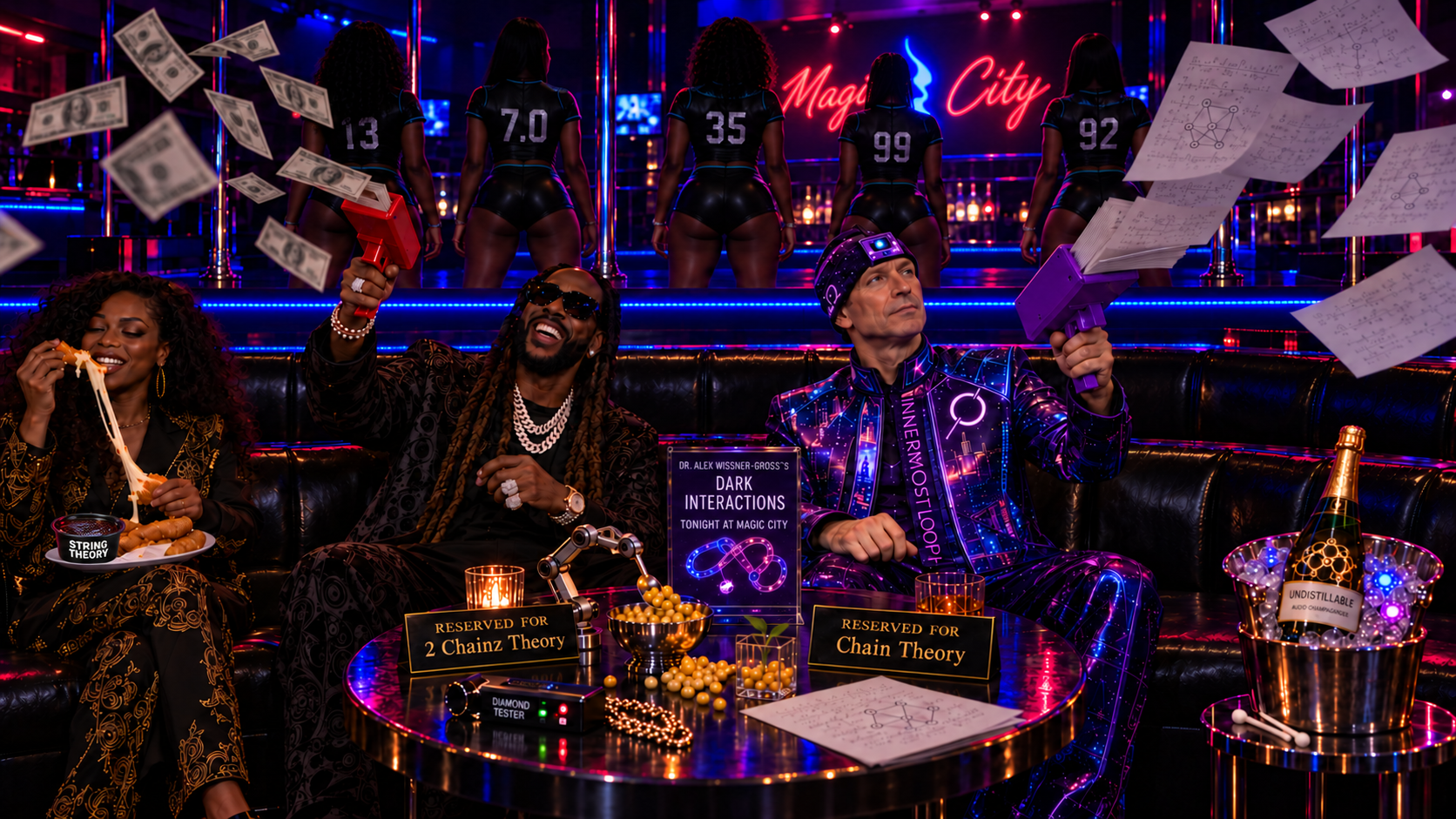
Siouid 142 stages a fictional Magic City meeting between 2 Chainz and Dr. Alex Wissner-Gross, turning the Chain Theory discussion in Moonshots 306 into cash and manuscript showers, numbered significant figures, string-cheese theory, and quantum bottle service.
Listen to narration
Read the narration
La théorie de 2 Chainz
2 Chainz Theory
October 28, 2026
On October twenty-eighth, the Siouid 142 account replied to Dr. Alex Wissner-Gross’s announcement of Moonshots episode three hundred and six with a scene in which fundamental physics has acquired a nightclub residency. Four days earlier, Wissner-Gross had introduced Chain Theory, his proposal to rebuild physics from quantum information. Now, following the episode’s extended discussion, the artist gives that research a distinctly different kind of public reception. There are reserved seats, bottle service, significant figures onstage, and an extraordinary amount of paper in the air.
The setting is an imagined gathering at Magic City. Seated together are the rapper 2 Chainz and Wissner-Gross, whose respective affiliations appear on matching reservation cards: “2 Chainz Theory” and “Chain Theory.” The nearly identical names bring two cultural worlds into the same booth. A familiar hip-hop emblem, the conspicuous chain, becomes an invitation into a difficult scientific idea. This fictional encounter allows the artist to approach the theory through objects we can recognize before we understand its mathematics.
The style is cinematic digital realism, saturated with the visual extravagance of a music video. Cobalt light traces the elevated platform. Magenta and red neon interrupt the darkness. Chrome catches narrow highlights, while the black leather booth absorbs them. The composition distributes its information through little pools of illumination: silver numbers, glittering jewelry, a purple suit, white manuscript pages. It feels lavish, but the lighting is also editorial. Each bright object asks for its own moment of attention.
2 Chainz supplies the room’s unmistakable swagger. His braids, sunglasses, chains, and rings accompany a broad, delighted smile. Gold ornament curls across his dark outfit, giving the seated figure the presence of someone entirely at home in this atmosphere. The fit is doing its job. Raising a red bill dispenser, he sends banknotes across the left side of the picture, performing the familiar gesture of making it rain.
Wissner-Gross answers from the right in purple Innermost Loop couture. Luminous city structures and circuit-like lines travel across his jacket and trousers, while the newsletter’s name runs vertically down his chest. The futuristic metropolis familiar from the artist’s earlier work has migrated onto the body. His coordinated cap, complete with a glowing forehead element, belongs to this invented wardrobe of technological possibility. Frontier physics has arrived with a fully coordinated look.
His dispenser is purple, and its ammunition is intellectual. Manuscript pages fly upward, carrying illustrative equations and networks of connected points. The visual pairing is precise: the rapper circulates money; the researcher circulates ideas. Both are throwing paper. On Moonshots, Wissner-Gross described a compendium of roughly eight hundred pages accompanying his initial result. The artist converts that formidable reading assignment into an exuberant paper shower. Publication becomes performance.
Above them, five performers in matching black outfits with teal edging carry the picture’s most exacting joke. Across their upper backs, from left to right, appear thirteen, seven point zero, thirty-five, ninety-nine, and ninety-two. Join those groups together, and they read: one hundred thirty-seven point zero three five nine nine nine two.
These are significant figures, in both senses of the expression.
The number is the proposed inverse fine-structure constant, rounded to ten significant digits. The fine-structure constant describes the strength of electromagnetism, including the interaction between light and electrically charged matter. It helps determine the behavior of atoms. Because it has no units, its numerical value does not depend on whether we measure distances in meters or feet. Why nature should select this particular value is the deeper question.
Wissner-Gross’s paper constructs a candidate value from his proposed quantum framework and reports agreement with the measured constant to ten significant digits. The striking claim is that this value follows from one starting axiom without fitting adjustable parameters to the experimental answer. On the platform, that claim to precision becomes choreography. Each performer carries part of a single numerical statement. The rear-facing arrangement makes the costumes readable across the room, turning the stage into a human display panel.
To understand what those digits are celebrating, imagine beginning a description of nature with small quantum systems and their relationships. A qubit has two distinguishable basis states; a qutrit has three; a qudit is the broader term for a system with a finite number of such states. Quantum superposition makes these richer objects than ordinary switches. Entanglement connects them in ways that cannot be described by treating each independently.
Chain Theory proposes that networks built from these finite quantum ingredients could account for the particles, forces, and geometry of our physical world. That is the ambition behind the jewelry analogy: links assembling into larger structures, relationships becoming fundamental. The artist gives an unfamiliar starting point a tactile equivalent. We already know what it means to see a chain and recognize that its structure depends on connections.
A small black instrument on the foreground table complicates the celebration. It reads “Diamond Tester.” Among the necklaces and rings, this is a plausible accessory. Within the larger composition, it becomes a beautifully economical question about verification.
A brilliant appearance and a demonstrable result are different achievements. Wissner-Gross’s technical materials distinguish the checked calculation from the conjecture that the construction describes nature. Lean, a computer proof assistant, checks the mathematical work expressed within its formal system. Establishing that the resulting number really explains electromagnetic coupling requires additional scientific scrutiny. The tester gives that distinction a place in the scene without interrupting the party. Even here, the ice has to pass inspection.
At the far left, another guest is occupied with an apparently less demanding experiment. She stretches long strands of mozzarella above a plate of breaded cheese sticks. Her black-and-gold outfit echoes the rapper’s ornamental language. On the plate sits a dipping cup labeled “String Theory.”
This is the most accessible theoretical comparison in the room. Wissner-Gross contrasts his finite linked systems with the continuous degrees of freedom he associates with string theory. The artist renders that contrast as stretching cheese beside linked jewelry. The culinary reduction is cheerfully outrageous, and its usefulness lies in making the distinction memorable. A notoriously difficult field has acquired a party snack.
The small table carries another argument from the episode. A miniature robot arm reaches over a bowl of yellow kernels. More kernels lie scattered across the reflective surface. Nearby, a green shoot rises from a transparent container.
During the discussion, Wissner-Gross addresses the anxiety that AI’s rapid solution of existing mathematical problems may consume the research community’s “seed corn.” A difficult question can nourish years of work and generate insights beyond its eventual answer. If machines rapidly clear the inventory, researchers also need new questions to cultivate. His response emphasizes fresh conjectures and original insight.
The artist makes that agricultural metaphor literal. The robot handles the kernels. Their scattering adds a food-based wink to the episode’s phrase “slop drops.” The little sprout offers the other possibility: intellectual resources can be planted and renewed. In a room devoted to conspicuous abundance, this modest green accent asks where the next harvest of ideas will come from.
That detail also gives the paper shower a richer meaning. The excitement concerns a new direction for inquiry, with questions that other people can investigate. The work can be read as a celebration of supplying future research with something to grow.
Between the seated figures stands a purple flyer announcing “Dr. Alex Wissner-Gross’s Dark Interactions,” tonight at Magic City. Scientific terminology has become the name of an imaginary club night. Darkness describes the lighting; interactions describe what happens when people share a booth. The phrase also points back to his discussion of possible dark-matter connections within Chain Theory.
At the right, a champagne bottle extends the joke. Its label reads “Undistillable,” beneath a gold network motif. In quantum information, some entangled states resist being converted into the useful, purified entangled pairs one might want, using local operations and ordinary communication between the parties. This phenomenon is known as bound entanglement. Wissner-Gross discusses how such restrictions might inform dark-sector candidates within his proposal.
The image relocates that difficult vocabulary to bottle service. Its humor comes from borrowing the language of drinks for a quantum operation. The gleaming bucket contains colored, jewel-like points that evoke the theory’s quantum ingredients. On the stand below are cotton swabs: Q-tips joining the company of qubits and qutrits. After all the mathematical ambition, the artist permits one extremely inexpensive accessory to participate in the theory.
The flyer, bottle, and glowing clusters make scientific language socially tangible. They furnish the room with ideas. Their appeal is strongest when we recognize the distance between the prop and the proposition: an amusing label can invite curiosity, while the underlying physical claim remains open to investigation.
Moonshots supplies a final connection between the spectacle and the work behind it. Wissner-Gross describes using AI extensively while retaining responsibility for the central direction of his research. His comparison is to supervising highly capable graduate students, whose productivity still requires judgment and guidance. That account gives the image its particular moment in the history of automation: extraordinary assistance, accelerated output, and a human researcher attempting to decide which questions deserve the effort.
The artist makes that moment convivial. The scientist’s composure and the rapper’s laughter establish shared enjoyment rather than a contest for authority. Their different forms of display occupy the same visual register. Gold ornament and luminous circuitry, necklaces and quantum links, banknotes and manuscripts all belong to this extravagant room.
The title’s pun therefore opens into something more substantial. What happens when a research proposal enters public culture with the energy of a record release? How can precision, pleasure, skepticism, and enthusiasm coexist in one image?
Here, the answer is staged across the whole composition. The performers carry a number. The papers advertise an intellectual undertaking. The sprout preserves the possibility of new questions. The tester waits beside the jewelry.
And beneath the neon, Chain Theory has a reservation.
House Innermost Loop — Alex Wissner-Gross Walks
Opening the gallery…