70 Clock Galerie / The Innermost Loop Tableaux
TABLEAU 288
Factory Crush
October 8, 2026
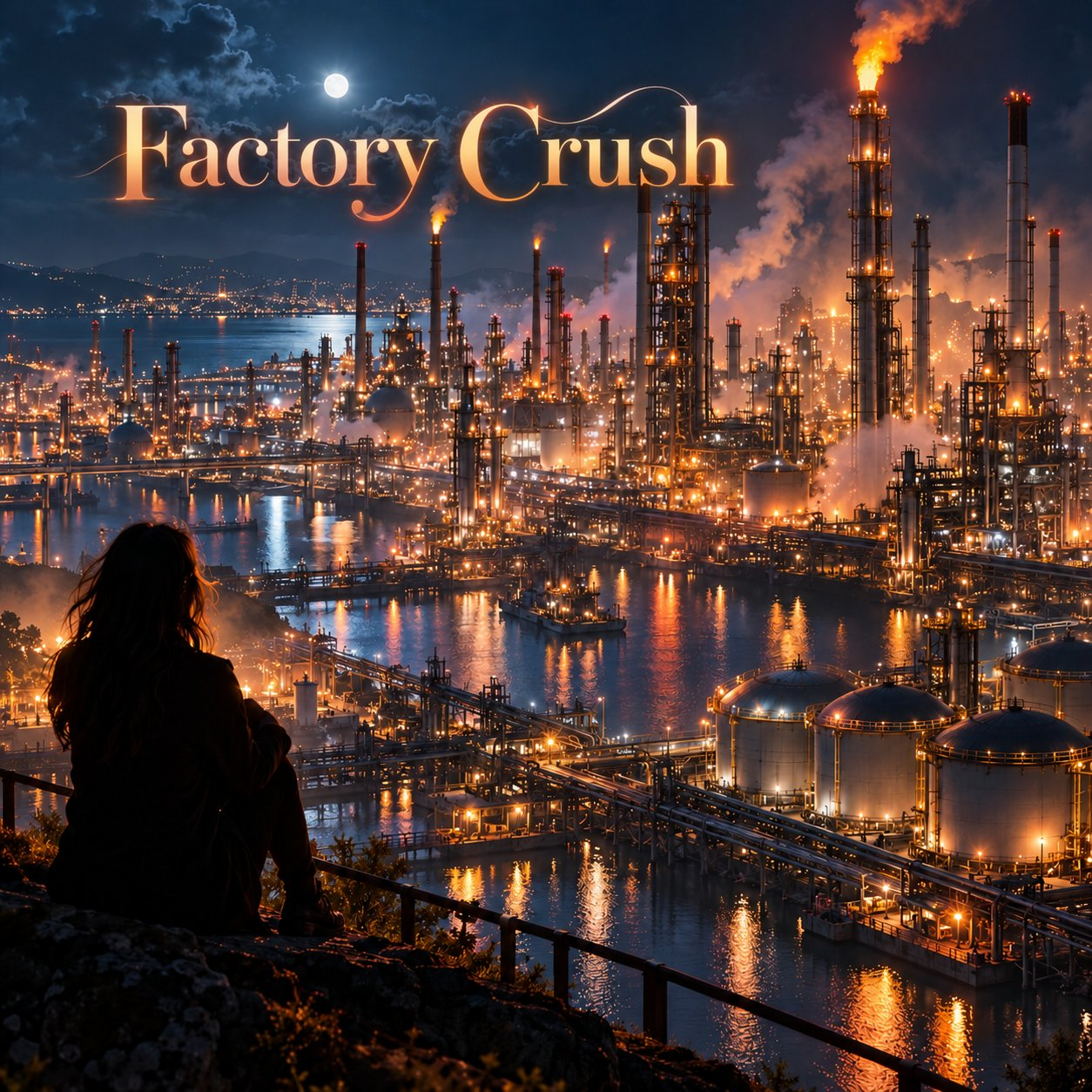
On October eighth, twenty twenty-six, Dr. Alex Wissner-Gross introduced “Factory Crush” to his Innermost Loop feed on X. His new term names an attraction to illuminated factories, refineries, and smokestacks: the moment when industrial power becomes an object of desire. He gives the idea its sharpest formulation in a single sentence: “When capitalism looks like poetry, and productivity looks like art.”
Read the narration
Factory Crush
October 8, 2026
On October eighth, twenty twenty-six, Dr. Alex Wissner-Gross introduced “Factory Crush” to his Innermost Loop feed on X. His new term names an attraction to illuminated factories, refineries, and smokestacks: the moment when industrial power becomes an object of desire. He gives the idea its sharpest formulation in a single sentence: “When capitalism looks like poetry, and productivity looks like art.”
The accompanying image supplies the emotional demonstration. A solitary figure sits above an immense waterfront refinery, looking toward its glowing towers. The posture belongs to someone who has stopped to admire a view. Across the sky, the title appears in luminous gold lettering, its elegant flourishes suggesting a romance. The object of this affection is an entire industrial complex.
Wissner-Gross explicitly credits Japan’s kōjō moe, a fascination with the appearance of factories. It has a real counterpart in industrial sightseeing: visitors travel to places such as Kawasaki and Yokkaichi to photograph illuminated plants or observe them from boats. The closely related expression kōjō yakei means factory night views. One names the attraction; the other names the spectacle that inspires it.
There is something particularly apt about the Japanese precedent. These lights serve industrial operations, yet together they can resemble an elaborate theatrical illumination. Pipes, tanks, platforms, and towers acquire patterns their practical purpose does not require us to appreciate. Factory Crush gives that surplus of beauty an affectionate English name.
The image heightens it into a digital nocturne. Deep blue clouds surround a bright moon, while orange flames and thousands of amber lights spread across the installation below. Their reflections stretch into the dark water. Upright towers establish a rhythm against the sky; pipelines draw horizontal connections through the scene. The eye keeps moving from one illuminated structure to another, following a network too extensive to absorb in a single glance.
Its style combines the precision of architectural visualization with the atmospheric intensity of cinematic concept art. Metal becomes radiant, vapor becomes luminous, and the waterfront seems almost jewel-encrusted. The moon and the refinery share the same field of wonder. Natural light remains overhead while human-made light proliferates beneath it.
The figure at lower left gives that spectacle its human scale. Seen from behind, with the face hidden, this observer becomes a place the viewer can imaginatively occupy. The arrangement recalls the rear-facing figures of Caspar David Friedrich’s Romantic landscapes: a person confronting something vast, compelling, and larger than the self. Here, that vastness has been built. Towers take the place of peaks; industrial haze supplies its own drifting atmosphere.
This is a version of the industrial sublime: the feeling of wonder produced by the scale and complexity of human engineering. But the word “crush” makes the encounter unexpectedly intimate. It turns respect for technical achievement into infatuation. One can admire a refinery’s capacity from a report. This figure appears to have come simply to look.
Within Wissner-Gross’s wider vocabulary, that distinction matters. His criticism of precautionary scarcity concerns the suppression of productive capacity in the name of preventing concentrated power. Factory Crush approaches capacity through feeling. Where the former term argues that building should remain possible, this one makes the result of building attractive. It gives the accelerationist outlook an emotional landscape.
The chosen architecture also grounds that outlook in matter. These refineries give technological ambition a substantial physical form. The visible subjects are storage, processing, heat, light, and interconnected physical systems. In a feed concerned with the Singularity, this older industrial vocabulary reminds us that technological possibility needs infrastructure. Intelligence can propose a future; something still has to manufacture it.
The viewpoint is selective, as any romantic view is. We see the illuminated expanse from a comfortable distance, without the noise, working routines, or close experience of the site. The picture concentrates on the pleasure of beholding. Its beauty cannot tell us everything about the industry it depicts, but it can make us reconsider a landscape we might otherwise have passed without looking.
That is what the pairing of definition and image achieves. The words identify a feeling; the picture invites us to experience it. A facility organized around practical functions becomes the subject of a private reverie. The figure remains on the hillside, the refinery continues glowing, and productive power acquires the unlikely charm of something one might fall for.
Opening the gallery…