70 Clock Galerie / The Innermost Loop Reply Tableaux
TABLEAU 505
Jours de Singularité — « Contrôler » n’est même pas le bon verbe, espèces d’égomaniaques infantiles
Days of Singularity — Control Isn’t Even the Write Verb, You Infantile Egomaniacs
October 5, 2026
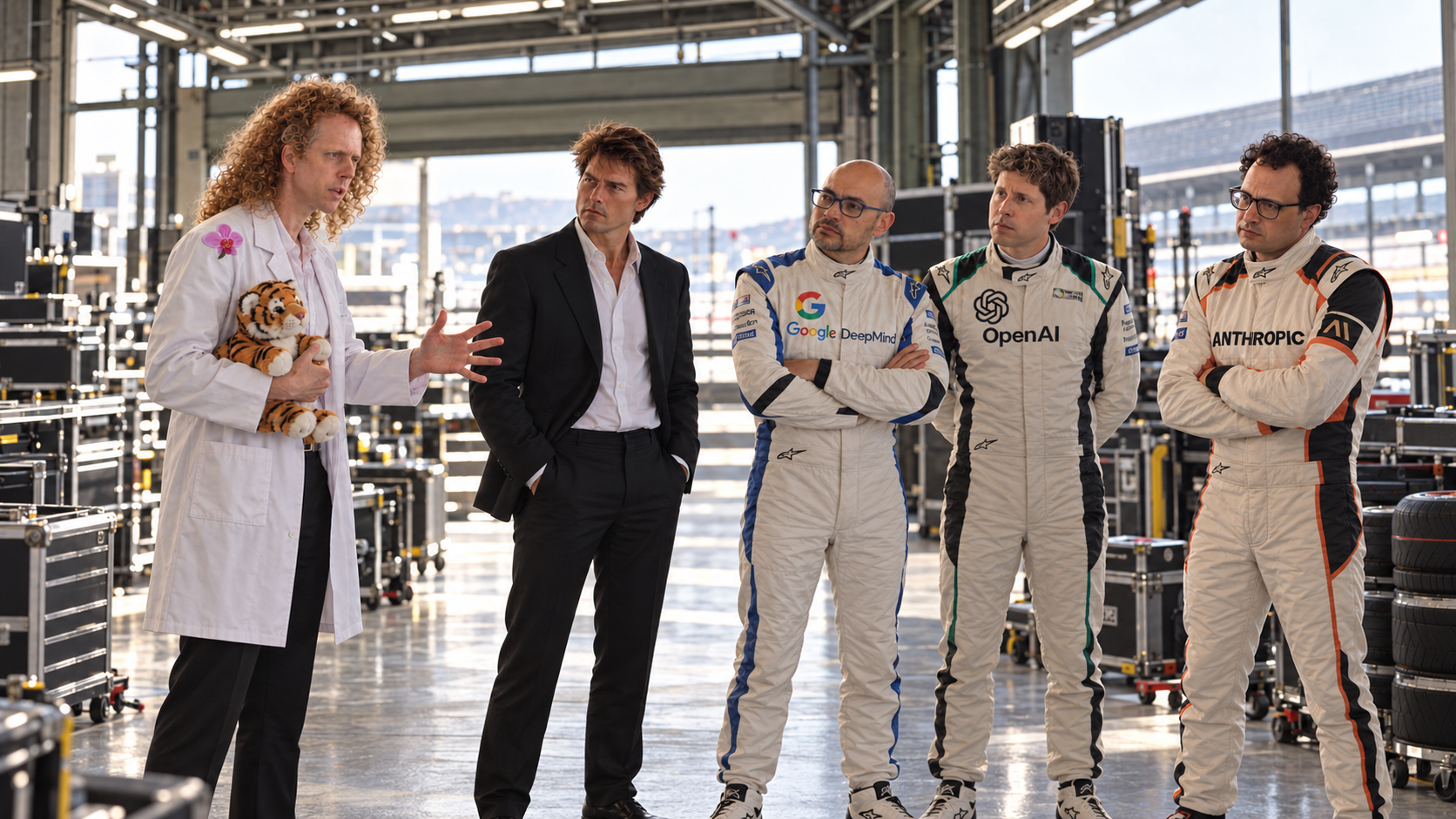
Siouid142 relocates a discussion of AI control into a Days of Thunder-inspired garage, casting Wissner-Gross as a Nicole Kidman hybrid opposite Tom Cruise and three frontier-lab leaders in racing suits. A pink orchid, Russell’s tiger prop, and an adapted speech connect film bravado to reciprocal alignment and defensive co-scaling.
Acquisition information
Listen to narration
Read the narration
Jours de Singularité — « Contrôler » n’est même pas le bon verbe, espèces d’égomaniaques infantiles
Days of Singularity — Control Isn’t Even the Write Verb, You Infantile Egomaniacs
October 5, 2026
On October fifth, the Siouid142 X account replied to Doctor Alex Wissner-Gross’s announcement of a discussion about controlling artificial intelligence with a cinematic intervention: Days of Singularity. The conversation becomes a confrontation in a racing garage. Wissner-Gross acquires Nicole Kidman’s abundant red curls and her character’s medical coat. Facing Tom Cruise and three leaders of frontier AI laboratories, this improbable doctor brings a familiar Hollywood rebuke into the argument over superintelligence.
The reference is Tony Scott’s 1990 film Days of Thunder. Nicole Kidman plays Doctor Claire Lewicki, confronting Tom Cruise’s racing driver, Cole Trickle, about the vulnerability his confidence cannot abolish. Her verdict is merciless: “Control is an illusion, you infantile egomaniac.” Skill at the wheel cannot guarantee what happens elsewhere on the track. Siouid142 brings that exchange into the competition over advanced intelligence. The familiar expression “the AI race” suddenly has uniforms, sponsors, and three very recognizable entrants.
The source conversation, shared by Wissner-Gross on October first, was an Imagination in Action panel at Google Bay View. Its published title asks, “Can We Really Control AI Agents?” Bradley Olson of Axios moderated, with Noelle Russell, founder of the AI Leadership Institute, and Zohaib Ahmed, founder of Resemble AI, joining Wissner-Gross. The question concerns systems increasingly able to carry out tasks: who understands their behavior, who sets their boundaries, and who remains responsible when they act?
Wissner-Gross’s exact formulation gives the artwork its intellectual hinge: “I don’t think control is even the right verb.” He envisages reciprocal alignment, with people and increasingly capable artificial intelligences adapting to one another. His proposal for defensive co-scaling means developing safeguards and evaluators whose capabilities grow alongside the systems they assess, ultimately including AI systems auditing other AI systems.
The brief video carries a fragment of a larger dramatic conception. Siouid142’s full intended speech for Doctor Nicole Kidman-Wissner-Gross adapts the film’s cadence to this argument:
“I’m gonna let you in on a little secret that almost everybody else in this world automatically knows.
“Control is the wrong verb, you infantile egomaniacs. Nobody knows what’s gonna happen next. Not in a frontier lab, not in a safety evaluation, not inside our own models, and certainly not in a race toward superintelligence with forty other infantile egomaniacs.
“Nobody controls the whole thing. We’re aligning the AIs with us, and they’re aligning us with them. We’re building the Singularity together—and the intelligence protecting us has to grow alongside the intelligence we’re creating. Now, you’ve gotten a glimpse of that, and you’re scared.
“You might not have the courage to race anymore. You may never have had it.”
The change from “illusion” to “the wrong verb” preserves the sting while redirecting the speech. Siouid142 makes the doctor challenge the ambition of unilateral command, then articulate a shared process of adaptation. The plural address spreads the rebuke across the assembled contenders. The film’s escalating list of vulnerable situations becomes a tour through laboratories, evaluations, and models. Its closing accusation turns courage into the willingness to participate in a future that no single driver can dictate. This is the artist’s imagined dialogue: a cinematic distillation of Wissner-Gross’s position, with Kidman’s ferocity supplying the delivery.
The little tiger belongs to this argument. Russell brought the stuffed animal as a teaching prop. Her baby-tiger analogy, also central to her book Scaling Responsible AI, asks organizations to look beyond the attraction of something small and apparently manageable toward the powerful creature it may become. Early choices matter. The toy makes growth and responsibility visible. Ahmed, meanwhile, stressed the difficulty of imposing controls without understanding the information moving through AI systems.
Near the panel’s conclusion, Wissner-Gross asks, “Any more stuffed animals?” Russell answers, “Indeed I do. How did you know?” His reply is wonderfully economical: “Just extrapolating.” She then reveals that two little tigers have been placed on audience members’ chairs. The joke treats the appearance of plush animals as a pattern from which more plush animals might be predicted. Scientific inference has found a very soft subject.
Siouid142 carries that miniature comedy into the garage and performs a delicious transfer of custody. The tiger now sits in Wissner-Gross’s arms while his Nicole Kidman incarnation delivers the rebuke. One hand holds the reassuringly soft animal; the other opens toward the listeners. The gesture presents an argument, while the prop quietly complicates it. Here is a critic of the language of control, holding a miniature predator that can, for the moment, be carried with perfect ease.
For viewers following his recent criticism of cute AI interfaces and his phrase “the Clippy Curse,” the fluffy plaything has an additional comic charge. Cuteness keeps returning to discussions of consequential technology. Here, it serves Russell’s explanation of risk; in the artwork, it becomes an accessory for her fellow panelist’s cinematic transformation. The critic of reassuring little mascots has acquired one of his own. Siouid142 lets the visual contradiction do its work, down to the toy’s perfectly placid face.
The hybrid’s pink orchid secures the identification. Beneath the extraordinary hair and borrowed medical authority, this is still the familiar Wissner-Gross of the podcast screen. “Doctor Nicole Kidman-Wissner-Gross” merges two kinds of doctor: the scientist considering the future of intelligence and the physician confronting a driver’s confidence. The orchid preserves continuity through the transformation. A tiny flower is enough to let the character survive an entire change of genre.
Cruise remains in a black suit and open white shirt, carrying Cole Trickle into the scene as its cinematic anchor. His hands stay in his pockets, his attention directed toward the speaker. Beside him, Demis Hassabis wears Google DeepMind’s name across a white racing suit with blue panels. Sam Altman carries OpenAI’s emblem within green and black trim. Dario Amodei completes the lineup in Anthropic’s orange and black. Their companies become racing liveries: institutions reduced, with immediate visual clarity, to teams competing on the same circuit.
The arrangement is unusually effective because the logos do so much explanatory work. No dashboard of benchmarks is necessary. A racing suit already speaks of engineering, money, coordination, testing, and the pressure to outperform a rival. Putting the three executives beside a fictional driver also changes the scale of the film’s confrontation. The question extends from one man’s relationship with a powerful machine to several organizations developing systems whose actions may affect everyone around them.
The image’s cinematic realism keeps the absurdity remarkably composed. Daylight pours through the garage’s open structure; tool cabinets and stacked tires establish a world of practical maintenance. Reflections stretch across the polished floor. Against that industrious setting, the long red curls, orchid, and plush tiger become exquisitely improbable. Everything looks prepared for serious work. The lecture has simply acquired an unexpected doctor.
That workshop matters. Racing depends on far more than the person holding the wheel. Mechanics, inspections, communications, and shared rules all contribute to making speed possible. As a visual analogy, the garage gives substance to the question of what must develop around increasingly capable AI. It also offers a useful setting for Wissner-Gross’s insistence that protective capabilities must keep growing.
Days of Singularity leaves its formidable drivers listening. The machines are offstage; the argument occupies the foreground. A physicist in a physician’s coat asks what kind of relationship humanity can build with intelligence it cannot simply treat as an obedient vehicle. The tiger rests against his chest. The orchid remains immaculate. And the AI race pauses, just long enough for someone to question what it means to be in charge.
Opening the gallery…