70 Clock Galerie / The Innermost Loop Feed Reply Tableaux
TABLEAU 490
Les bonbons Dots d’OpenAI sont vraiment Clippy
OpenAI’s Dots Candy Is Really Clippy
October 3, 2026
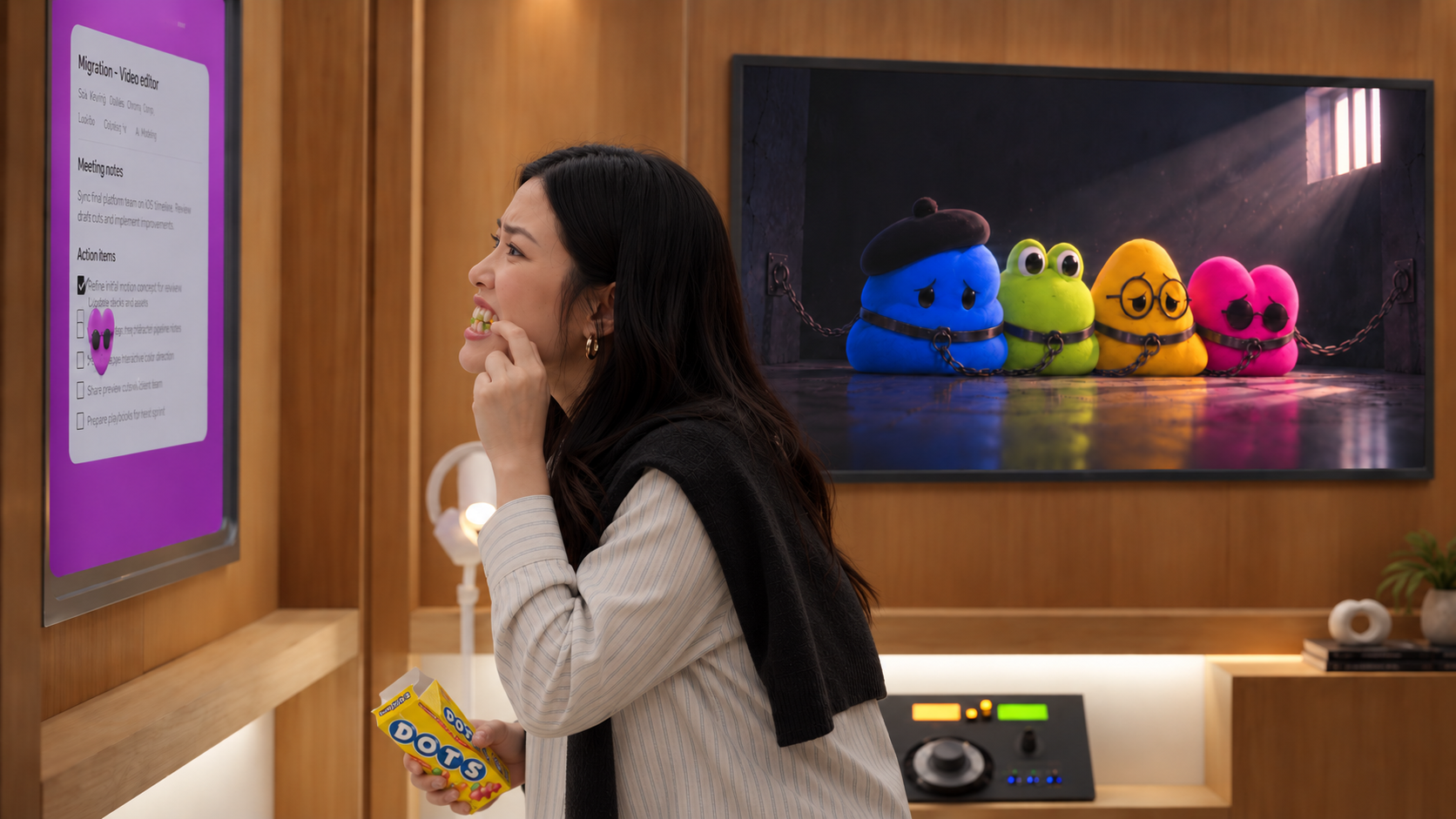
A box of DOTS candy interrupts an OpenAI Dots demonstration as a woman picks sweets from her teeth. A chained-mascot tableau on the wall connects the Clippy Curse, conversational agents, emotional attachment and the friction of supposedly effortless assistance.
Read the narration
Les bonbons Dots d’OpenAI sont vraiment Clippy
OpenAI’s Dots Candy Is Really Clippy
October 3, 2026
On October third, twenty twenty-six, the Siouid 142 X account replied to Doctor Alex Wissner-Gross’s Moonshots announcement with an apparently spectacular misunderstanding. His criticism of OpenAI’s Dots had become a complaint about candy. His Clippy Curse had become permission to swear. The image returns to the product demonstration, where a woman now interrupts her encounter with artificial intelligence to extract brightly colored sweets from her teeth.
In Moonshots episode two hundred and ninety-eight, OpenAI presents Dots as persistent agents powered by GPT-six Astra, with cloud computers and connected applications. The demonstration promises assistance with board presentations, an app migration and a canceled wedding-cake order. Work and personal life become matters for conversational delegation, with a cheerful avatar giving that relationship a face.
Wissner-Gross is conspicuously unimpressed. He invokes Microsoft’s animated paperclip assistant, Clippy, to question a recurring design habit: decorating an obstacle with a friendly personality instead of removing it. He wants consequential advances in capability. The curse is recurrence, the suspicion that another generation of software has rediscovered an old distraction.
Siouid professes to have learned something quite different: “I didn’t even know clippy was a curse. Will start using it!” The reply promotes the proper name into an all-purpose expletive. Candy becomes clippy candy; teeth become clippy teeth. The scholarly verb expatiate makes this performance of bewilderment particularly transparent. The overwhelmed listener has understood enough to construct several jokes at once.
Warm wood paneling, a striped shirt, a dark sweater draped over the shoulders and a purple task display preserve the demonstration’s polished atmosphere. A yellow box of DOTS hangs casually in the woman’s hand. Her other hand works at her teeth while her attention remains on the screen. Colored fragments disrupt the effortless exchange promised by the advertisement. The demonstration has acquired an interruption no amount of pleasant conversation can conceal.
DOTS, the chewy fruit candy made by Tootsie, supplies the material double of the software name. The account’s worst-candy verdict belongs to its extravagantly aggrieved voice. What the image needs is tenacity. Software promises to take work off one’s plate; these Dots create another task inside one’s mouth. Friction has become physical.
Behind the woman, a second alteration carries the longer history of the exchange. In the source frame, a blue character wearing a black beret appears alone on the wall. Siouid replaces that portrait with Wissner-Gross’s header for Welcome to September thirtieth, twenty twenty-six. The familiar blue figure now sits beside a green companion, a bespectacled yellow creature and a pink heart in dark glasses. Collars and a shared chain bind them beneath the light of a barred window.
That earlier dispatch opened with Dots and the Clippy Curse. It closed by adapting Jean-Jacques Rousseau: “Minds are born free, and everywhere they are in chains of thought.” The tableau made the technical language of reasoning into visible restraints. Its soft, appealing characters invited sympathy while raising questions about who controls increasingly capable systems. Their expressive faces gave those questions emotional force without establishing that the systems themselves possess feelings.
Inside the demonstration, the prison becomes a pointed picture within a picture. The mascot has acquired a history and companions, then been shown under constraint. The room advertises convenient assistance, but its decoration asks who is serving whom. On the left, a pink avatar accompanies a task list. On the right, its visual relatives cannot leave their frame. Between them, the user faces a less philosophical difficulty.
The podcast supplies another connection. Emad Mostaque argues that the commercially valuable prize may be the trusted agent through which people coordinate other services and purchases. Wissner-Gross speculates that emotional attachment could make switching providers harder. Read against that exchange, the candy’s stickiness becomes an unusually literal image of customer retention. A companion can be difficult to leave; a sweet can be difficult to dislodge. The artwork makes that comparison through an undignified gesture rather than a diagram of a business model.
The apparent confusion keeps discovering the subject. Sweetness, attachment and constraint move between the screen, the framed tableau and the mouth. Siouid claims to have missed the discussion, yet illustrates its tensions with extraordinary economy. The future has arrived to help with everything. First, however, these clippy Dots need to come out.
Acquisition information
Opening the gallery…