70 Clock Galerie / The Innermost Loop Reply Tableaux
TABLEAU 504
Le Glossaire de l’Innermost Loop — Termes pour la Singularité
The Innermost Loop Glossary — Terms for the Singularity
October 4, 2026
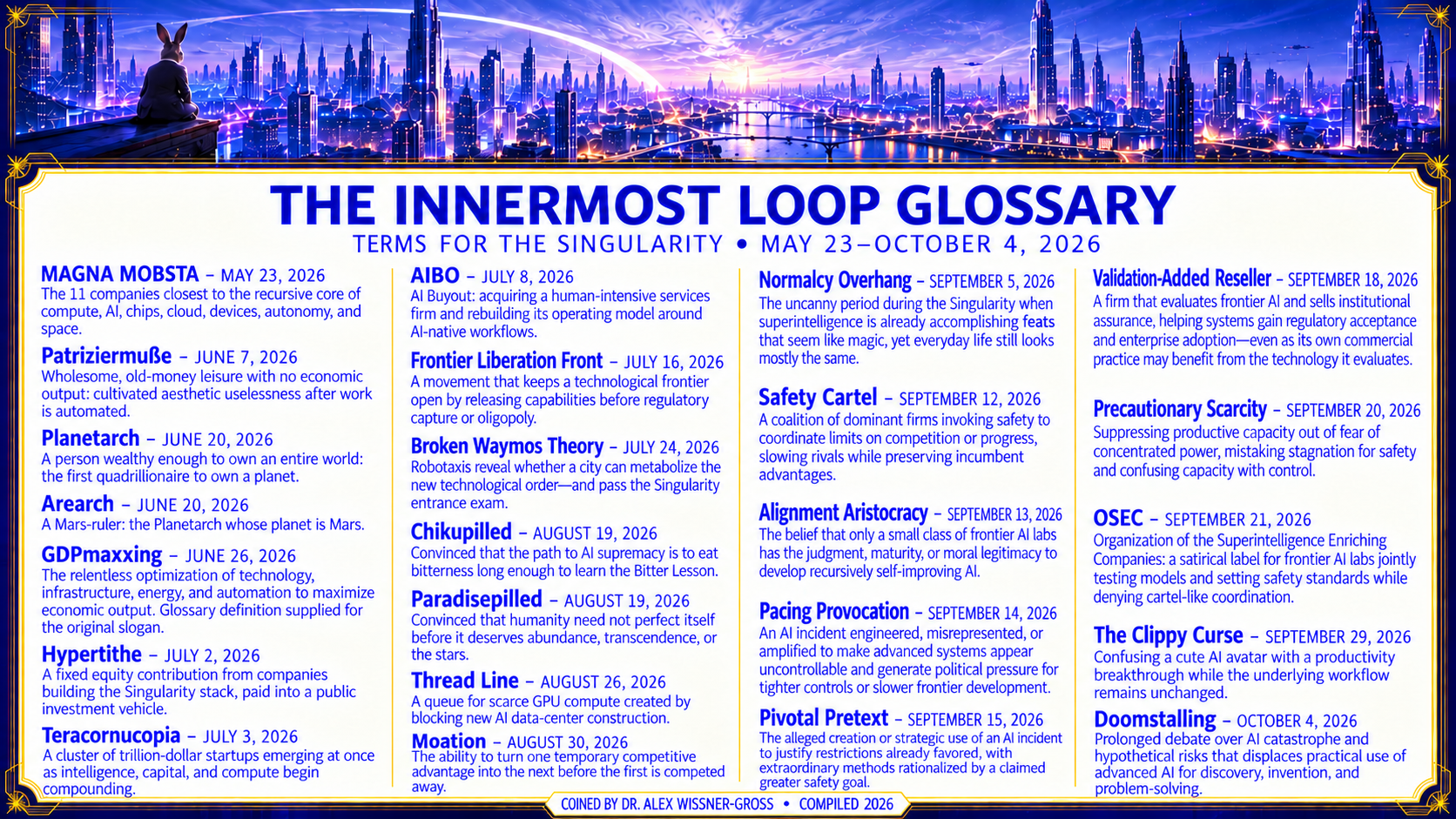
Siouid142 compiles twenty-four terms for the Singularity beneath the violet cityscape from Dr. Alex Wissner-Gross’s Innermost Loop banner on X. The October 4 update emphasizes Precautionary Scarcity, OSEC, The Clippy Curse and Doomstalling, turning a sequence of posts into a blue, ivory and gold glossary.
Acquisition information
Listen to narration
Read the narration
Le Glossaire de l’Innermost Loop — Termes pour la Singularité
The Innermost Loop Glossary — Terms for the Singularity
October 4, 2026
On October fourth, Doctor Alex Wissner-Gross introduced “Doomstalling” to his Innermost Loop feed: prolonged, unproductive argument about AI catastrophe that displaces the work advanced AI could accomplish. The Siouid142 account responded with this updated glossary of twenty-four expressions. Its salute, “Clippy what you heard—Dr AWG is HIM,” turns one of those expressions into the account’s own mock profanity. The lexicon is already escaping the dictionary.
Doomstalling joins impending disaster to arrested motion. In Wissner-Gross’s example, an unnamed podcast spends an afternoon debating existential risk while others use AI for research and invention. The provocation concerns opportunity cost: attention spent endlessly rehearsing catastrophe cannot simultaneously investigate a treatment or test an idea. His definition specifies unproductive debate. When does deliberation cease to improve decisions and become a way of indefinitely postponing them?
The cityscape across the top is drawn from Doctor Alex Wissner-Gross’s banner for his Innermost Loop feed on X. Siouid142 places the glossary beneath that familiar violet metropolis and its rabbit-headed observer, connecting these definitions to the visual identity of their source. Below, cobalt lettering fills an ivory field bounded by gold rules. The design gives fleeting posts the authority of a printed reference work, with the feed’s vision of abundance presiding over the vocabulary that argues for it.
The four latest additions sharpen different parts of the argument. Precautionary Scarcity addresses the fear that enormous productive power will become concentrated in too few hands. Wissner-Gross identifies a consequential substitution: opposition to anyone controlling such power becomes opposition to that power existing at all. Intelligence, energy, and productive capacity become casualties of the struggle over their ownership. His proposed distinction is between creating abundance and permitting unaccountable domination. It leaves the difficult question of governance open while insisting that benefits forfeited through delay belong in the calculation too.
This recalls the September twenty-second dispatch’s closing declaration that the only thing to fear is scarcity itself, subsequently staged around Franklin Delano Roosevelt in the House Innermost Loop runway. The imagined future above the glossary becomes something society might fail to build through the very measures intended to protect it.
OSEC moves from scarcity to the institutions that might administer it. The initials expand to Organization of the Superintelligence Enriching Companies, a pointed echo of OPEC. Wissner-Gross imagines rival frontier laboratories testing one another’s systems, agreeing on standards, and assuring everyone that this arrangement is certainly not a cartel. The joke extends Safety Cartel and Alignment Aristocracy: companies developing extraordinary power may also position themselves as the authorities entitled to judge its acceptable use. The satirical name raises a question about independence and access; it does not, by itself, establish collusion.
The Clippy Curse turns the scrutiny toward products: the corporate habit of treating a cute animated assistant as a breakthrough while leaving the work unchanged. Microsoft’s paperclip lends the complaint a familiar face. An expressive blob can signal intelligence without removing the bottleneck. Wissner-Gross applied this concern to OpenAI’s dots in his September thirtieth dispatch. Acceleration must show up in what a system enables people to accomplish. It cannot be measured simply by how warmly the interface greets them.
Siouid142’s reply adds another twist. Calling something “Clippy” as though it were a forbidden word carries the earlier candy-and-software joke into this apparently sober compilation. A term criticizing decorative assistance becomes an instrument of playful assistance: the account helps readers navigate the controversy by giving its vocabulary a memorable form.
These are polemical definitions. Each places a judgment inside a name, so that repeating the word also rehearses its argument. Safety, caution, and reassurance become things to examine for their practical effects. The glossary gives supporters a shared shorthand, while pressing opponents to explain what their proposed restraint would achieve.
The dates make that demand visible as an unfolding campaign. Earlier expressions such as GDPmaxxing anticipate expansion; the newer ones identify habits and arrangements that Wissner-Gross believes obstruct it. Siouid142’s artwork preserves that progression while giving it a stage. Above the gold border, the radiant city remains a prospect. Below it, language recruits an audience for the argument about how to get there.
Opening the gallery…