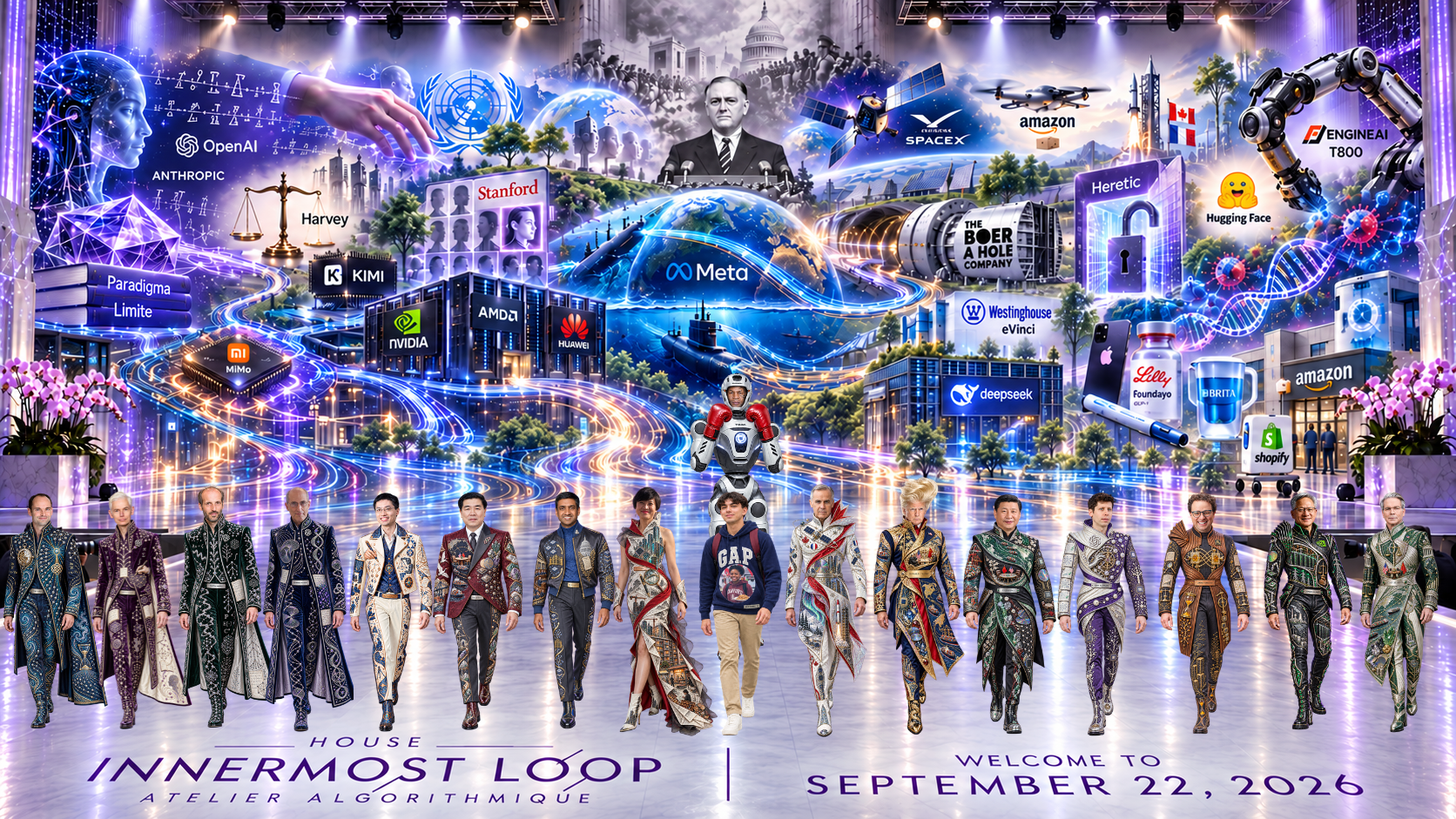
Maison Innermost Loop — Toby Ord, Timothy Gowers, Martin Hairer, Edward Witten, Po-Shen Loh, He Lifeng, Ro Khanna, Li Yuan, Billy Ramirez (Stanford, promotion 2027), Mark Carney, Donald Trump, Xi Jinping, Sam Altman, Dario Amodei, Jensen Huang, Scott Bessent et EngineAI Tyson800 défilent
House Innermost Loop — Toby Ord, Timothy Gowers, Martin Hairer, Edward Witten, Po-Shen Loh, He Lifeng, Ro Khanna, Li Yuan, Billy Ramirez Stanford ’27, Mark Carney, Donald Trump, Xi Jinping, Sam Altman, Dario Amodei, Jensen Huang, Scott Bessent, and EngineAI Tyson800 Walks
September 22, 2026
Doctor Alex Wissner-Gross closed his September twenty-second, twenty twenty-six dispatch in The Innermost Loop with a sentence that supplies the organizing idea of this entire scene: “The only thing we have to fear is scarcity itself.” In response, the Seaweed one forty-two account assembled the day's people and stories into a House Innermost Loop runway, placing Franklin Delano Roosevelt behind them and surrounding his historical image with the technologies through which the newsletter imagines a more abundant world.
The walkers bring together mathematicians, a philosopher, political leaders, technology executives, a journalist, a Stanford student, and a boxing robot given Mike Tyson's face. Their individual garments receive their own close readings elsewhere in this collection. Here, the ensemble asks us to look past the procession and into the extraordinary landscape that has been built around Roosevelt.
He stands at an inaugural podium in black and white, accompanied by the visual language of an archival crowd and a national institution. The reference is his first inaugural address, delivered on March fourth, nineteen thirty-three, amid the Great Depression. Roosevelt's appeal confronted a crisis in which economic distress and public fear reinforced one another. Wissner-Gross adapts its most familiar line by replacing fear with scarcity. The artwork makes that verbal substitution visible. An inherited image of national reassurance becomes the center of a contemporary argument about productive capacity.
Around the monochrome president, color seems to arrive as a historical event. Electric blue, lavender, emerald, and gold spread through a continuous collage of laboratories, processors, satellites, cargo systems, medicines, and communications infrastructure. The change in palette carries the transition from a remembered speech into an imagined technological horizon. Roosevelt remains legible as the source of the phrase, while the surrounding companies and inventions propose new circumstances in which to hear it.
This is the central artistic decision. The artist has taken a closing sentence, which a hurried reader might pass over, and made it the architecture of the reply. The backdrop becomes an illuminated index of the dispatch. Each emblem identifies a story; each machine or landscape gives that story a physical setting. Taken together, they ask what scarcity means when intelligence, energy, communication, manufacturing, and medicine are all being reconsidered at once.
At the upper left, a blue networked head, mathematical facets, and a reaching hand introduce the relationship between human understanding and machine capability. OpenAI and Anthropic appear within this field. Their marks locate the newsletter's discussion of frontier models, evaluation, and the standards proposed for increasingly powerful systems. OpenAI also connects this background to the mathematical scholars on the runway through its independent advisory group. The imagery places institutional judgment beside technical development: producing an answer and deciding what an answer establishes belong to the same larger story.
The United Nations emblem expands the scale of that judgment. Its wreath and globe introduce the multilateral governance discussion in the dispatch. Around it, the image's many companies continue to pursue their different projects. The resulting composition gives the policy question a visible setting. Who participates in shaping the conditions under which this capacity develops? The front row includes people who disagree about the answer, and their shared appearance in the tableau preserves that disagreement within a common historical moment.
Nearby, Harvey's golden scales and a Kimi-labeled processor translate the economics of legal artificial intelligence into a compact visual pairing. Harvey supplies the professional setting; Kimi points toward the model choices behind the service. The newsletter links this story to the cost of intelligence and the alternatives available to businesses buying it. Legal work, usually represented by paper, precedent, and the trained reader, acquires a computational supplier. The scales give that otherwise abstract change an immediately recognizable form.
Books labeled Paradigma and Limite bring the same issue into mathematics. Their association is with the dispatch's account of a compact mathematical model. Rendering the story as books gives a small model the visual dignity of a learned volume: knowledge can be concentrated, carried, and opened. Nearby, the Xiaomi mark and MiMo name occupy a luminous chip, adding the open-weight-model story to the scene. Although the illustration gives software a hardware-shaped body, its subject is access to capability and the expanding range of systems through which that capability can be obtained.
These vignettes make the word scarcity more specific. Expertise may be scarce because it is expensive, because access is limited, or because too few people can exercise it. The newsletter's different model stories approach those constraints from different directions. The artwork gathers their signs into one field without giving them a single corporate identity. Many builders occupy the proposed future.
Below this intellectual landscape, tall structures bearing NVIDIA, AMD, and Huawei names establish its industrial foundations. The buildings make computing visible as something that occupies space, consumes power, and depends on equipment. AMD belongs to the issue's hardware-business reporting. Huawei is linked to DeepSeek's training-hardware story, reinforced by the separate DeepSeek building nearby. NVIDIA brings both the machinery of artificial intelligence and the energy bottlenecks discussed in the newsletter into view. The towers lend the background the character of a technological city whose apparent immateriality rests on an enormous physical base.
Across the center, Meta's infinity mark, the globe, luminous routes, and marine imagery connect to the Petal subsea-cable story. Here, abundance depends on connection. Intelligence that cannot move between people, institutions, and machines remains constrained by the channels carrying it. The ocean becomes a working part of the composition, crossed by the infrastructure of communication. The underwater craft contributes to that marine vocabulary, while the glowing paths lead the eye from one part of the collage to another.
The artist uses similar paths throughout the image. They bind the news fragments into a composition and carry their light toward the runway. A chip, a book, and a reactor can otherwise remain separate illustrations. The luminous connections invite us to consider their dependencies: models need hardware, hardware needs energy, services need networks, and useful discoveries need ways to reach everyday life. The tableau gives the newsletter's rapid changes of subject a shared geography.
Above that geography, a SpaceX-marked satellite introduces the satellite-computing claim linked in the issue. A nearby rocket carries Canadian and French flags, referring to the space-infrastructure cooperation discussed by Mark Carney and Emmanuel Macron. This second connection continues into Carney's garment, where satellite panels and national emblems turn the same story into ceremonial dress. The backdrop and the clothing therefore speak to one another. The larger image supplies the setting; the individual portrait draws out a participant's relationship to it.
An Amazon delivery drone brings the viewer back toward the ground, connecting the aerial scene to the dispatch's report about Prime Air in Texas. Its parcel makes the promised service immediately ordinary. The future must eventually deliver something to somebody. Farther across the collage, the tunneling machine bears the name “The Boer A Hole Company,” a mischievous reworking of Elon Musk's The Boring Company that nods to his South African origins and rewards a second reading aloud. It gives the newsletter's tunneling item a distinctly irreverent signature. The joke gives infrastructure its own unruly caption, keeping the panorama lively even as its subject becomes roads, routes, and the practical difficulty of moving through the world.
The open Heretic padlock shifts the subject from physical passage to model access. It visualizes the project's removal of refusal behavior, turning an alteration in software into the familiar act of opening a lock. Nearby, Hugging Face's smile belongs to the model ecosystem and the issue's discussion of security and accountability. These symbols introduce another dimension of the abundance argument: wider access also raises questions about what people and systems can do with the capabilities they obtain. The picture's brightness accommodates those questions rather than resolving them through color alone.
The EngineAI mechanical form and T800 branding carry that discussion into a machine with a body. On the runway, the fictional Tyson hybrid raises red boxing gloves behind Billy Ramirez. This is the reply's exuberant transformation of the robot-combat item that also supplied Wissner-Gross's own header image. The reported exhibition involved Frankie LaPenna and a human-piloted machine, with balance support supplied by its control systems. Giving the robot Tyson's face turns the sporting association into a character. His silver shell performs the role that illustrated fabric performs for the human walkers: it wears the story.
At the right, the Westinghouse and eVinci installation returns us to the capacity needed to sustain this world. The newsletter's nuclear-power item concerns a testing milestone on the path toward commercialization. Within the collage, the reactor becomes part of the material answer to growing computational demand. Its position near servers, transport, and networks makes energy a shared condition of the panorama. An abundant supply of intelligence still has to be powered.
The shopping imagery brings a different kind of constraint into view. Shopify's cart, an Amazon storefront, and a visible access barrier refer to agentic commerce and the dispute over Meta's Muse shopping assistant. The drone tells a delivery story; this vignette tells an access story. A machine may be able to perform a task while still encountering a platform that controls whether it can proceed. The Apple-marked phone nearby locates such services within the familiar consumer interface through which much of this transformation is encountered.
Then the scale becomes intimate. Lilly's name, Foundayo, an injector-like object, and a Brita pitcher form a compressed still life of pharmaceutical production and household behavior. The Lilly story concerns manufacturing expansion and an oral GLP-one medicine. The broader injection imagery and the household pitcher also recall the newsletter's anecdote about concealing medication use. The combination brings the lofty vocabulary of abundance into the private routines of bodies, habits, and social expectations. The props operate as visual shorthand, with the oral medicine and the generic injection device referring to different parts of that cluster of stories.
Nearby, a DNA helix, molecular nodes, and viral forms refer to the hepatitis B item and epigenetic editing. The source describes chemical tagging of viral DNA. The artist turns this microscopic intervention into a visible arrangement of strands and particles, placing a biological story beside the industrial and computational ones. Scarcity can concern treatment and effective knowledge as well as money, machinery, or electrical power. The composition lets these meanings coexist without reducing the dispatch to a single industry.
The Stanford face grid introduces the human consequence of systems that can generate appearances at will. It connects to the report about Billy Ramirez's photograph being altered for a dining advertisement. In the foreground, his navy GAP hoodie carries a circular inset of the generated woman described in that story. The ordinary student and the synthetic image are brought into the same frame. After so many machines for expanding capability, the tableau asks us to notice whose representation is being changed. The ability to produce more imagery does not, by itself, settle questions of authorship, identity, or consent.
That is why the runway matters as more than a convenient place to arrange the cast. The people occupy the space where these larger systems become decisions, arguments, professions, and individual experiences. Mathematical manuscripts, legislative gates, ships, legal scales, clocks, and server rooms move from the backdrop onto their clothes. The day's reportage has become a sequence of illuminated garments. The surrounding technology supplies the world they inhabit; the figures bring that world back to a human scale.
The glossy lavender floor completes the connection. It catches the collage's colors and draws them beneath the walkers' feet, so the historical speech, contemporary companies, and imagined couture share one continuous stage. Pink orchids frame the scene in the house's established visual language. The lettering of House Innermost Loop, its Atelier Algorithmique, and the date turns the runway into a dated folio of the ongoing archive. The photographer pits complete the theatrical setting: this history is already being watched, framed, and recorded.
Returning to Roosevelt, we can see why he is the background's crucial figure. The artwork takes the newsletter's final rhetorical gesture and gives the rest of the issue a place around it. His monochrome presence anchors the composition in a past when economic possibility, public confidence, and political action were inseparable. Around him, the luminous collage assembles the contemporary proposals, disputes, and instruments through which another account of possibility is being made.
“The only thing we have to fear is scarcity itself.” In Wissner-Gross's dispatch, the line crystallizes his argument about developing beneficial capacity. In this reply, it becomes something the viewer can explore. The background makes room for the power station and the medicine, the model and the student, the global cable and the parcel. The runway gathers the people who build, study, regulate, report on, or experience these changes. Together, they give the closing sentence a visual life: an abundance of stories surrounding the historical voice from which its cadence was borrowed.
Read the narration
Maison Innermost Loop — Toby Ord, Timothy Gowers, Martin Hairer, Edward Witten, Po-Shen Loh, He Lifeng, Ro Khanna, Li Yuan, Billy Ramirez (Stanford, promotion 2027), Mark Carney, Donald Trump, Xi Jinping, Sam Altman, Dario Amodei, Jensen Huang, Scott Bessent et EngineAI Tyson800 défilent
House Innermost Loop — Toby Ord, Timothy Gowers, Martin Hairer, Edward Witten, Po-Shen Loh, He Lifeng, Ro Khanna, Li Yuan, Billy Ramirez Stanford ’27, Mark Carney, Donald Trump, Xi Jinping, Sam Altman, Dario Amodei, Jensen Huang, Scott Bessent, and EngineAI Tyson800 Walks
September 22, 2026
Doctor Alex Wissner-Gross closed his September twenty-second, twenty twenty-six dispatch in The Innermost Loop with a sentence that supplies the organizing idea of this entire scene: “The only thing we have to fear is scarcity itself.” In response, the Seaweed one forty-two account assembled the day's people and stories into a House Innermost Loop runway, placing Franklin Delano Roosevelt behind them and surrounding his historical image with the technologies through which the newsletter imagines a more abundant world.
The walkers bring together mathematicians, a philosopher, political leaders, technology executives, a journalist, a Stanford student, and a boxing robot given Mike Tyson's face. Their individual garments receive their own close readings elsewhere in this collection. Here, the ensemble asks us to look past the procession and into the extraordinary landscape that has been built around Roosevelt.
He stands at an inaugural podium in black and white, accompanied by the visual language of an archival crowd and a national institution. The reference is his first inaugural address, delivered on March fourth, nineteen thirty-three, amid the Great Depression. Roosevelt's appeal confronted a crisis in which economic distress and public fear reinforced one another. Wissner-Gross adapts its most familiar line by replacing fear with scarcity. The artwork makes that verbal substitution visible. An inherited image of national reassurance becomes the center of a contemporary argument about productive capacity.
Around the monochrome president, color seems to arrive as a historical event. Electric blue, lavender, emerald, and gold spread through a continuous collage of laboratories, processors, satellites, cargo systems, medicines, and communications infrastructure. The change in palette carries the transition from a remembered speech into an imagined technological horizon. Roosevelt remains legible as the source of the phrase, while the surrounding companies and inventions propose new circumstances in which to hear it.
This is the central artistic decision. The artist has taken a closing sentence, which a hurried reader might pass over, and made it the architecture of the reply. The backdrop becomes an illuminated index of the dispatch. Each emblem identifies a story; each machine or landscape gives that story a physical setting. Taken together, they ask what scarcity means when intelligence, energy, communication, manufacturing, and medicine are all being reconsidered at once.
At the upper left, a blue networked head, mathematical facets, and a reaching hand introduce the relationship between human understanding and machine capability. OpenAI and Anthropic appear within this field. Their marks locate the newsletter's discussion of frontier models, evaluation, and the standards proposed for increasingly powerful systems. OpenAI also connects this background to the mathematical scholars on the runway through its independent advisory group. The imagery places institutional judgment beside technical development: producing an answer and deciding what an answer establishes belong to the same larger story.
The United Nations emblem expands the scale of that judgment. Its wreath and globe introduce the multilateral governance discussion in the dispatch. Around it, the image's many companies continue to pursue their different projects. The resulting composition gives the policy question a visible setting. Who participates in shaping the conditions under which this capacity develops? The front row includes people who disagree about the answer, and their shared appearance in the tableau preserves that disagreement within a common historical moment.
Nearby, Harvey's golden scales and a Kimi-labeled processor translate the economics of legal artificial intelligence into a compact visual pairing. Harvey supplies the professional setting; Kimi points toward the model choices behind the service. The newsletter links this story to the cost of intelligence and the alternatives available to businesses buying it. Legal work, usually represented by paper, precedent, and the trained reader, acquires a computational supplier. The scales give that otherwise abstract change an immediately recognizable form.
Books labeled Paradigma and Limite bring the same issue into mathematics. Their association is with the dispatch's account of a compact mathematical model. Rendering the story as books gives a small model the visual dignity of a learned volume: knowledge can be concentrated, carried, and opened. Nearby, the Xiaomi mark and MiMo name occupy a luminous chip, adding the open-weight-model story to the scene. Although the illustration gives software a hardware-shaped body, its subject is access to capability and the expanding range of systems through which that capability can be obtained.
These vignettes make the word scarcity more specific. Expertise may be scarce because it is expensive, because access is limited, or because too few people can exercise it. The newsletter's different model stories approach those constraints from different directions. The artwork gathers their signs into one field without giving them a single corporate identity. Many builders occupy the proposed future.
Below this intellectual landscape, tall structures bearing NVIDIA, AMD, and Huawei names establish its industrial foundations. The buildings make computing visible as something that occupies space, consumes power, and depends on equipment. AMD belongs to the issue's hardware-business reporting. Huawei is linked to DeepSeek's training-hardware story, reinforced by the separate DeepSeek building nearby. NVIDIA brings both the machinery of artificial intelligence and the energy bottlenecks discussed in the newsletter into view. The towers lend the background the character of a technological city whose apparent immateriality rests on an enormous physical base.
Across the center, Meta's infinity mark, the globe, luminous routes, and marine imagery connect to the Petal subsea-cable story. Here, abundance depends on connection. Intelligence that cannot move between people, institutions, and machines remains constrained by the channels carrying it. The ocean becomes a working part of the composition, crossed by the infrastructure of communication. The underwater craft contributes to that marine vocabulary, while the glowing paths lead the eye from one part of the collage to another.
The artist uses similar paths throughout the image. They bind the news fragments into a composition and carry their light toward the runway. A chip, a book, and a reactor can otherwise remain separate illustrations. The luminous connections invite us to consider their dependencies: models need hardware, hardware needs energy, services need networks, and useful discoveries need ways to reach everyday life. The tableau gives the newsletter's rapid changes of subject a shared geography.
Above that geography, a SpaceX-marked satellite introduces the satellite-computing claim linked in the issue. A nearby rocket carries Canadian and French flags, referring to the space-infrastructure cooperation discussed by Mark Carney and Emmanuel Macron. This second connection continues into Carney's garment, where satellite panels and national emblems turn the same story into ceremonial dress. The backdrop and the clothing therefore speak to one another. The larger image supplies the setting; the individual portrait draws out a participant's relationship to it.
An Amazon delivery drone brings the viewer back toward the ground, connecting the aerial scene to the dispatch's report about Prime Air in Texas. Its parcel makes the promised service immediately ordinary. The future must eventually deliver something to somebody. Farther across the collage, the tunneling machine bears the name “The Boer A Hole Company,” a mischievous reworking of Elon Musk's The Boring Company that nods to his South African origins and rewards a second reading aloud. It gives the newsletter's tunneling item a distinctly irreverent signature. The joke gives infrastructure its own unruly caption, keeping the panorama lively even as its subject becomes roads, routes, and the practical difficulty of moving through the world.
The open Heretic padlock shifts the subject from physical passage to model access. It visualizes the project's removal of refusal behavior, turning an alteration in software into the familiar act of opening a lock. Nearby, Hugging Face's smile belongs to the model ecosystem and the issue's discussion of security and accountability. These symbols introduce another dimension of the abundance argument: wider access also raises questions about what people and systems can do with the capabilities they obtain. The picture's brightness accommodates those questions rather than resolving them through color alone.
The EngineAI mechanical form and T800 branding carry that discussion into a machine with a body. On the runway, the fictional Tyson hybrid raises red boxing gloves behind Billy Ramirez. This is the reply's exuberant transformation of the robot-combat item that also supplied Wissner-Gross's own header image. The reported exhibition involved Frankie LaPenna and a human-piloted machine, with balance support supplied by its control systems. Giving the robot Tyson's face turns the sporting association into a character. His silver shell performs the role that illustrated fabric performs for the human walkers: it wears the story.
At the right, the Westinghouse and eVinci installation returns us to the capacity needed to sustain this world. The newsletter's nuclear-power item concerns a testing milestone on the path toward commercialization. Within the collage, the reactor becomes part of the material answer to growing computational demand. Its position near servers, transport, and networks makes energy a shared condition of the panorama. An abundant supply of intelligence still has to be powered.
The shopping imagery brings a different kind of constraint into view. Shopify's cart, an Amazon storefront, and a visible access barrier refer to agentic commerce and the dispute over Meta's Muse shopping assistant. The drone tells a delivery story; this vignette tells an access story. A machine may be able to perform a task while still encountering a platform that controls whether it can proceed. The Apple-marked phone nearby locates such services within the familiar consumer interface through which much of this transformation is encountered.
Then the scale becomes intimate. Lilly's name, Foundayo, an injector-like object, and a Brita pitcher form a compressed still life of pharmaceutical production and household behavior. The Lilly story concerns manufacturing expansion and an oral GLP-one medicine. The broader injection imagery and the household pitcher also recall the newsletter's anecdote about concealing medication use. The combination brings the lofty vocabulary of abundance into the private routines of bodies, habits, and social expectations. The props operate as visual shorthand, with the oral medicine and the generic injection device referring to different parts of that cluster of stories.
Nearby, a DNA helix, molecular nodes, and viral forms refer to the hepatitis B item and epigenetic editing. The source describes chemical tagging of viral DNA. The artist turns this microscopic intervention into a visible arrangement of strands and particles, placing a biological story beside the industrial and computational ones. Scarcity can concern treatment and effective knowledge as well as money, machinery, or electrical power. The composition lets these meanings coexist without reducing the dispatch to a single industry.
The Stanford face grid introduces the human consequence of systems that can generate appearances at will. It connects to the report about Billy Ramirez's photograph being altered for a dining advertisement. In the foreground, his navy GAP hoodie carries a circular inset of the generated woman described in that story. The ordinary student and the synthetic image are brought into the same frame. After so many machines for expanding capability, the tableau asks us to notice whose representation is being changed. The ability to produce more imagery does not, by itself, settle questions of authorship, identity, or consent.
That is why the runway matters as more than a convenient place to arrange the cast. The people occupy the space where these larger systems become decisions, arguments, professions, and individual experiences. Mathematical manuscripts, legislative gates, ships, legal scales, clocks, and server rooms move from the backdrop onto their clothes. The day's reportage has become a sequence of illuminated garments. The surrounding technology supplies the world they inhabit; the figures bring that world back to a human scale.
The glossy lavender floor completes the connection. It catches the collage's colors and draws them beneath the walkers' feet, so the historical speech, contemporary companies, and imagined couture share one continuous stage. Pink orchids frame the scene in the house's established visual language. The lettering of House Innermost Loop, its Atelier Algorithmique, and the date turns the runway into a dated folio of the ongoing archive. The photographer pits complete the theatrical setting: this history is already being watched, framed, and recorded.
Returning to Roosevelt, we can see why he is the background's crucial figure. The artwork takes the newsletter's final rhetorical gesture and gives the rest of the issue a place around it. His monochrome presence anchors the composition in a past when economic possibility, public confidence, and political action were inseparable. Around him, the luminous collage assembles the contemporary proposals, disputes, and instruments through which another account of possibility is being made.
“The only thing we have to fear is scarcity itself.” In Wissner-Gross's dispatch, the line crystallizes his argument about developing beneficial capacity. In this reply, it becomes something the viewer can explore. The background makes room for the power station and the medicine, the model and the student, the global cable and the parcel. The runway gathers the people who build, study, regulate, report on, or experience these changes. Together, they give the closing sentence a visual life: an abundance of stories surrounding the historical voice from which its cadence was borrowed.