70 Clock Galerie / Innermost Loop Tableaux
TABLEAU 301
Welcome to November 2, 2026
November 2, 2026
Dr. Alex Wissner-Gross / @alexwg
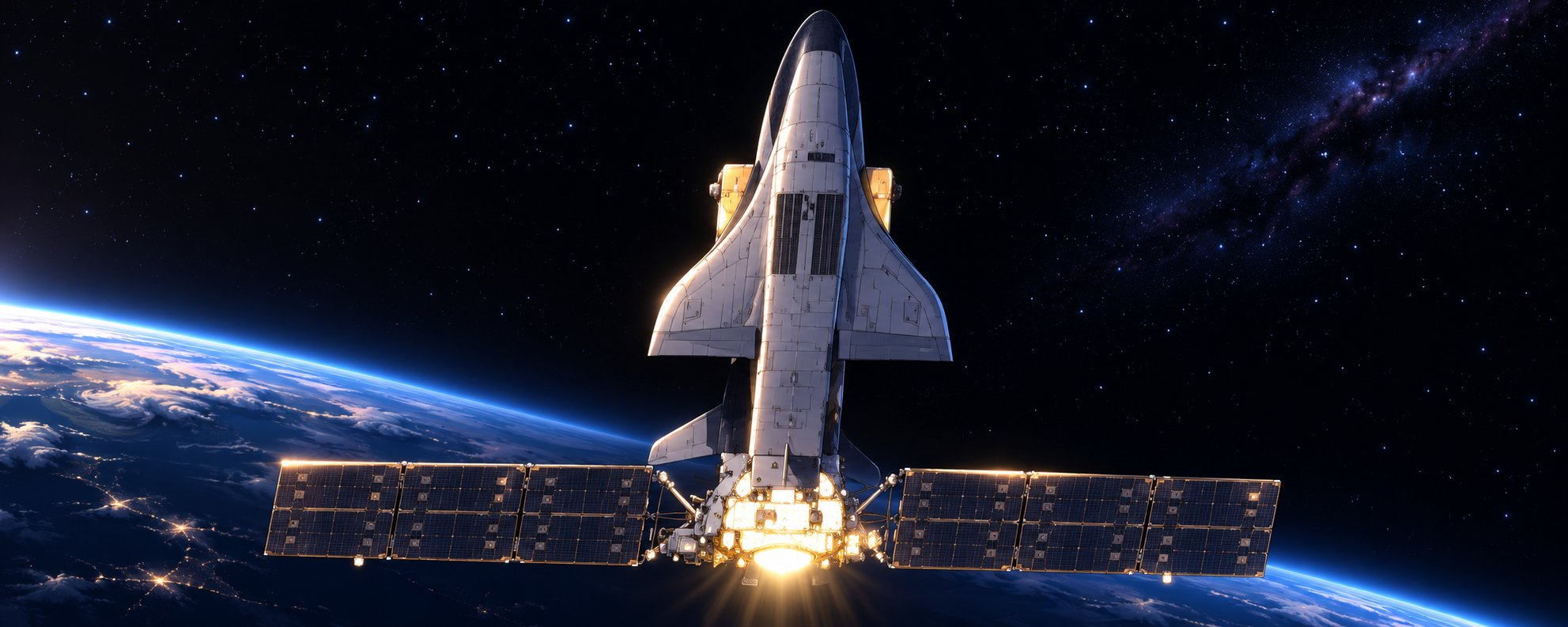
A silver-white spaceplane with broad solar arrays floats above Earth’s curved blue horizon against a star-filled sky.
Reusable spaceplanes · Orbital imaging · AI-assisted engineering · Human oversight · Electricity demand · Aging research
Listen to narration
Read the narration
Welcome to November 2, 2026
Above the blue curve of Earth, a pale spaceplane occupies the center of an immense, dark sky. Its nose points toward the upper edge of the picture. Its wings spread across the stars, while two long solar arrays extend sideways from the machinery at its rear. Gold light catches the panels and the seams of the fuselage. Below, clouds, coastlines, and scattered concentrations of light belong to a world that is already beginning to look small.
Dr. Alex Wissner-Gross chose this orbital scene to introduce his November second, twenty twenty-six dispatch from The Innermost Loop. The immediate reference appears near the end of the newsletter: the publication of a clearer photograph of China's secretive reusable spaceplane. But the image also offers a vantage point from which to read the entire edition. Across its stories, machines are assuming more responsibility for designing, maintaining, and operating the systems on which civilization depends. The view from orbit makes that transfer feel momentous. It also leaves the planet that must support it very much in sight.
The source photograph deserves a moment of attention. A newly released American Defense Intelligence Agency report includes a higher-resolution view of the Chinese vehicle. Vantor, formerly Maxar, confirmed that its WorldView-3 satellite took the photograph in May twenty twenty-four. The new development is the clearer public view and official identification, rather than a spacecraft suddenly appearing for the first time. Vantor also identified a separate satellite docked at the vehicle's rear, with its structure and solar arrays visible. That unusual configuration helps explain the striking combination of wings and broad rectangular panels in the tableau.
Wissner-Gross transforms this subject into cinematic space illustration. The spacecraft has the meticulous surface detail of an engineering object, but the lighting gives it the presence of a monument. We see its underside, including panel divisions and dark rectangular recesses. The exposed machinery at its base glows against the surrounding blackness. Behind it, a violet band of stars stretches diagonally into the distance. The narrow blue atmosphere and warm illumination on the craft establish two distinct realms of light: the living planet below, and the manufactured object suspended above it.
The composition is unusually disciplined. The upright spacecraft and the horizontal arrays hold the center, while Earth's tilted horizon cuts across that stability. There is no need for an explosion, a crowded city, or a procession of humanoid robots. Scale does the work. A machine occupies the foreground; an inhabited world becomes its setting.
This is the technological sublime: the feeling that an engineered object can produce the awe once reserved for mountains, storms, or the night sky itself. Yet the vehicle retains its seams, joints, and attachments. Its grandeur depends on assembled parts. Even here, in the apparent freedom of space, it needs a source of power.
That combination of extraordinary capability and practical dependence organizes the dispatch. Its opening sentence announces, “The Singularity is now its own lead engineer.” The strongest illustration comes from Anthropic's use of Claude inside the company that develops it. The company's disclosures say that Claude wrote more than ninety percent of the code added in September. They also compare internal use, valued at customer prices, with employee compensation: that notional value had already exceeded monthly personnel expense excluding stock compensation. The distinction matters. This measures the scale of use at retail prices; it is not a statement that Anthropic's actual computing bill surpassed its payroll.
The broader implication is more interesting than an accounting comparison. A tool is becoming part of the machinery that produces its successors. People still choose objectives, evaluate results, and bear responsibility, but more of the work passes through the intelligence they are developing. This is a concrete feedback loop. Whether it becomes an autonomous intelligence explosion remains a further question. The dispatch finds its drama in how far the feedback has already entered ordinary engineering practice.
Seen beside that opening, the spaceplane acquires another significance. No human figure is visible. The apparatus commands the picture on its own. We should not infer an AI flight system from an illustration, but the visual metaphor is apt: technological competence increasingly presents itself through machines doing the work, while the people who built them recede from view.
Architecture offers a particularly revealing example. Architect Stephen Gallagher tested thirteen AI models on technical drawing. With professional guidance and rounds of corrections, he judged Claude Opus five point five capable of producing permit-quality drawings for a simple house. The model generated editable linework through code, inspecting and revising its output. Gallagher also documented errors and the continuing value of his own expertise.
This is a substantial change in what an image can do. A beautiful rendering invites us to imagine a building. A construction drawing helps specify how to assemble one. The difference is consequential: the machine moves from depicting a possible world toward contributing instructions for its manufacture. That distinction brings the newsletter close to the spaceplane's own aesthetic, where every visible panel suggests a design translated into material form.
The benchmarks in this edition make the picture more complicated. SemiAnalysis's new GDPx evaluation gives its leading model a score of roughly twelve percent across a demanding selection of tasks in eleven economically significant domains. Those tasks include areas such as software, hardware, finance, and law. Twelve percent here is a benchmark result. It is not a finding that twelve percent of the economy, or twelve percent of all human work, has been automated.
OpenAI's LifeVal asks a different question, examining assistance with everyday responsibilities such as household administration, education, shopping, and caregiving. The two evaluations sample different kinds of difficulty. Read together, they suggest a landscape of uneven capability: practical usefulness can advance rapidly while demanding professional tasks remain stubbornly difficult. The spacecraft's clean silhouette makes progress look unified. The measurements remind us how many separate competencies have to meet before an entire system works reliably.
The human consequences are already arriving before that reliability becomes universal. A survey by Anna Brandenberger, Hanna Mularczyk, and Dora Woodruff collects the concerns of early-career mathematicians across dozens of institutions. Its significance lies in the people being asked. Graduate students and postdoctoral researchers are deciding what years of training will prepare them to do. Their expectations cannot prove what AI will eventually accomplish, but those expectations can change careers now. Technological anticipation has consequences of its own.
Software maintenance supplies an even sharper complication. PostgreSQL developer Robert Haas describes a release delayed partly because language models have become much better at finding bugs. Problems accumulated over decades are suddenly easier to expose. Correcting them, reviewing the fixes, and preserving the quality of a major database system still require substantial human work. A growing stream of discoveries therefore creates a growing queue of obligations.
This is a wonderfully awkward form of progress. The software becomes more visible to inspection, and that very success can slow the next release. Discovery and repair do not accelerate at identical speeds. The tableau's spacecraft looks complete because a picture gives us the finished object in a single glance. The newsletter repeatedly returns us to the labor of integration: checking whether all the parts can actually function together.
Money is another part of that machinery. Anthropic's filing describes commitments approaching nine hundred billion dollars, extending through twenty forty-five. Such figures belong to long-term obligations, rather than a single year's expenditure, but their scale reveals how much physical infrastructure the business anticipates needing. The apparently weightless intelligence of a conversation depends on buildings, processors, electricity, and contracts reaching far into the future.
The dispatch places those commitments beside unease in financial markets and rising resistance to data-center construction. The result is a more demanding picture of acceleration. Improvements in models can arrive quickly, while financing, electrical connections, and permission to build follow different schedules. The future can be computationally plausible and still struggle to obtain a site, a connection, or a sustainable business arrangement.
The solar arrays make that tension visible without a single word. Their large, dark surfaces occupy much of the image's width. The craft's elegance includes an energy requirement. It has brought a power-gathering structure into the composition with it.
On Earth, OpenAI's proposed Grid Protectors program addresses a related problem. The company describes future computing campuses that would pay for additional energy infrastructure and reduce demand when the grid comes under strain. Its Georgia plans include an agreement for up to a thousand megawatts of flexible demand. These are development commitments, not proof that the promised capacity is already operating. Their importance is the admission built into the proposal: an intelligent economy must negotiate with the electrical system that sustains it.
The newsletter also reports Google's interest in orbital computing alongside an energy executive's warning about its cost. Space promises a different setting for infrastructure, but reaching orbit does not abolish economics. That gives this beautiful view a productive irony. We can imagine moving the machinery beyond the atmosphere while still having to answer the most terrestrial questions: who pays, what supplies the energy, and what makes the arrangement practical?
There is a similar gap between ambition and integration in the report about Apple's delayed tabletop robot. The hardware may be ready while the software remains unfinished. A physical body does not guarantee the intelligence needed to make that body useful. Throughout the edition, different layers of the technological system advance at different speeds. Wissner-Gross's spaceplane compresses them into one apparently coherent object, allowing us to feel the appeal of successful integration even as the text describes its difficulties.
Its origin in an intelligence report introduces a further tension. The same spacecraft can appear as an engineering achievement, an object of strategic scrutiny, or a source of public wonder. The tableau removes the explanatory apparatus of the report and gives the vehicle a luminous sky. That shift invites admiration, but the underlying geopolitical context remains. Technical accomplishment does not arrive with a universally agreed purpose.
Earth's presence prevents the image from becoming a fantasy of complete separation. The planet fills the lower part of the frame, with its thin atmosphere, weather, darkness, and light. Everything in the dispatch ultimately returns there: the people changing professions, the engineers reviewing code, the communities negotiating power demand, and the institutions deciding how to use new capabilities. The spacecraft has distance from Earth. It still belongs to an Earth-made system.
Then the newsletter closes with a small biological experiment and an enormous verbal pivot: “Lift long and prosper.” The familiar Star Trek blessing becomes a pun that joins the orbital scene to research on mechanical loading of bone.
In the study, published in Cell Metabolism, researchers applied controlled loading to the leg bones of old mice. They reported improvements in health-related measures and an extension of lifespan. The work investigates bone as a tissue that senses force and can influence aging elsewhere in the body. Its lifespan findings come from mice; they do not establish a human longevity treatment.
Even with that boundary clear, the conceptual connection is lovely. The dispatch moves from machines that build and inspect to bodies that respond to physical pressure. Matter is active throughout: processors perform work, structures bear loads, bones register forces, and biological signals travel beyond the point where a force is applied. The last line gives the spaceplane a second destination, in the imagination: a future in which greater technical reach might accompany longer, healthier lives.
This helps explain why the spacecraft is such an effective choice for the edition. An architectural drawing, a balance sheet, or a benchmark chart could illustrate an individual story. The orbital view supplies a common horizon for all of them. It lets us contemplate the scale of the ambition while keeping its supporting world in the frame.
Wissner-Gross gives that ambition the beauty of a finished machine. His dispatch shows how much remains in motion underneath it. Intelligence is taking on more engineering, inspection, and coordination; human institutions are working out how to absorb the consequences. The glowing craft appears poised between those conditions, assembled from familiar materials and placed in an extraordinary setting.
The invitation is to look upward with the Earth still visible. To recognize achievement, examine what sustains it, and ask whether its gains can reach the lives below. In that light, the closing blessing becomes more than an exuberant space joke. It joins technological ascent to the hope of having more life in which to benefit from it.
House Innermost Loop — Vladimir Putin, Jeetu Patel, Matt Murphy, and Elon Musk Walk
Opening the gallery…