70 Clock Galerie / Pull Ups and Psy-Op-20
Traction Fond en Brique Brune
Brown Brick Background Pull Up
June 2020
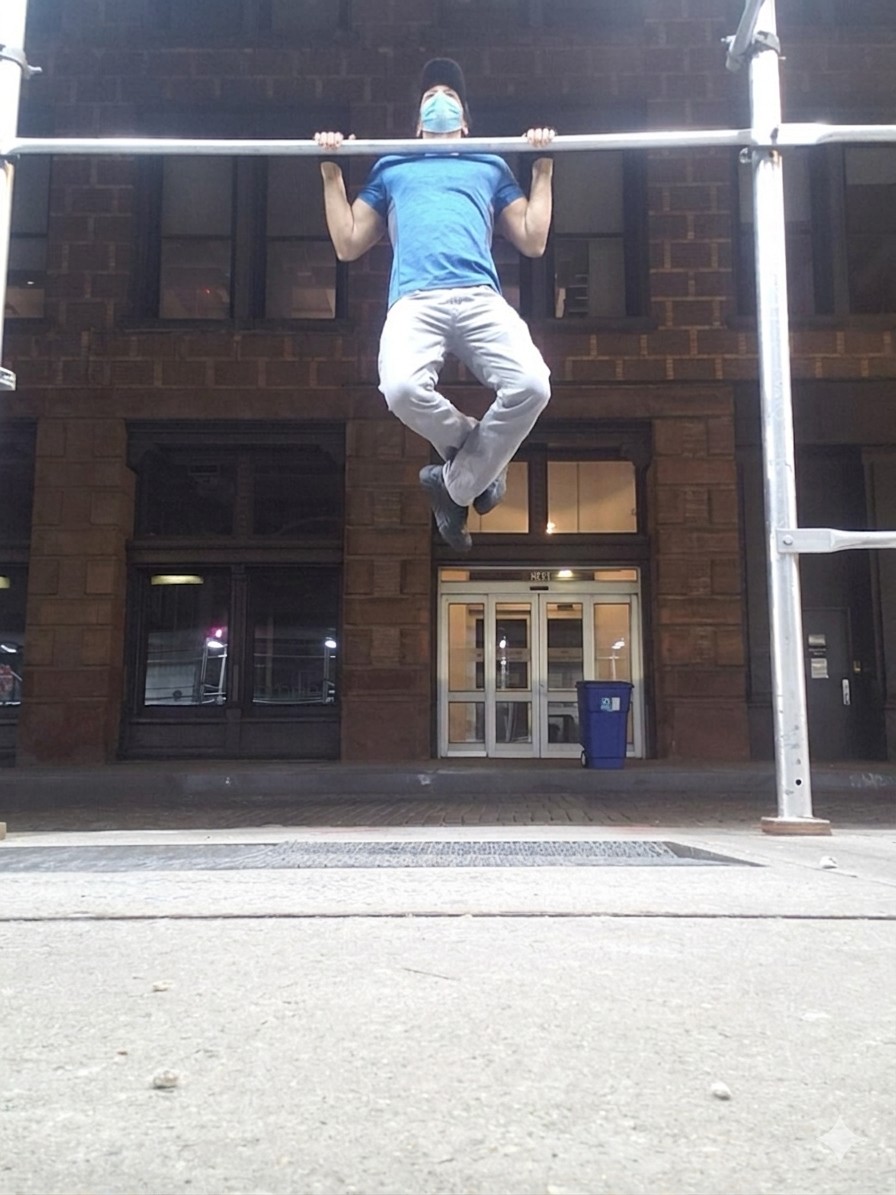
Brown brick absorbs the scene into material silence. Thousands of nearly identical units create a wall so visually and acoustically dense that Chakubie's effort appears isolated from the wider city. Burnt umber, weathered tan, mortar gray, and scaffold metal f
Read the narration
Brown brick absorbs the scene into material silence. Thousands of nearly identical units create a wall so visually and acoustically dense that Chakubie's effort appears isolated from the wider city. Burnt umber, weathered tan, mortar gray, and scaffold metal form a restricted palette without relief. Repetition builds both architecture and physique, but the analogy is not comforting: brick becomes enclosure one unit at a time, just as ritual can become compulsion one repetition at a time.
A broad brown-brick facade fills the background, stripped of the bright signage and prominent landmarks found elsewhere in the exhibition. Chakubie hangs from the scaffold bar in front of this uniform field, and the masonry's repeated courses give the image a steady, almost textile-like rhythm.
The restricted palette brings small variations forward: weathering in the brick, changes in mortar, reflected light on the poles, and the contrast between clothing and wall. The body reads clearly because the architecture does not compete for attention. Its effort becomes the principal event against a surface designed through repetition.
Brown Brick Background Pull Up is intentionally literal. The title refuses to inflate the location into a monument. It recognizes that the city's most common materials can provide a complete formal setting when the camera attends to proportion, texture, and the placement of a single figure.
Brick is both background and unit: thousands of small repeated blocks producing one seemingly continuous wall. The relationship to the pull-up is exact. Repeated individual movements accumulate into practice, just as repeated bricks accumulate into architecture.
With signage minimized and the brick wall held almost flat behind him, the eye can study Chakubie's physique and mechanics. Shoulders stabilize beneath the rail, forearms rise vertically, the torso stays controlled, and crossed ankles prevent loose swinging. The body is athletic without being monumentalized; its strength is shown as practice rather than display. Against the repeating brick courses, muscular development appears architectural—built incrementally, unit after unit, during a period when maintaining physical and psychological structure was itself a form of resistance.
Material silence invites solemn interpretation, and solemnity can be another trap. It is still a man doing pull-ups before a brown wall; the work's aggression lies in making the viewer feel intellectually inadequate for saying so.
Opening the gallery…