70 Clock Galerie / Pull Ups and Psy-Op-20
Traction Graffiti DOCH
DOCH Graffiti Pull Up
June 2020
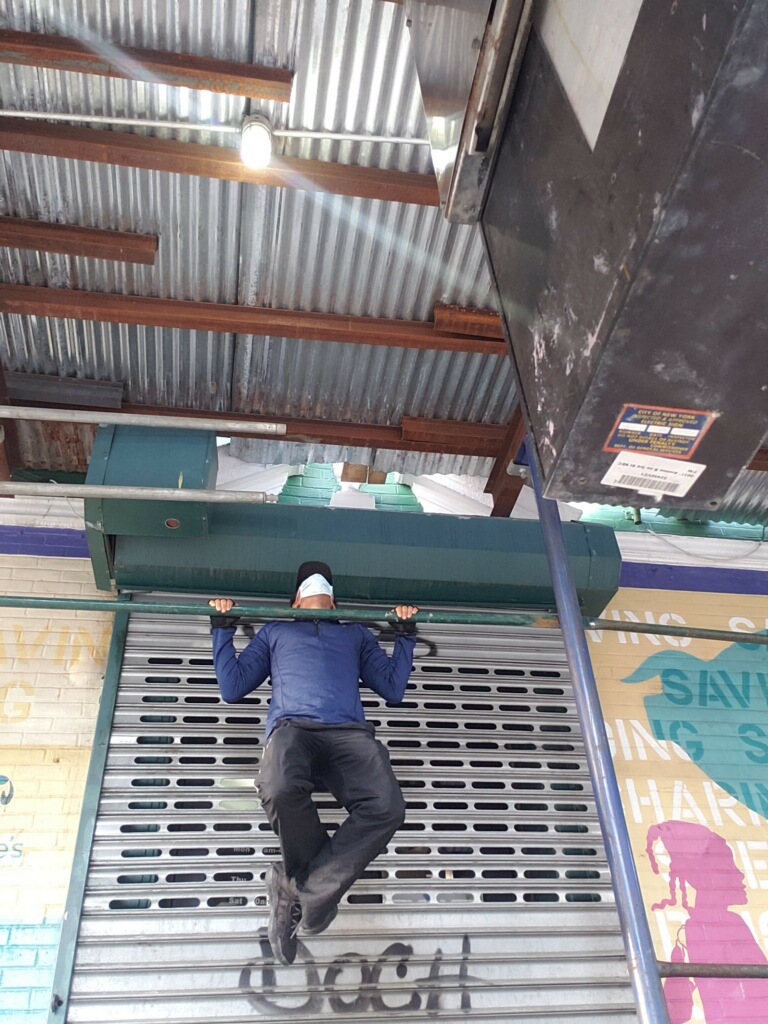
The sidewalk becomes a site of dual authorship. DOCh claims the shutter through a quick, high-contrast tag; a salon mural offers a more commercial body; Chakubie claims the scaffold through action. Above them, the corrugated canopy drives toward the corner in
Read the narration
The sidewalk becomes a site of dual authorship. DOCh claims the shutter through a quick, high-contrast tag; a salon mural offers a more commercial body; Chakubie claims the scaffold through action. Above them, the corrugated canopy drives toward the corner in a serrated perspectival wedge, threatening to crush the layered identities beneath it. One performance is graphic, one commercial, one bio-mechanical, and none possesses the wall for long.
A compact DOCh tag on a metal shutter gives this pull-up its title. Nearby, a painted salon image and additional street markings complicate the background, so the named graffiti is one voice among several. Chakubie hangs under the scaffold while the shutter's horizontal ridges extend across the frame.
The work treats graffiti as local nomenclature. DOCh may not explain itself, but it distinguishes this wall from the many other closed shutters in the series. The body, scaffold, commercial imagery, and tag occupy different registers of authorship: exercise, construction, advertisement, and unsanctioned mark-making.
Together they create a layered urban portrait without requiring a famous landmark. The pull-up is the repeated sentence; DOCh is the changing annotation. What remains consistent is the artist's attention to the accidental visual collaborations already present on the block.
The salon figure adds another body to the scene, but as painted image rather than performer. Between that commercial likeness, the anonymous tag, and Chakubie's exercise, the shutter becomes a crowded field of identities. The photograph preserves their temporary coexistence before the storefront changes again.
The low angle sends the corrugated canopy sharply toward the upper corner, its serrated edge and rusted crossbeams creating an aggressive perspectival wedge. Below it, the DOCh tag stretches across a perforated shutter while a colorful hair-salon mural appears to the side. Those surfaces carry different speeds of looking: the tag is quick and gestural, the commercial painting descriptive, the scaffold bluntly structural. Chakubie's body binds them into one vertical collage, a temporary figure posed between street authorship and overhead industrial weight.
Everyone in the frame appears to claim something—the tagger, the salon image, the athlete, the photographer. The viewer's claim to interpretation is simply the latest and least visible layer.
Opening the gallery…