70 Clock Galerie / Pull Ups and Psy-Op-20
Traction Reflets du Strand
Reflections of the Strand Pull Up
June 2020
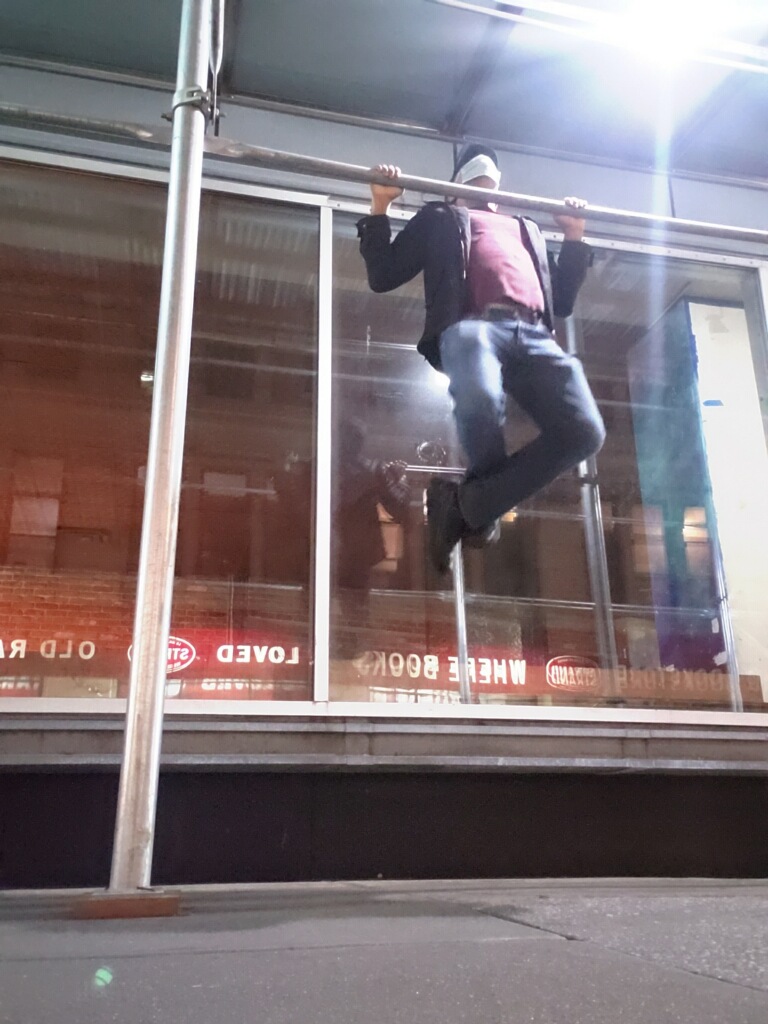
The Strand appears as an intellectual ghost, its famous lettering reversed and fragmented in the glass behind Chakubie. The bookstore—an archive of human language and one of the Village's most durable cultural institutions—is present only as a reflection that
Read the narration
The Strand appears as an intellectual ghost, its famous lettering reversed and fragmented in the glass behind Chakubie. The bookstore—an archive of human language and one of the Village's most durable cultural institutions—is present only as a reflection that must be mentally corrected before it can be read. A hard flare clouds the window like damaged memory. Physical exertion takes place inside the orbit of inaccessible knowledge, the body immediate while culture survives as optical residue.
The Strand Bookstore does not appear directly in this photograph. Its familiar lettering is caught backward and fragmented in the glass behind Chakubie, visible as a reflection across the lower portion of the window. The pull-up takes place in front of that reflected text, under scaffold poles illuminated by a strong flare from above.
Reflection makes the landmark present and absent at once. The Strand exists across the street or outside the camera's direct field, yet its identity enters the work as reversed language. The glass also catches brick, lights, and interior darkness, combining several spatial layers behind the body.
The title teaches the listener not to search for a storefront sign but for an optical trace. That indirectness gives the work its character. A celebrated New York bookstore becomes a ghostly inscription, while the pull-up remains immediate, physical, and pressed close to the picture plane.
A bookstore is an archive of language, and here language arrives as a reflection that must be mentally reversed. The viewer performs a small act of reconstruction to read it. That effort parallels the exhibition's larger demand: ordinary street evidence must be assembled rather than passively received.
The Strand, founded in 1927 and celebrated for its miles of books, is one of New York's most durable independent bookstores. Here it enters indirectly, its lettering reversed in glass, as though the city's literary memory were being read through a mirror. The strong flare above Chakubie adds the glow of revelation but also obscures part of the scene. During lockdown, when browsing shelves and gathering in shops became fraught, the reflected landmark feels especially apt: culture remains visible and desired, yet held at optical distance.
Reversed lettering makes the viewer perform a small correction and rewards him with recognition. That successful act of reading can become a trap: solving the reflection is not the same as solving the image.
Opening the gallery…