70 Clock Galerie / Pull Ups and Psy-Op-20
Traction Colonne Art Déco
Art Deco Column Pull Up
June 2020
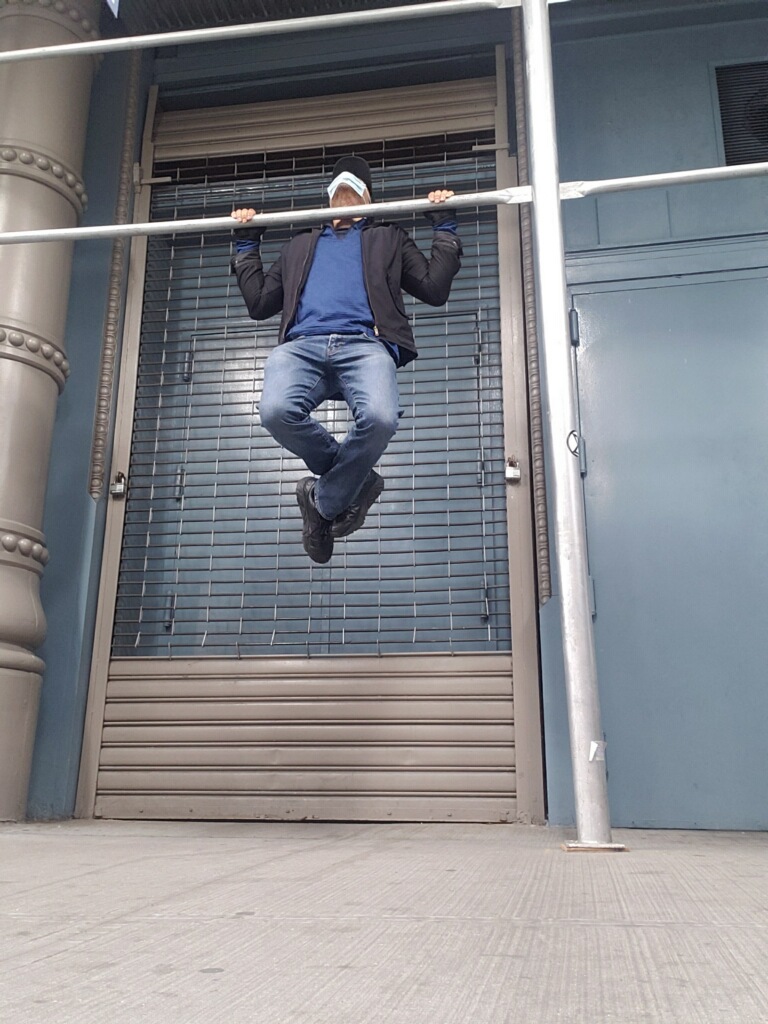
A fluted Art Deco column stands beside the scaffold as the fossil of an earlier faith in speed, power, and ordered modernity. Cool blue-gray tones drain warmth from the scene, lending it the melancholy of a metropolitan Blue Period while the beaded column and
Read the narration
A fluted Art Deco column stands beside the scaffold as the fossil of an earlier faith in speed, power, and ordered modernity. Cool blue-gray tones drain warmth from the scene, lending it the melancholy of a metropolitan Blue Period while the beaded column and closed grille turn the facade into ornamented confinement. The historic pillar remains motionless; Chakubie supplies the mechanical force it once symbolized. The living architecture is also the more temporary one.
At the left of this pull-up, an Art Deco column rises beside the scaffold. Its stepped and fluted architectural detailing belongs to a permanent facade, while the plain tubular steel crossing in front of it is temporary and strictly functional. Chakubie's body is suspended between those two design languages.
The column carries an older idea of modernity: ornament disciplined by geometry, progress expressed through stylized vertical ascent. The pull-up literalizes that ascent on a human scale. Bent elbows, raised torso, and crossed feet create a brief living ornament beside the stone or metal shaft.
The photograph does not need a famous address. A single column is enough to locate its aesthetic argument. The city accumulates eras rather than replacing them cleanly, and the scaffold makes that layering visible. Exercise, temporary construction, and historic decoration share one narrow strip of sidewalk.
Both column and body are designed to draw the eye upward, but one does so through mass and the other through effort. Their adjacency allows architectural aspiration and physical aspiration to mirror one another without becoming identical. The scaffold is the plain intermediary that makes the comparison possible.
Cool blue-gray paint, silvery scaffold, and the shadowed Art Deco surround give the scene a restrained tonal unity. Its cobalt notes may recall the charged blues of Van Gogh's nocturnes, while the phrase Blue Period properly belongs to Picasso's melancholy early work; both references help name the emotional temperature without claiming imitation. The color cools the athlete's exertion into something contemplative. Beside the beaded column and closed grille, his crossed legs become another ornamental motif within a facade composed of vertical aspiration.
Art Deco promises progress through disciplined form. Lockdown empties that promise into style, and the pull-up repeats it as labor. The viewer may admire the symmetry; the image asks what obedience has been aestheticized.
Opening the gallery…