70 Clock Galerie / Pull Ups and Psy-Op-20
Traction Lignes Horizontales
Horizontal Lines Pull Up
June 2020
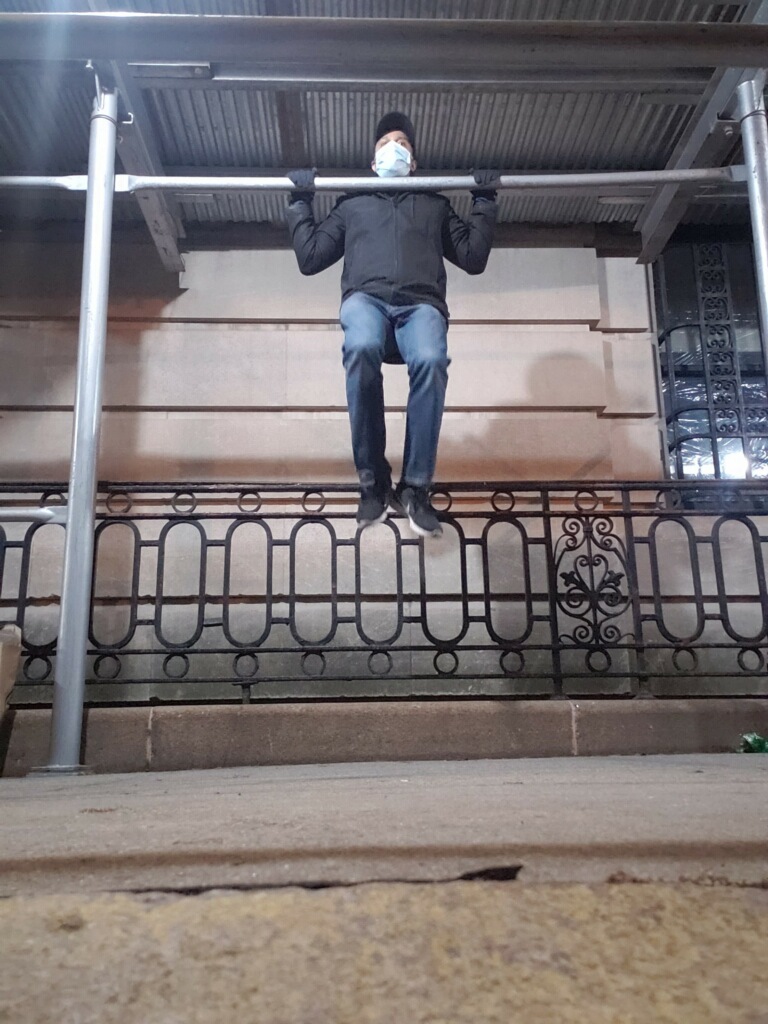
This is urban grid as doctrine. Shadow, pavement edge, railing, brick courses, scaffold rail, and pull-up bar create stacked horizontal planes with the severity of ruled paper. Chakubie becomes a kinetic glyph embedded inside that linear regime, his forearms p
Read the narration
This is urban grid as doctrine. Shadow, pavement edge, railing, brick courses, scaffold rail, and pull-up bar create stacked horizontal planes with the severity of ruled paper. Chakubie becomes a kinetic glyph embedded inside that linear regime, his forearms providing short vertical interruptions and his crossed feet a pendulum beneath the text. Accidental order hardens into visual law, and the body is permitted motion only by repeating the structure that confines it.
This photograph is organized as a sequence of horizontal bands. A shadow draws one line across the pavement; the sidewalk edge supplies another; scaffold rails and braces repeat the direction; brick courses extend it through the facade; and the pull-up bar establishes the highest and most consequential line.
Chakubie's body interrupts that structure without escaping it. His hands lock onto the bar, bent arms create short verticals, and crossed legs gather beneath him. The human figure becomes a hinge connecting the parallel layers. What might otherwise look like an incidental construction scene is revealed as a tightly ordered composition once the title teaches the eye how to read it.
Horizontal Lines Pull Up demonstrates the series' attention to overlooked formal arrangements. The city is already drawing before the camera arrives—with curb, shadow, steel, mortar, and bar. The exercise briefly activates that drawing.
Even time can be understood horizontally here. The pull-up pauses at one instant along a repeated cycle, just as each photograph pauses at one stop along a route. Lines that appear static become measures of passage once the performing body enters them.
This is among the series' most nearly abstract photographs. Parallel rails run horizontally behind the figure; scaffold uprights establish a strict bilateral frame; the body's centered placement creates a temporary axis of symmetry. Even the feet hang together like a pendulum beneath the torso. The ornamental loops below soften the grid without breaking it. The image shows why repetition matters aesthetically: once the subject is familiar, attention can migrate to spacing, interval, balance, and the quiet pleasure of one human form held inside a measured field of iron.
Geometry flatters the analytical viewer. Once the lines have been counted and the symmetry admired, the composition asks whether formal intelligence has revealed anything—or merely made captivity sound elegant.
Opening the gallery…