70 Clock Galerie / Pull Ups and Psy-Op-20
Traction Crâne Orange et Dixième Op-Psy-20
Orange Skull Pull Up and Tenth Psy-Op-20
June 2020
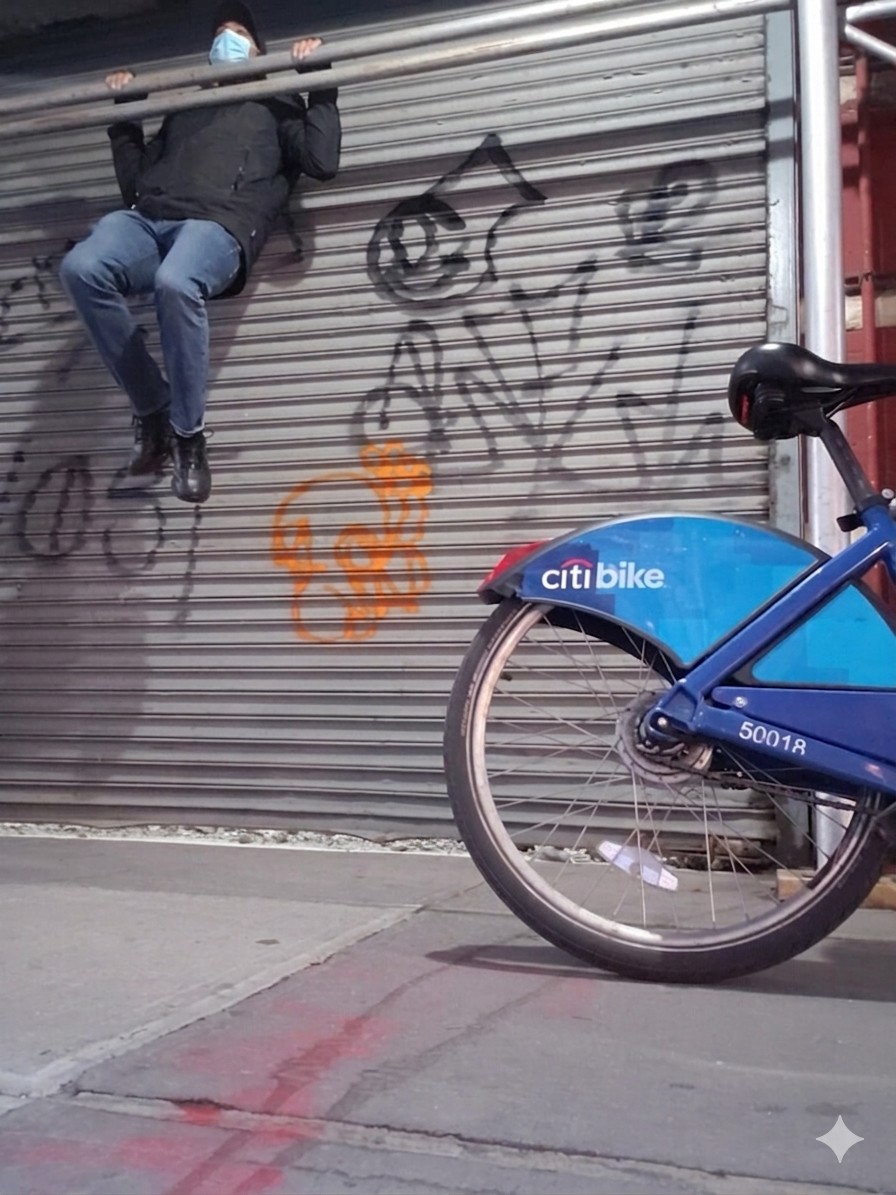
A closed shutter becomes a memento mori written in street syntax. Black calligraphic lines suggest a skeletal figure, while the small orange skull burns against the gray corrugation like a hazard symbol no agency installed. Bicycle wheel, scaffold rail, and pa
Read the narration
A closed shutter becomes a memento mori written in street syntax. Black calligraphic lines suggest a skeletal figure, while the small orange skull burns against the gray corrugation like a hazard symbol no agency installed. Bicycle wheel, scaffold rail, and painted contour create competing circles and bars around Chakubie. The image uses symbolic anchoring with almost insulting efficiency: death on the wall, vitality on the bar, and the viewer congratulating himself for noticing.
A closed metal shutter becomes a drawing surface in this image. Black graffiti suggests a large skeletal or skull-like figure, while a smaller orange mark sits beneath it. A Citi Bike wheel and blue fender fill the lower right, and Chakubie hangs from the scaffold bar at the upper left.
The title isolates the Orange Skull even though the wall contains several competing lines and figures. That act of naming directs attention into the graffiti's ambiguity: face, skull, body, symbol, or hurried street notation. The bicycle wheel supplies a clean mechanical circle against the shutter's horizontal ribs and the graffiti's loose gestures.
This is called the Tenth Psy-Op-20, but the explanation is withheld. The apparent evidence remains ordinary and specific—a shutter, a bicycle, a pull-up, and layered marks made by unknown hands. The title asks the viewer to suspect more without telling the viewer what to find.
The orange mark's smallness is part of the work's wit. A title elevates a few sprayed lines into a principal character, much as the series repeatedly promotes incidental street details into subjects. The archive depends on this redistribution of attention from landmark to overlooked mark.
The shutter is a palimpsest: gray corrugation carries a large black linear figure, stray lettering, and the small orange sprayed form singled out by the title. The black drawing has a skeletal, almost calligraphic energy, its elongated contours echoing the scaffold uprights. Orange acts as a chromatic spark in the otherwise cool, dirty palette. Graffiti here is neither mere backdrop nor a code the narration pretends to solve; it is a competing gesture, another body's movement fixed on metal while Chakubie's movement is arrested by the camera.
The Tenth Psy-Op offers death as symbolic anchoring and dares the viewer to confuse interpretation with detection. Seeing the skull is easy. Knowing why the work insists that you see it is another matter.
Opening the gallery…