70 Clock Galerie / Pull Ups and Psy-Op-20
Traction au 325 Est 15e Rue
325 East 15th Street Pull Up
June 2020
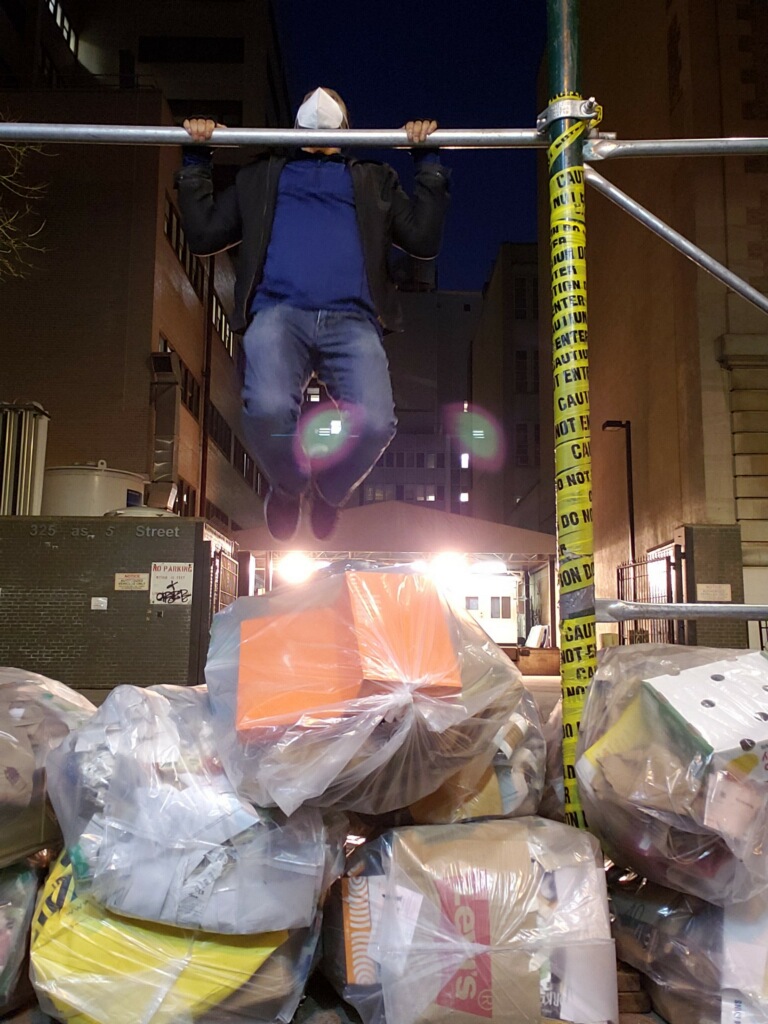
At 325 East 15th Street, address, caution tape, work lamps, and clear bags of flattened packaging produce the evidentiary precision of a crime-scene photograph. Cardboard preserves torn fragments of corporate color, an involuntary mural of consumption by deliv
Read the narration
At 325 East 15th Street, address, caution tape, work lamps, and clear bags of flattened packaging produce the evidentiary precision of a crime-scene photograph. Cardboard preserves torn fragments of corporate color, an involuntary mural of consumption by delivery. The residential facade remains sealed and quiet above it. Chakubie's localized effort is performed in the narrow clearance between accumulated waste and scaffold roof, as if the block has allotted him only this much air.
At 325 East 15th Street, the address is visible on the brick at the left while a dense pile of clear-bagged cardboard fills the foreground. A scaffold upright wrapped repeatedly in yellow caution tape divides the image. Above the refuse, Chakubie pulls himself toward a silver bar, with bright work lights flaring behind him.
The photograph is crowded with packaging, warnings, and support structures. Flattened boxes retain traces of commercial color inside transparent bags; the caution tape turns the vertical pole into a column of repeated commands. The address prevents this accumulation from becoming generic. It is a specific night's inventory at a specific Manhattan coordinate.
The pull-up occupies the only open space left between the piles and the dark sky. That small clearance gives the body a precarious prominence. The work transforms an improvised workout into a study of how much urban matter can gather beneath a single repeated motion.
The boxes preserve fragments of logos and color, turning discarded packaging into a broken commercial mural. Nothing was composed for the photograph, yet the pile records patterns of delivery and consumption. Above it, the disciplined body supplies a counter-economy based on repetition rather than acquisition.
The address, caution tape, work lamps, and clear bags of flattened packaging give this stop the documentary specificity of a municipal evidence photograph. Yet the composition is also unexpectedly painterly: ochres and browns of cardboard, orange warning accents, bluish artificial light, and dark scaffold poles produce a restrained nocturne. The trash suggests deliveries flowing toward apartments while empty cartons flow back to the curb. Chakubie's pull-up occupies the middle of that circulation, a noncommercial repetition amid the material traces of locked-down domestic consumption.
The exact address turns debris into archive and coincidence into evidence. Yet the more forensic the description becomes, the more theatrical its authority should appear.
Opening the gallery…