70 Clock Galerie / Pull Ups and Psy-Op-20
Traction sur un Autre Tas d'Ordures
Another Pile of Garbage on Another Street Pull Up
June 2020
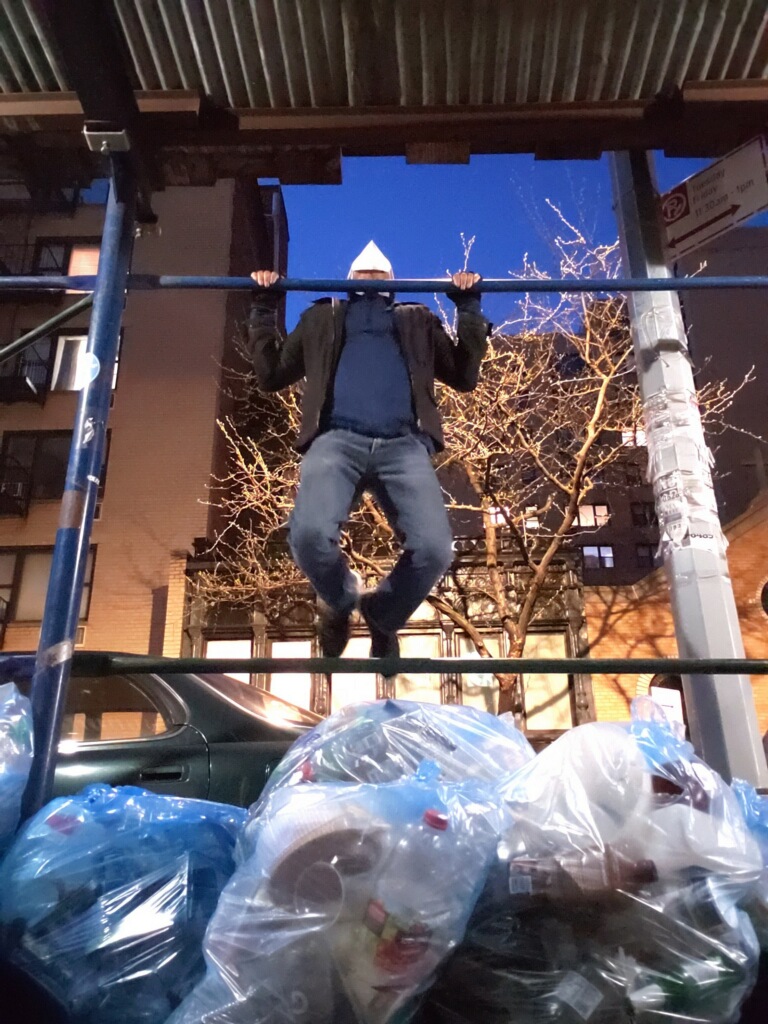
The garbage returns as an urban refrain, darker now and stripped of novelty. Polyethylene mounds crowd another anonymous curb beneath another scaffold, producing what might be called geographic fatigue—the same stalled civic metabolism encountered on a differe
Read the narration
The garbage returns as an urban refrain, darker now and stripped of novelty. Polyethylene mounds crowd another anonymous curb beneath another scaffold, producing what might be called geographic fatigue—the same stalled civic metabolism encountered on a different block. Sparse light glances off crinkled plastic like oil on black water. The repeated pull-up does not redeem the scene; it merely supplies the only measurable movement inside a landscape of municipal exhaustion.
Another street, another scaffold, another concentration of bagged refuse. This time the scene is darker, and the garbage collects along the base of the structure as Chakubie performs the same elevated ritual above it. The repetition of the title is deliberate: the exhibition refuses to treat the first pile as an isolated urban curiosity.
Where the previous work presents pale bags as a broad foreground terrain, this photograph is more compressed and nocturnal. Dark plastic catches limited highlights, the scaffold becomes a shadowed cage, and the body is absorbed into the same restricted palette. The difference between locations lies in texture, light, and the accidental arrangement of what has been left at the curb.
By repeating both exercise and refuse, the pair turns routine into evidence. Personal maintenance continues overhead while the city's discarded matter waits below. Neither is romanticized. Their proximity gives the image its blunt physical logic.
Seen beside the preceding work, this photograph makes the exhibition behave like a visual refrain. The repeated subject is not evidence of a lack of difference but a device for detecting it. Once the action stays constant, changes in light, material, and street management become unusually vivid.
At night, refuse loses the bright, almost sculptural whiteness of the preceding image and becomes a heavier mass at the curb. Point light glances off plastic, producing small highlights within an otherwise compressed tonal range. The recurrence of trash across several works creates a grim urban triptych: the city still consuming, discarding, and waiting to be serviced while its public life is suspended. Above that stalled horizontal pile, Chakubie's body supplies a vertical cadence—an assertion that routine can be made even when civic routines falter.
Repetition breeds contempt, but also compliance. By the second garbage pile, the viewer believes he understands the system. The image waits inside that fatigue, knowing that certainty is easiest to install when attention has become bored.
Opening the gallery…