70 Clock Galerie / Pull Ups and Psy-Op-20
Traction sur le Tas d'Ordures de la 15e Rue
15th Street Garbage Pile Pull Up
June 2020
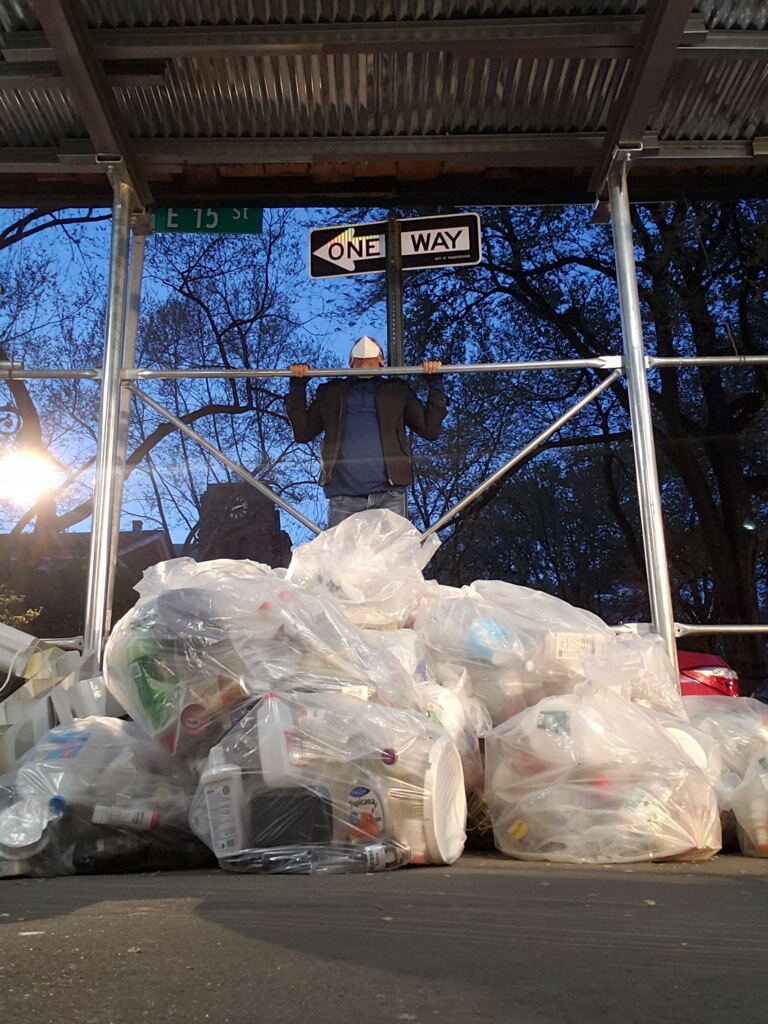
The city displays its abject underside as a monumental accumulation of bagged refuse. Translucent white plastic forms a glistening artificial geology beneath the scaffold, soft bulges colliding with rigid poles and curb lines. Chakubie hangs above it as though
Read the narration
The city displays its abject underside as a monumental accumulation of bagged refuse. Translucent white plastic forms a glistening artificial geology beneath the scaffold, soft bulges colliding with rigid poles and curb lines. Chakubie hangs above it as though mounted on a pedestal made from domestic waste. The sublime and the abject share one vertical axis: personal discipline resisting entropy while the city's metabolism piles up below.
A large mound of white and translucent garbage bags occupies most of the foreground beneath a scaffold on East 15th Street. Street signs and a one-way arrow locate the scene, while Chakubie hangs above the accumulation, his body compressed into the narrower upper band of the photograph.
The bags are not a minor detail; they form a temporary landscape. Their irregular rounded volumes contrast with the straight poles, curb lines, and facade edges around them. Refuse that would ordinarily remain peripheral becomes the base on which the entire composition appears to rest. The pull-up is elevated not only by the bar but by the camera's decision to give waste the greatest share of the frame.
The work records two kinds of persistence. The body continues its disciplined repetition, and the city continues to produce material that must be collected and removed. In the strange quiet of June 2020, that ordinary relationship becomes newly visible and slightly monumental.
White and translucent plastic also reverse the usual moral palette of refuse. The pile is bright rather than dirty-looking, almost geological under daylight. That visual seduction does not erase what it is; it makes the viewer confront how easily waste can become form when isolated by a camera.
The piled bags register the city's stressed metabolism. Residential refuse continued to accumulate even as offices, dining rooms, and much street activity shut down, and irregular collection could make that accumulation conspicuous. Formally, the mound behaves like a low white cloudbank beneath the black scaffold: soft bulges against rigid uprights, translucency against steel. Chakubie's elevated body seems to clear this temporary terrain. His route through lockdown is not picturesque; it passes directly over the evidence of households compressed indoors and the material excess that confinement produced.
The rhetoric may sound absurdly grand for garbage and a chin-up bar. That disproportion is deliberate. The viewer is forced to choose between surrendering to the critique and admitting how readily refuse becomes spectacle when framed as art.
Opening the gallery…