70 Clock Galerie / Pull Ups and Psy-Op-20
Traction à la Banque du Peuple et Troisième Psy-Op-20
The People Bank Pull Up and Third Psy-Op-20
June 2020
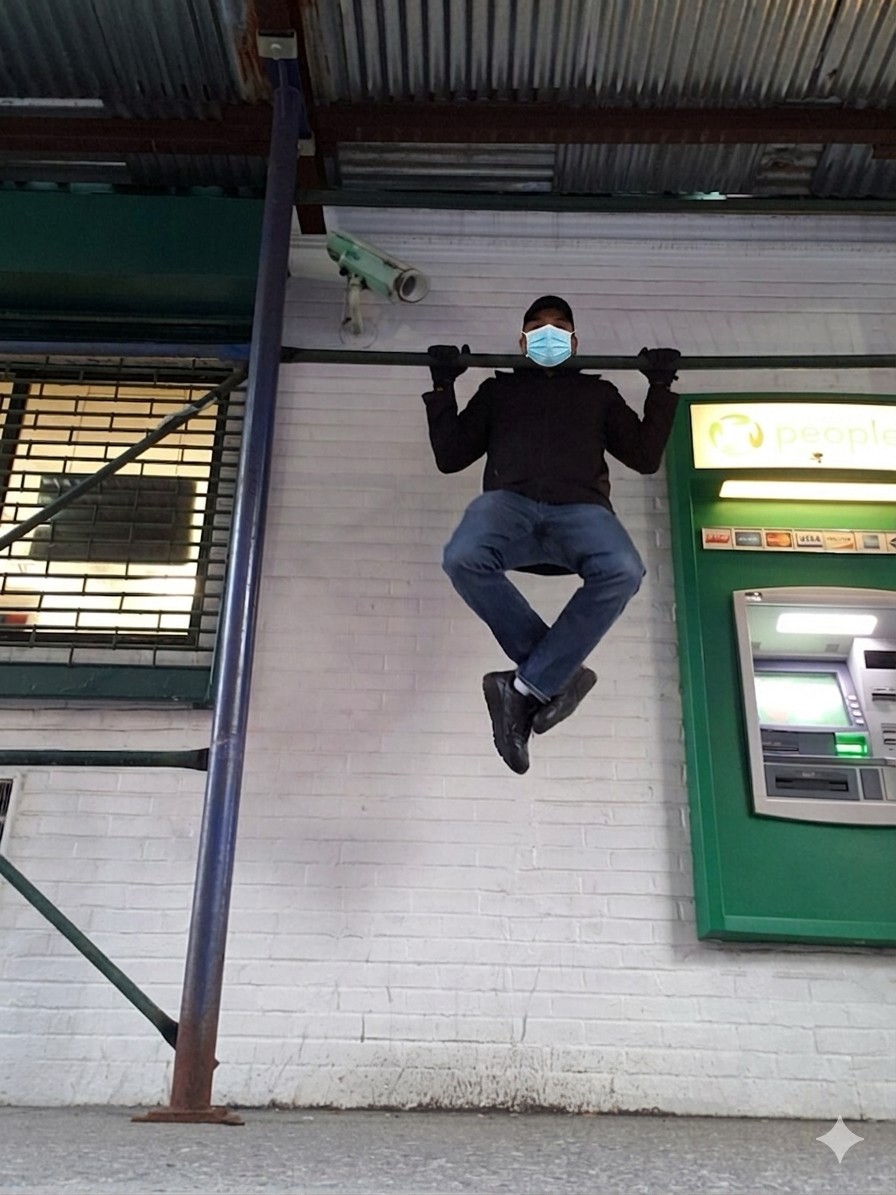
The People's Bank presents itself as a democratic institution while its glass, camera, and glowing machine create the atmosphere of a monitored fortress. No people wait in line. No lobby activity softens the architecture. Chakubie's ritual becomes bio-mechanic
Read the narration
The People's Bank presents itself as a democratic institution while its glass, camera, and glowing machine create the atmosphere of a monitored fortress. No people wait in line. No lobby activity softens the architecture. Chakubie's ritual becomes bio-mechanical production conducted outside capital's sealed interior, a body generating value that the ATM cannot count. The title's institutional irony is almost too neat, which is precisely when a confident viewer should become suspicious.
A green People's bank cash machine glows at the right of a white brick wall. Above Chakubie, a surveillance camera projects diagonally into the scene, observing the sidewalk as he performs a pull-up under the corrugated scaffold roof. The green ATM, blue face covering, and dark clothing create a compact field of institutional color against the pale masonry.
The title names this the Third Psy-Op-20, although the image does not disclose what earns that designation. Instead, it offers a quiet triangle of body, cash machine, and camera. One device distributes money; another records movement; between them, a person converts strength into repeated vertical motion.
The phrase People's Bank acquires a dry ambiguity in an almost empty streetscape. The machine is available to the public, the camera watches the public, and the scaffold occupies public passage. Chakubie's pull-up briefly claims that managed space for an unsanctioned personal ritual, while the title's unresolved Psy-Op remains in plain language rather than visible explanation.
The camera above the bar subtly doubles the exhibition's own act of looking. Chakubie is photographed while another lens points toward the same public zone. Neither gaze explains the title. Instead, observation itself becomes part of the atmosphere, present as infrastructure rather than announced as a conclusion.
People's Bank and its green ATM evoke a social choreography that has vanished from the picture: no queue, no shoulder-to-shoulder waiting, no exchange at a teller window. The facade is almost clinically blank, and the surveillance camera supplies the only implied witness besides the photographer. Chakubie's solitary exertion therefore reads as both withdrawal and claim. He keeps distance from other people while making emphatic use of public space, converting an emptied financial threshold into a place where value is measured in repetitions rather than cash.
The Third Psy-Op borrows legitimacy from institutional space. The bank, ATM, and camera appear to certify the scene, but authority is not accuracy. The viewer who trusts the architecture has already made the intended deposit.
Opening the gallery…