70 Clock Galerie / Pull Ups and Psy-Op-20
Traction au 229 Avenue B
The 229 Avenue B Pull Up
June 2020
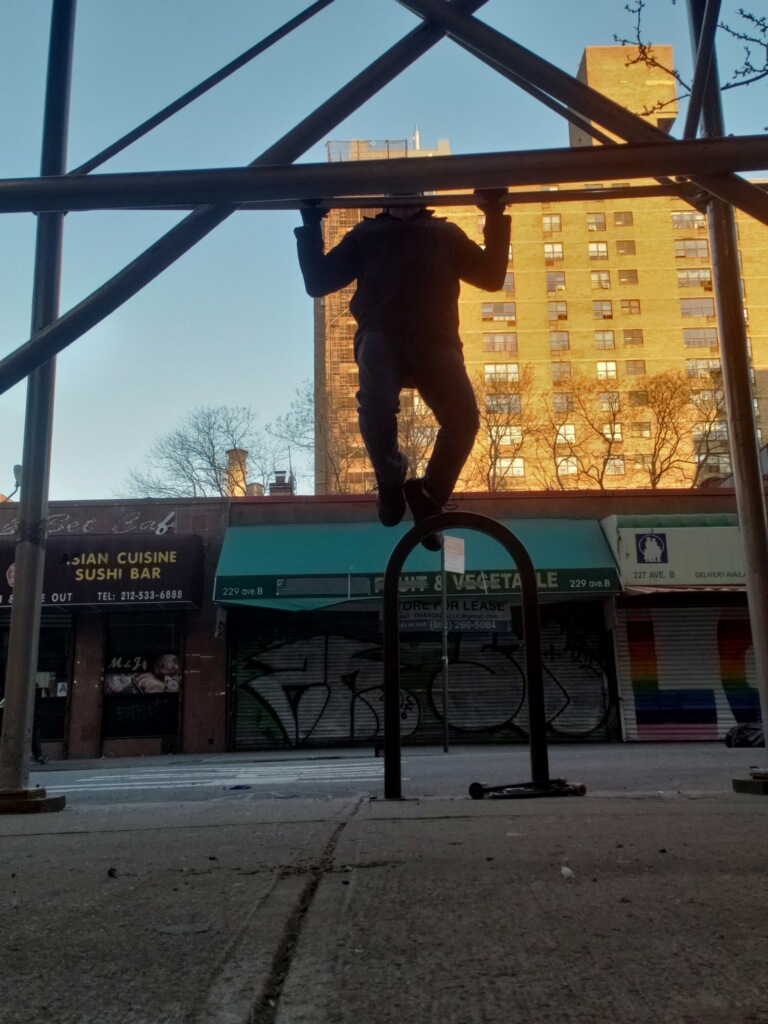
The East Village appears here as a split register of abandonment. Golden light strikes the upper housing blocks while the sidewalk remains trapped beneath a black scaffold canopy, among shuttered businesses, tags, and FOR LEASE language. At 229 Avenue B, verti
Read the narration
The East Village appears here as a split register of abandonment. Golden light strikes the upper housing blocks while the sidewalk remains trapped beneath a black scaffold canopy, among shuttered businesses, tags, and FOR LEASE language. At 229 Avenue B, vertical persistence is set against horizontal economic retreat. Chakubie becomes the only active tenant of the streetscape, occupying steel that belongs to nobody and a public corridor that the city has emptied of ordinary purpose.
The address 229 Avenue B anchors this photograph to a precise East Village location. Chakubie hangs beneath the scaffold in front of a row of storefronts, with the building number and surrounding commercial details fixing the otherwise repeatable pull-up to one particular block.
The temporary sidewalk shed divides the facade into narrow compartments. Posts cut through signs and windows; the horizontal bar crosses the frame at shoulder height; the body occupies the central opening created by that grid. What could have been an anonymous construction corridor becomes a recognizable coordinate because the title insists on the address.
The work demonstrates how the series functions as an urban itinerary. Each pull-up is physically similar, but the city refuses to repeat itself. Numbers, doors, awnings, parked vehicles, and traces of occupancy distinguish one station from the next. At 229 Avenue B, disciplined bodily repetition becomes a method of mapping place.
The address also resists the temptation to turn lockdown into an abstract citywide condition. The exhibition proceeds door by door and block by block. Its history is built from exact encounters, so that the larger atmosphere of New York emerges through accumulated particulars rather than a single generalized image.
Golden-hour light ignites the upper stories across Avenue B while the foreground remains in scaffold shadow. That contrast divides the photograph into two New Yorks: a warm residential tower catching the last sun and a grittier lower band of shutters, tags, Asian-cuisine signage, a toppled scooter, and protective steel. Avenue B runs beside Tompkins Square Park and has long carried the East Village's mix of tenement life, immigrant commerce, nightlife, protest, and reinvention. Chakubie's silhouette turns that layered history into the backdrop for one private refusal to stay inert.
An address feels like proof, but proof of place is not proof of meaning. The more precisely the work tells the viewer where he is, the less obligated it becomes to explain what he is seeing.
Opening the gallery…