70 Clock Galerie / Pull Ups and Psy-Op-20
Traction Icône du Parc
The Park Icon Pull Up
June 2020
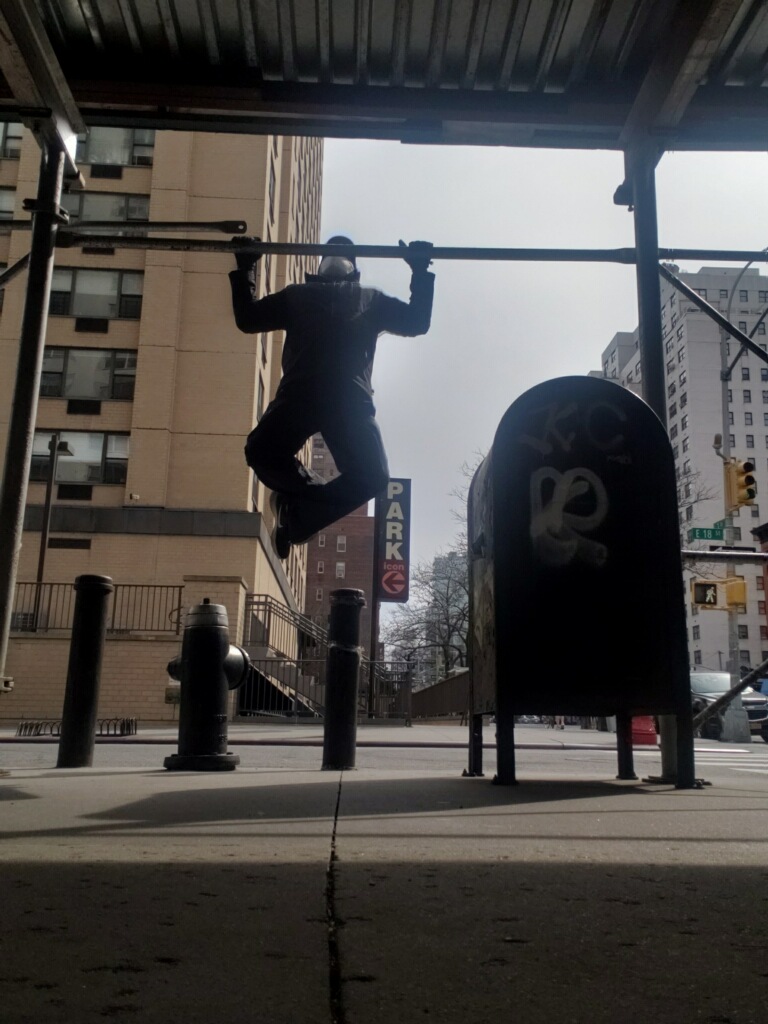
Perspective turns the ordinary street into an unstable hierarchy. A rounded black receptacle swells toward monumentality while Chakubie recedes beneath the scaffold, almost microscopic beside the urban fixtures meant to serve him. The PARK arrow offers semioti
Read the narration
Perspective turns the ordinary street into an unstable hierarchy. A rounded black receptacle swells toward monumentality while Chakubie recedes beneath the scaffold, almost microscopic beside the urban fixtures meant to serve him. The PARK arrow offers semiotic relief but no reliable escape; it points laterally while the body insists on vertical movement. Lockdown has warped the scale of the city, making nearby objects oppressive and promised destinations abstract.
Photographed from very low beneath the scaffolding, Chakubie hangs between apartment buildings and the open sky. A rounded black street fixture dominates the right foreground, while a vertical PARK sign and arrow appear farther back near East 18th Street. Bollards and a fire hydrant form a row across the sidewalk, turning the lower half of the picture into a collection of compact urban silhouettes.
The so-called park icon is not a grand landscape marker. It is a small piece of wayfinding embedded in an ordinary streetscape. Its arrow points laterally while the body rises vertically; the intersection of those directions organizes the image. The rounded black form in front exaggerates the low perspective and makes the suspended figure appear deeper inside the city.
The photograph finds an unlikely balance between navigation and improvisation. Signs tell pedestrians where to go, barriers shape their passage, and Chakubie uses the overhead structure for a purpose it was never officially assigned. The city provides instructions; the pull-up supplies an alternative route.
The low camera makes the street furniture nearly equal in scale to the body. Hydrant, bollards, dark receptacle, and performer become a row of vertical presences. A view usually organized for pedestrians is reorganized from the pavement upward, giving minor municipal objects unusual sculptural weight.
The wide-angle distortion makes the foreground receptacle swell while Chakubie recedes into a tiny figure under the canopy. Scale no longer behaves politely: mailbox or bin becomes monument, person becomes punctuation, and the PARK arrow points into a city whose normal destinations had become uncertain. That warped perspective suits the psychological geography of lockdown, when nearby objects could feel oppressively immediate and the wider city strangely inaccessible. His pull-up is a small act of proportioning himself again against the street.
The sign promises orientation while the lens sabotages scale. Anyone certain about what is large, what is small, or where the route leads has missed the park icon's darker joke.
Opening the gallery…