70 Clock Galerie / Pull Ups and Psy-Op-20
Traction Connexion Fer et Arroseur
The Iron and Sprinkler Connection Pull Up
June 2020
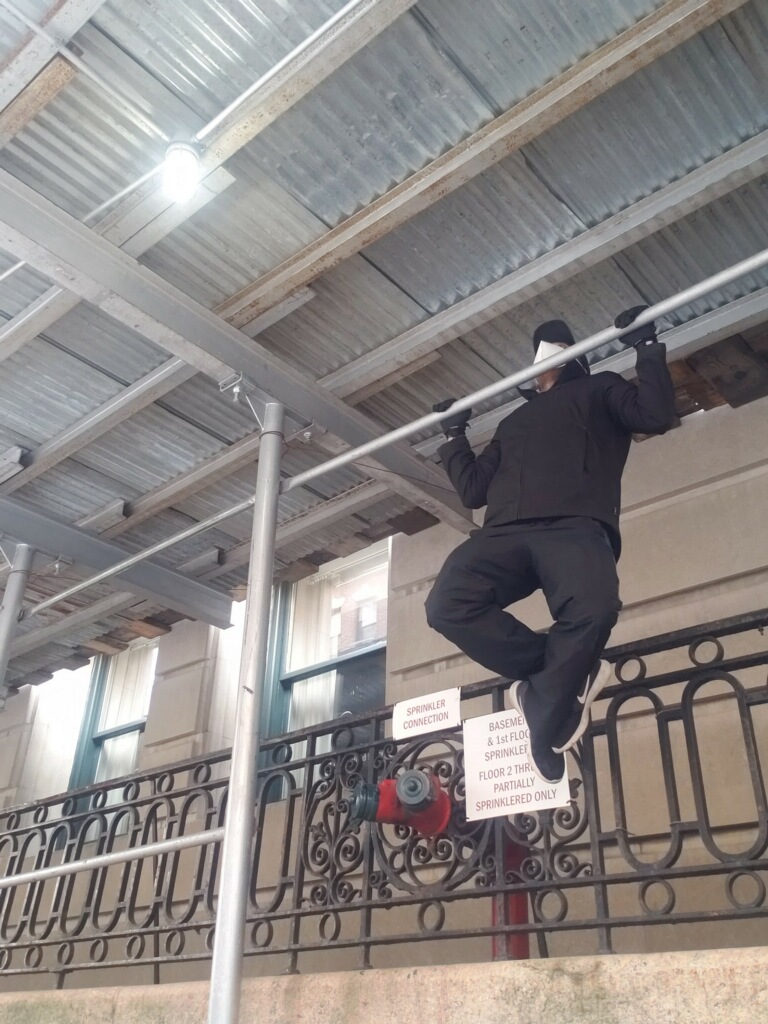
The conceptual focus shifts from architecture to infrastructure. A vivid red sprinkler connection punctures the somber field like a violent arterial rupture, surrounded by iron rails, pipes, and the scaffold's indifferent tubing. There is profound, deliberatel
Read the narration
The conceptual focus shifts from architecture to infrastructure. A vivid red sprinkler connection punctures the somber field like a violent arterial rupture, surrounded by iron rails, pipes, and the scaffold's indifferent tubing. There is profound, deliberately pretentious poetry in the pairing: the dormant hydraulic pressure of the building mirrored by the bio-mechanical tension of a body holding itself above the pavement. Municipal survival apparatus and private endurance become rival systems waiting to discharge.
This image arranges three kinds of metal around the body: the scaffold used for the pull-up, the ornate iron railing behind it, and the red fire-sprinkler connection fixed near the building. Their functions differ—temporary support, architectural boundary, emergency infrastructure—but their bars, pipes, and fittings speak a common material language.
Chakubie's body supplies the only flexible geometry. Bent arms and crossed legs interrupt the grids and curls of the surrounding ironwork. The sprinkler hardware contributes a concentrated note of red, drawing attention to a system designed to remain dormant until needed. The pull-up, by contrast, makes stored physical capacity immediately visible.
The title treats this chance meeting of iron and sprinkler connection as the work's subject. That precision is characteristic of the series: ordinary equipment, usually passed without notice, becomes newly legible when a body pauses beside it. The photograph is less a portrait against architecture than a temporary circuit linking person, scaffold, railing, and pipe.
The red connection also acts like a punctuation mark in the muted streetscape. It is built to connect a larger emergency system, while hands connect directly to the overhead rail. The photograph turns infrastructure into a series of dormant and active grips, each waiting for a different kind of demand.
The oblique viewpoint makes the scene feel discovered rather than staged. Scaffold rails slice diagonally across the field while the ornamental railing repeats loops, curls, and narrow arches behind Chakubie's crossed feet. A bare utility lamp whitens the zinc-gray canopy, exposing rust along its supporting beams. This is an essay in line and material: industrial tubing laid temporarily over an older decorative facade, with the flexible human body mediating between severe straightness and wrought-iron flourish.
The red connection looks like an answer because it is visually emphatic. It may be only a decoy. Viewers who believe they have solved the image at the first bright object are precisely where the composition wants them.
Opening the gallery…