70 Clock Galerie / Pull Ups and Psy-Op-20
Traction au Niveau du Sol
The Ground Level Pull Up
June 2020
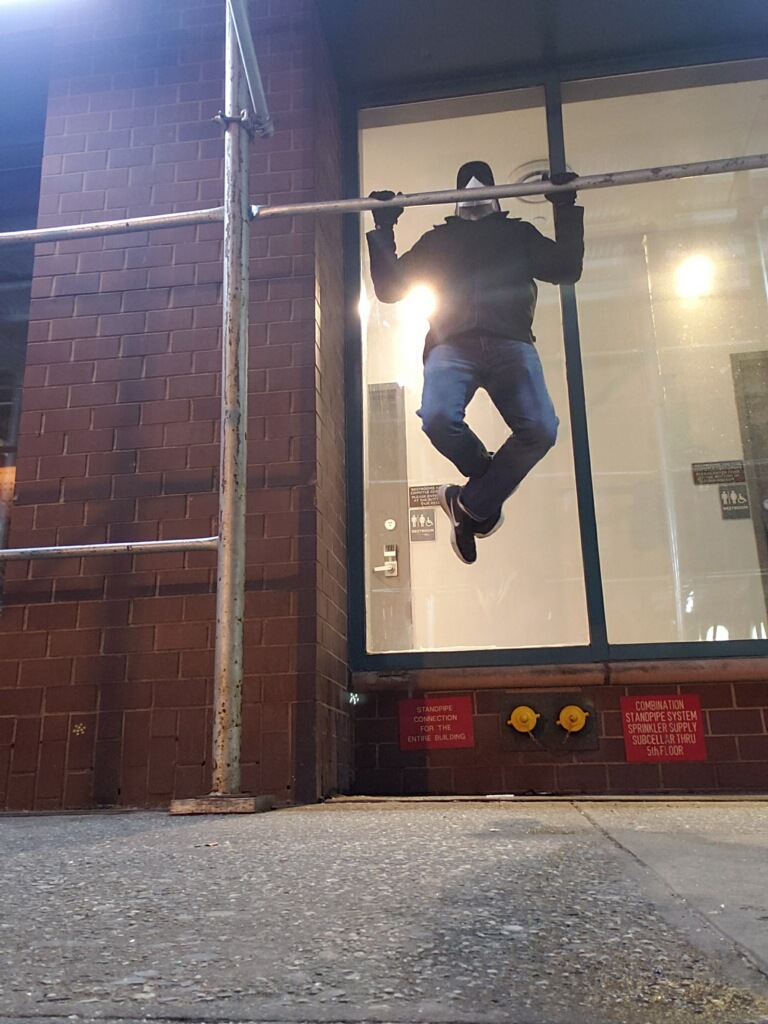
A profound shift in perspective anchors the viewer to the physical grit of New York pavement. From below, the scaffold becomes a rusted brutalist ceiling whose weight appears to press the entire city downward. Steel bars cross brick and glass with the severity
Read the narration
A profound shift in perspective anchors the viewer to the physical grit of New York pavement. From below, the scaffold becomes a rusted brutalist ceiling whose weight appears to press the entire city downward. Steel bars cross brick and glass with the severity of a diagram, while Chakubie's suspended form is monumentalized by the worm's-eye view. The image is less about elevation than oppression: gravity made architectural, and persistence practiced beneath it.
The camera drops to pavement level for this work, making the underside of the scaffold feel unusually large. Chakubie hangs high in the frame above a corridor of storefront glass and brick, while the nearest steel poles rise like columns from the sidewalk. From this angle, the ground is not incidental foreground; it becomes the viewing platform from which the whole temporary structure is measured.
The low vantage changes the familiar pull-up into a small monument. His body is lifted against the ceiling of corrugated metal and cross-bracing, while the storefront beyond catches broken reflections and available daylight. The architecture feels heavier because the camera looks up through it, yet the human figure occupies the point where those rigid lines meet.
Across the series, the same exercise is repeatedly altered by location and framing. Here the decisive element is not a business name or piece of graffiti but the camera's height. A few feet of vertical displacement turns a sidewalk workout into an image about weight, support, and the effort required to rise above street level.
The portrait orientation intensifies the ascent. Pavement, storefront, scaffold ceiling, and body are stacked rather than spread across a panorama. The viewer feels the distance from ground to bar, and the repetition of the exercise acquires an architectural scale through perspective alone.
Here the bars create a stern abstract composition. A vertical pole divides the brick wall from the glass doorway; the pull-up rail cuts horizontally across Chakubie's shoulders; smaller pipes and window mullions repeat both axes. Two lights burn behind him like a pair of stage lamps, flattening his upper body into silhouette while the pavement expands below. At ground level, the adventure becomes less about spectacle than about seeing: the most nondescript stop can become formally exact when a body locks itself into the crossing of horizontal and vertical lines.
The low camera makes submission resemble triumph. Whether the body is rising against the city or merely performing within its cage depends on how badly the viewer needs the image to be inspirational.
Opening the gallery…