70 Clock Galerie / Pull Ups and Psy-Op-20
Défense d'afficher Traction
Post No Bills Pull Up
June 2020
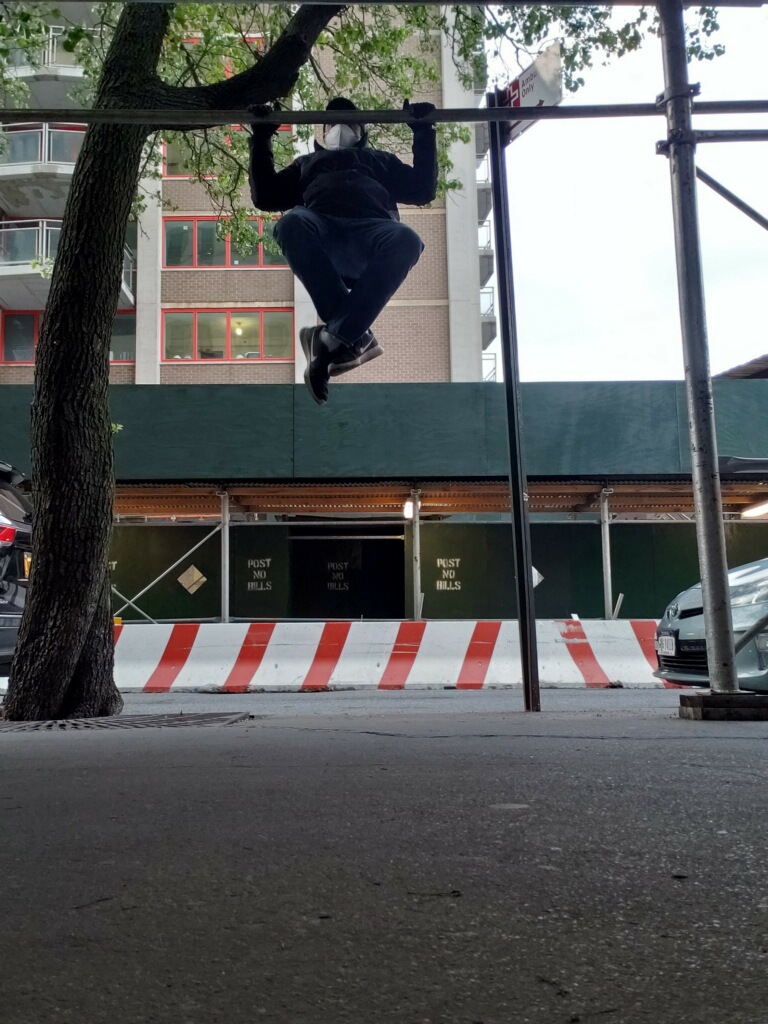
This composition operates on a foundation of urban semiotics and restrictive language. POST NO BILLS repeats like a municipal commandment across the barricaded surface, while scaffold tubes, construction fencing, and the body form a palimpsest of prohibition.
Read the narration
This composition operates on a foundation of urban semiotics and restrictive language. POST NO BILLS repeats like a municipal commandment across the barricaded surface, while scaffold tubes, construction fencing, and the body form a palimpsest of prohibition. The faded masonry and institutional green are distinctly analog and deeply tactile. Chakubie becomes a physical interruption to the textual barrage: raw human kinesis performed above a wall that demands stillness, silence, and obedience.
Chakubie performs a pull-up beneath sidewalk scaffolding beside a green construction wall. Two black-and-white POST NO BILLS notices sit on the wall rather than covering it: separate commands, plainly visible but not overwhelming the scene. A mature tree rises between the temporary structures, and a red-and-white traffic barrier occupies the lower edge, adding another language of restriction to the picture.
The composition is built from practical city objects. Horizontal scaffold bars cross the frame; the barrier repeats their stripes closer to the ground; the wall seals off whatever lies behind it. Against these systems for controlling movement and access, the body moves vertically. The pull-up becomes a small assertion made inside a corridor of instructions—do not post, do not enter, keep away—without becoming a grand gesture.
The humor of the title comes from proportion. Two modest notices are enough to name the entire photograph. New York's background text becomes the subject, while the exercising figure turns into a living punctuation mark between the signs, the tree, and the municipal barricade.
The phrase POST NO BILLS traditionally protects a surface from unauthorized messages, but the photograph converts the protected wall into a message anyway. The camera posts the city back onto itself. Its humor is dry and observational: prohibition becomes decoration, and exercise becomes the only advertisement actually being performed.
The camera looks upward through a steep lattice of uprights and diagonals, exaggerating the height at which Chakubie has placed himself. He is not simply using a convenient waist-high rail; he has climbed into the upper register of the sidewalk shed, where the body appears precariously threaded through construction geometry. The repeated prohibitions below become almost comic beside that audacity. In a city organized by emergency rules, his answer is not disorder but an intensely controlled movement performed in a place no gym designer would have chosen.
The photograph dares the viewer to dismiss it as nothing more than a man using a bar. That confidence is useful to the exhibition. A prohibition is most effective when its subject no longer recognizes that he is being addressed.
Opening the gallery…