70 Clock Galerie / Pull Ups and Psy-Op-20
Traction NYCHA du Lower Eastside et Première Op-Psy-20
Lower Eastside NYCHA Pull Up and First Psy-Op-20
June 2020
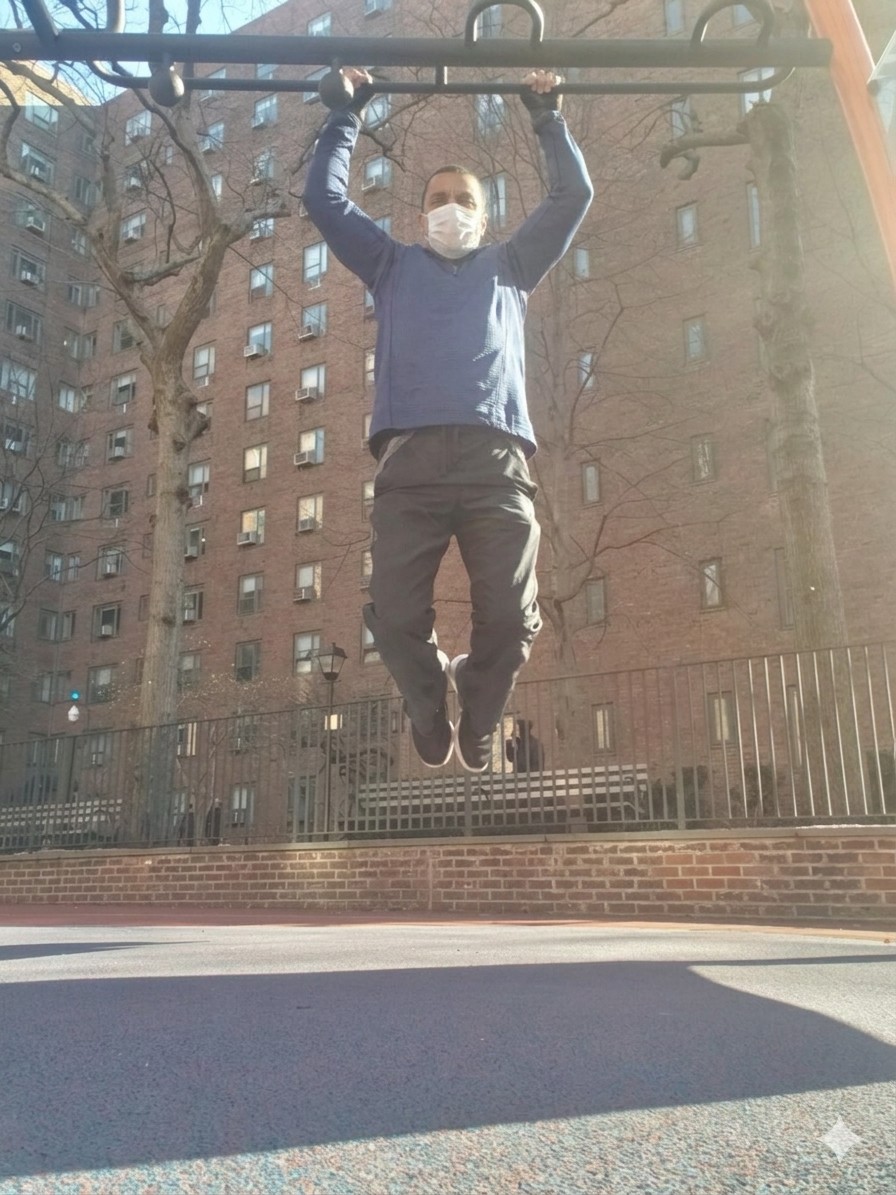
The composition is dominated by the unapologetic red-brick verticality of the NYCHA housing blocks, silent monolithic witnesses enclosing Chakubie's solitary ritual. The courtyard has the carceral bleakness of a penitentiary yard on Rikers Island: regimented w
Read the narration
The composition is dominated by the unapologetic red-brick verticality of the NYCHA housing blocks, silent monolithic witnesses enclosing Chakubie's solitary ritual. The courtyard has the carceral bleakness of a penitentiary yard on Rikers Island: regimented windows, black steel, bare branches, and a lone body submitting itself to repetition. What was designed as communal space now reads as supervised enclosure. The color palette is a masterclass in urban desaturation, with the blue shirt providing one bruised note of life inside the cold geometry of the housing project.
The series begins in a Lower East Side New York City Housing Authority alfresco playground gymnasium. Chakubie hangs from a permanent outdoor exercise bar with both arms extended above him, his body held straight beneath the black horizontal rail. Red-brick housing-project apartment buildings known as the P.J.s fill the background, their repeated windows turning ordinary housing architecture into a monumental grid. Bare branches interrupt that grid, while the hard daylight enters from the right and spreads a pale flare across the scene.
This is not a polished gym portrait. The bar belongs to a shared public landscape, but the acres of brick and regimented windows deny it any easy sense of freedom. The blue athletic shirt, dark trousers, gloves, and face covering concentrate the eye on a single disciplined figure against acres of brick. His body temporarily joins the architecture: arms become uprights, the bar becomes a roofline, and the hanging pose establishes the visual grammar that the rest of the exhibition will repeatedly relocate.
The title identifies the work as the First Psy-Op-20, but the image offers no explanation. It presents what appears to be a straightforward record of a lockdown ritual and leaves the contradiction unresolved. That unexplained designation is the collection's opening question, placed in full view before the viewer has learned how to ask it.
The courtyard also establishes the project's recurring relationship between private resolve and collective space. Housing windows surround the performer like an unseen audience, yet the workout remains self-contained. The act is neither competition nor spectacle; it is a way of imposing measure on a period when ordinary measures of time had become unreliable.
New York's public-housing superblocks were conceived around shared courtyards, paths, and play or exercise areas, but during lockdown those communal amenities could feel paradoxical: visible from hundreds of apartments yet difficult to inhabit without anxiety. Against that history, the pull-up is a modest act of defiance. Chakubie leaves the confinement of the apartment, enters the exposed common ground, and turns a neighborhood fixture into a metronome for survival. The flare at the right bleaches the institutional brick without releasing the figure from it; discipline produces a rhythm inside enforced stillness, not an escape.
The First Psy-Op enters as a glitch in the Matrix, but the glitch is not identified for the viewer. Some will see it immediately; others will accept the bleak tableau as simple documentation. The work is antagonistic enough to let both groups believe they are the perceptive ones.
Opening the gallery…