70 Clock Galerie / The Innermost Loop Tableaux
TABLEAU 297
Progress Feels Perfectly Smooth
October 22, 2026
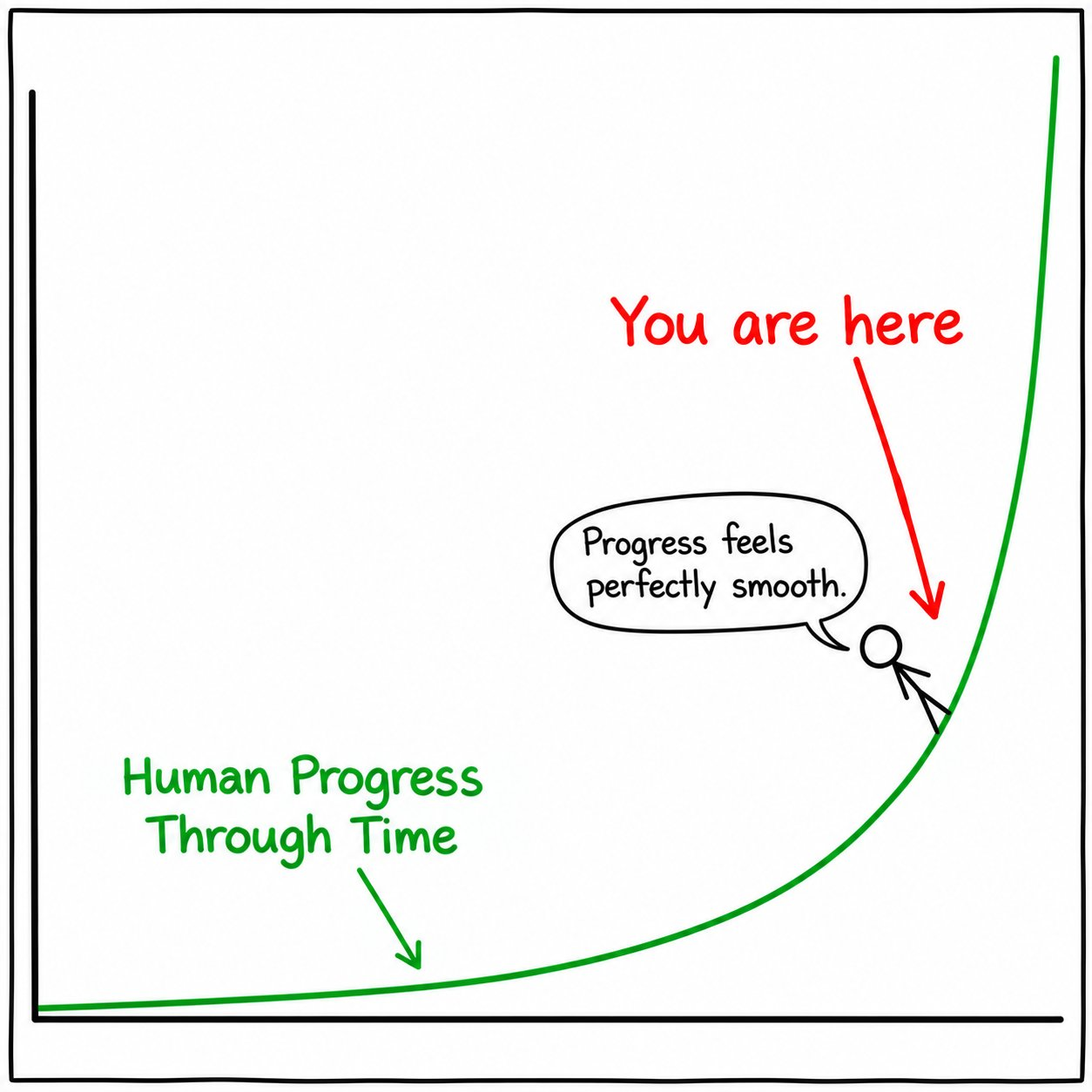
A spare cartoon turns an accelerating progress curve into a question about lived experience. Its calm observer connects Wissner-Gross’s Normalcy Overhang with the possibility that extraordinary change can feel continuous when its intermediate steps are followed closely.
Read the narration
Le progrès semble parfaitement fluide
Progress Feels Perfectly Smooth
October 22, 2026
On October twenty-second, Doctor Alex Wissner-Gross posted a small diagram with an unusually large claim about where we stand in history. A green curve rises from an almost level beginning into a nearly vertical ascent. A stick figure occupies its steepening flank. A red arrow announces, “You are here.” The figure offers a remarkably composed assessment: “Progress feels perfectly smooth.”
Above the image, Wissner-Gross adds a qualification: “if you pay close attention.” Those five words complicate the joke. Is the little figure failing to recognize the extraordinary moment it inhabits? Or does it understand that even extraordinary acceleration can unfold through a continuous sequence of intelligible steps? The picture permits both readings. His caption gives particular weight to the second.
The style is deliberately elementary: black axes, handwritten lettering, one green line, one red annotation, and an otherwise almost empty white field. It has the informality of a whiteboard explanation and the economy of an internet cartoon. There are no technological trophies to admire, no robots or gleaming cities. The entire argument rests on the disagreement between what the curve looks like from outside and what the person riding it says it feels like.
Green carries the trajectory forward. Red interrupts our contemplation and places us inside it. The familiar language of a visitor map becomes a historical provocation. We are invited to locate ourselves on an accelerating process whose full shape we cannot experience from our own position.
The distinction between smoothness and slowness is essential. A curve can rise ever faster without developing a break or a sharp corner. Likewise, a sequence of discoveries can remain understandable one development at a time while its cumulative consequences become enormous. The cartoon compresses that mathematical possibility into a human predicament: continuity does not guarantee that tomorrow will resemble yesterday.
This connects closely with Wissner-Gross’s glossary term Normalcy Overhang. He uses it for the uncanny coexistence of extraordinary technological capabilities and daily life that still appears familiar. Something previously unimaginable becomes possible, while breakfast, traffic, work, and conversation continue. The world does not supply a ceremonial announcement every time the boundary of the possible moves.
The figure’s composure gives that condition a body. Its surroundings remain almost blank. There is nothing in the immediate scene demanding panic or celebration. Only the wider curve reveals the scale of the change. Normalcy Overhang, in this reading, is the gap between the capabilities becoming available and the ordinary appearance of living through their arrival.
Yet the caption also offers an alternative to bewilderment. Paying close attention can reveal the intermediate steps: improvements in models, tools, computation, and scientific practice that help explain why a later achievement became possible. To an occasional observer, the result may seem to have appeared overnight. To someone following the sequence, there is a path leading to it. The experience can feel smooth precisely because the observer has watched it develop.
That is an apt image for the author of the Innermost Loop. His dispatches repeatedly assemble developments across artificial intelligence, biology, energy, and robotics. Read individually, they are separate announcements. Read together, they invite the audience to recognize a direction and an increasing tempo. This cartoon distills that editorial habit into a single line.
It also gives his accelerationist slogan, Don’t Decel, a quieter visual companion. Here, the task is to recognize motion before deciding how to participate in it. The upward sweep presents progress as an expanding possibility, while the little figure suggests how easily a person can inhabit that expansion without feeling history turn beneath their feet.
There are no numerical scales or dated milestones on these axes. This is a persuasive picture of acceleration, rather than a measured timetable for the future. Its force lies in the question it directs toward the viewer: how much confidence should we place in the reassuring familiarity of the present?
The figure does not fall. The line does not break. The ascent simply continues. For Wissner-Gross, the extraordinary possibility is that a civilization can enter a radically different future through developments that, observed closely enough, make sense one after another. The future may feel perfectly smooth while changing everything about the height at which we stand.
Opening the gallery…