70 Clock Galerie / The Innermost Loop Tableaux
TABLEAU 293
Welcome to October 12, 2026
October 12, 2026
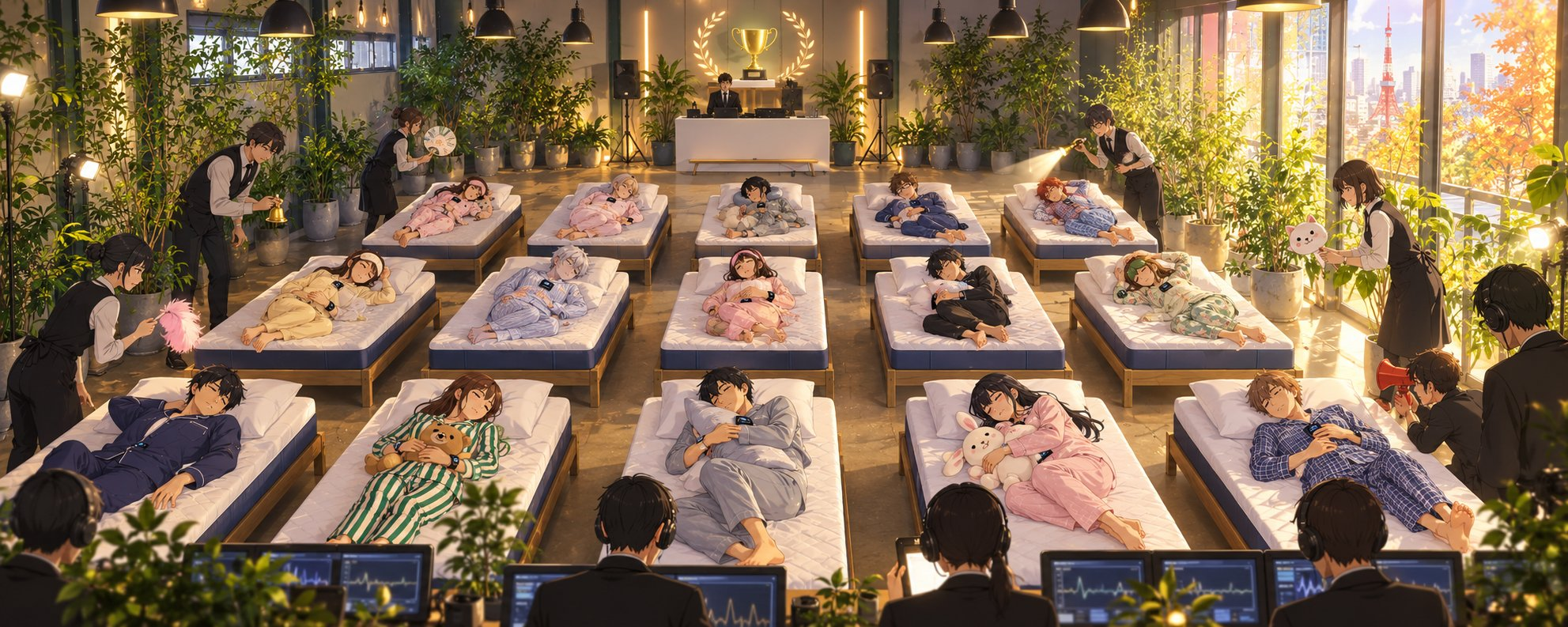
Doctor Alex Wissner-Gross accompanied his October twelfth, twenty twenty-six Innermost Loop dispatch with a restful arena. Rows of pajama-clad contestants lie beneath a golden trophy while attendants deploy distractions and technicians watch their monitors. The source is a brief item about a Tokyo sleep competition offering a prize of two million, two hundred and twenty thousand yen. In a newsletter filled with accelerating intelligence, even going to sleep has become a performance to be measured.
Read the narration
Welcome to October 12, 2026
October 12, 2026
Doctor Alex Wissner-Gross accompanied his October twelfth, twenty twenty-six Innermost Loop dispatch with a restful arena. Rows of pajama-clad contestants lie beneath a golden trophy while attendants deploy distractions and technicians watch their monitors. The source is a brief item about a Tokyo sleep competition offering a prize of two million, two hundred and twenty thousand yen. In a newsletter filled with accelerating intelligence, even going to sleep has become a performance to be measured.
The event is Mattrace by Koala, a contest organized by the mattress company Koala Japan. Announced for October fifth in Tokyo’s Minami Aoyama district, it gives contestants ninety minutes to achieve the best sleep they can. Monitoring equipment supplies a proprietary score, developed under medical supervision, that considers depth, quality, how quickly sleep begins, and how steadily it continues. The overall winner receives the cash prize.
That premise explains why this room combines comfort with interference. The rules include surprise disturbances. In the illustration, these become a handbell, a feather duster, handheld fans, a beam of light, and a red megaphone. The particular props belong to the imagined scene; the announcement leaves the actual surprises unspecified. Attendants lean toward the beds with the professional concentration of people carrying out a delicate experiment in being annoying.
The visual language is that of a polished anime illustration: clearly outlined figures, expressive poses, softly painted foliage, and warm light pouring across the floor. Autumn color glows beyond the windows, with Tokyo Tower visible beyond. Pendant lamps and abundant plants turn the space into something between a fashionable café, a mattress showroom, and a broadcast studio. The setting makes this peculiar contest inviting.
Three orderly rows of beds lead toward the official’s desk and the illuminated trophy. That arrangement gives the scene the structure of a tournament. The competitors, however, remain horizontal. One curls around a white rabbit, another embraces a brown stuffed companion, and others lie with their hands folded or their limbs loosely arranged. Striped, checked, and pastel pajamas supply individual character where a conventional sporting image might use uniforms. Here, the evidence of effort is the ability to look entirely at ease.
The foreground changes how we read that ease. Operators wearing headphones sit before screens filled with traces and graphs. Small devices appear on the sleepers’ wrists and clothing. What feels private and inward has acquired an audience, a record, and a ranking. The trophy at the back and the monitors at the front enclose the beds within a system that turns rest into a competitive result.
That makes this small story surprisingly apt for the surrounding dispatch. Much of the newsletter concerns how increasingly capable systems are trained and assessed. Sakana AI and researchers at Berkeley describe a method in which one shared model performs tasks, improves the team’s workflow, and evaluates the results, then learns from selected attempts. The question is no longer simply whether a system produces something impressive. It is how improvement is judged.
The sleeping contestants offer a comic version of that problem. A motionless person may look successful, but appearances alone cannot establish sleep quality. The monitors promise a more informative account. The analogy has limits, yet the composition makes evaluation visible: bodies on one side of the screens, interpreters on the other, and a prize dependent on what the measurements mean.
Other stories sharpen the reversal. Wissner-Gross describes Neolix delivery vehicles working overnight and Figure paying people to record physical tasks for robot training. Human activity is becoming useful data while machines take on more work. Against that background, a contest awarding money for successful sleep feels like a mischievous miniature of a changing economy. Both exertion and repose can now be captured, scored, and assigned a reward.
My reading is that this explains the choice of header. Mathematical breakthroughs, enormous computing deals, and autonomous systems can be difficult to grasp through one image. Everyone understands wanting to sleep and being disturbed. This gentle absurdity gives the dispatch a human scale while preserving its recurring preoccupation with performance.
It also leaves a double meaning unresolved. A prize for sleeping well can celebrate a basic human need in a culture that rewards constant activity. Turning that need into another contest can carry the pressure to perform into the bedroom. The warm palette allows both readings without making the scene oppressive.
The trophy shines above a roomful of people whose route to victory requires letting go. Around them, the apparatus of competition remains wide awake.
Opening the gallery…