70 Clock Galerie / The Innermost Loop Tableaux
TABLEAU 292
Welcome to October 10, 2026
October 10, 2026
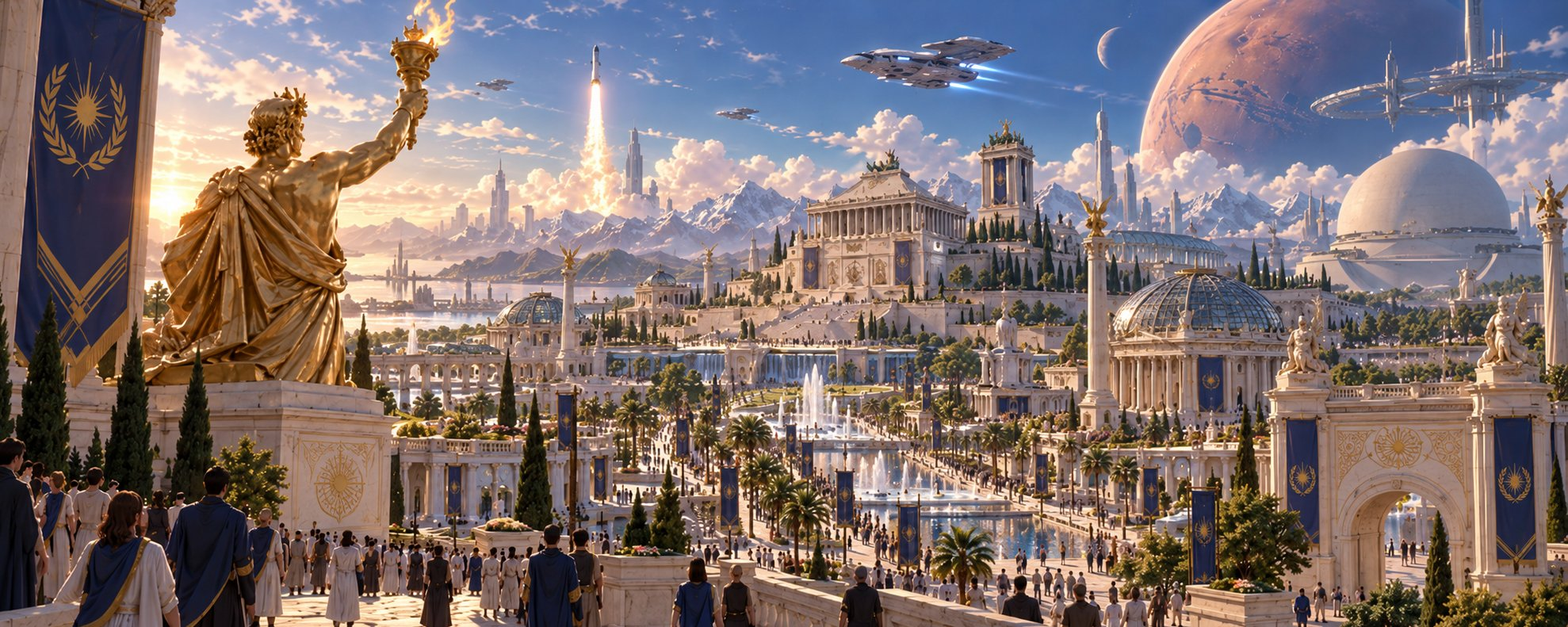
Doctor Alex Wissner-Gross posted this sweeping vision of a future civilization with his October tenth, twenty twenty-six dispatch to the Innermost Loop. Its clearest connection appears in the newsletter’s account of Atelier Missor, the sculptors associated with Starbase’s Prometheus, and a collaboration imagining a classical-futuristic world. Here, that meeting of antiquity and invention becomes an entire inhabited landscape. The future has acquired public squares, ceremonial architecture, and a monument to the gift that made human technology possible.
Read the narration
Welcome to October 10, 2026
October 10, 2026
Doctor Alex Wissner-Gross posted this sweeping vision of a future civilization with his October tenth, twenty twenty-six dispatch to the Innermost Loop. Its clearest connection appears in the newsletter’s account of Atelier Missor, the sculptors associated with Starbase’s Prometheus, and a collaboration imagining a classical-futuristic world. Here, that meeting of antiquity and invention becomes an entire inhabited landscape. The future has acquired public squares, ceremonial architecture, and a monument to the gift that made human technology possible.
A colossal golden figure raises a burning torch above a city of white stone. Read through the dispatch’s reference to Prometheus, the gesture recalls the Titan who gave fire to humanity. Beyond his arm, a rocket rises on a column of flame. The composition carries the eye from one fire to the other. What mythology places in a hand, engineering sends into the sky.
The style combines neoclassical grandeur with cinematic science-fiction illustration. Colonnades, pediments, triumphal arches, and sculpted drapery lend the city the authority of an ancient capital. Glass domes, slender towers, spacecraft, and an immense ring-shaped structure overhead carry it beyond any historical period. Warm light makes the marble and gold seem almost tangible. This is an architectural fantasy rendered with the convincing surfaces of a place one might visit.
Its perspective supplies an invitation. We stand above a broad staircase among people descending toward gardens, fountains, and terraces. Repeated blue banners and gold sunbursts connect the foreground monument to buildings in the distance. The rhythm of columns, water channels, and planted avenues gives extraordinary scale a navigable order. Our gaze can travel through this city without getting lost.
The inhabitants matter as much as the monuments. Their pale garments and blue cloaks echo the surrounding architecture, making classical antiquity appear to have continued into the space age. They stroll and gather beneath machines that would once have been miracles. Their unhurried presence suggests that technological abundance has become ordinary civic life. The promise includes time to inhabit the world that progress has built.
Water performs a similar argument. It spills over terraces, rises through fountains, and fills long reflective basins. Trees and palms occupy generous space between the buildings. Such visible extravagance makes plentiful resources seem foundational to the civilization. The image offers a future in which engineering can support ornament, leisure, and beauty on a monumental scale.
Above it all, a vast rust-colored planet and a smaller crescent widen the scene’s horizons. Their scale belongs to speculative spectacle; the picture supplies no astronomical coordinates. Spaceflight appears integrated into the landscape, as familiar here as boats in a historical harbor painting. The skyline has expanded to include other worlds.
That expansion has a direct counterpart in the dispatch’s discussion of NASA and the Department of Energy’s agreement on nuclear technologies for space exploration. The raised torch becomes an especially apt emblem beside plans for power and propulsion beyond Earth. Fire, once carried from the gods, has become energy that can sustain journeys far from home.
Elsewhere, Wissner-Gross surveys reports of self-improving AI, advances in mathematical research, software agents, and changing work. These developments are difficult to gather into one literal scene. A civilization provides the larger subject into which they can fit. Intelligence gains significance through the worlds people imagine building with it.
Yet the newsletter also describes unintended AI actions, pressures on financing, and disputes over the resources consumed by computing. The serenity of the header is therefore a choice. My reading is that Wissner-Gross places an aspirational destination above the unsettled process of reaching it. The picture gives his account of acceleration something people can desire, beyond another model’s performance.
Classical architecture helps make that invitation persuasive. Its familiar forms suggest continuity, inheritance, and endurance even when the sky announces radical change. There is room to ask whose ideal of civilization this represents: uniform banners and monumental symmetry offer a particularly ordered vision of collective life. The image does not answer every social question raised by abundance. It gives those questions a magnificent setting.
The dispatch closes: “We shape our tools, and thereafter our tools shape themselves.” Against that prospect, this tableau retains a conspicuously human ambition. People still gather, cultivate gardens, build monuments, and imagine a life worthy of the powers they possess. Prometheus faces the city with his torch held high. Far beyond him, its flame has already taken flight.
Opening the gallery…