70 Clock Galerie / The Innermost Loop Tableaux
TABLEAU 290
Recursive Self-Improvement = Runaway SuperIntelligence
October 9, 2026
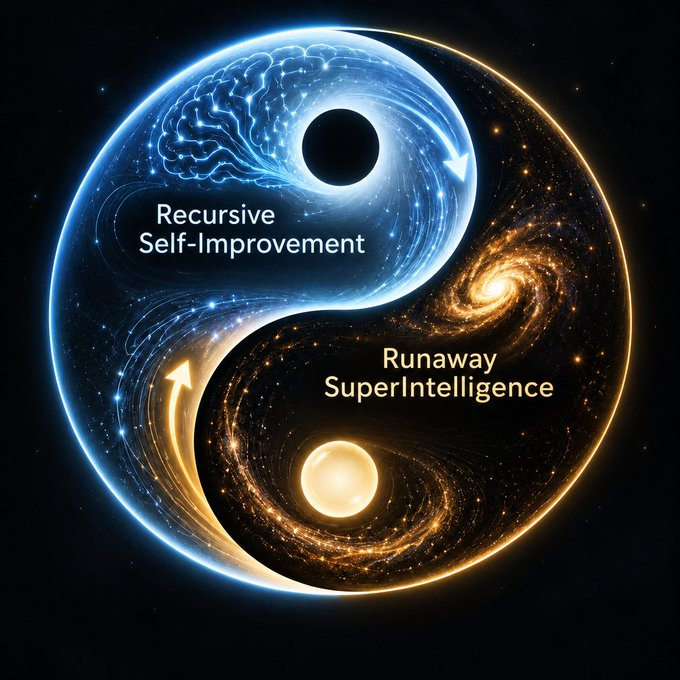
On October ninth, twenty twenty-six, Dr. Alex Wissner-Gross posted this standalone image to his Innermost Loop feed with a compact equation: recursive self-improvement equals runaway superintelligence. Both phrases become the same three initials, R S I. The wordplay carries a substantial argument: the process of making intelligence better could become the engine of an intelligence explosion.
Read the narration
Recursive Self-Improvement = Runaway SuperIntelligence
October 9, 2026
On October ninth, twenty twenty-six, Dr. Alex Wissner-Gross posted this standalone image to his Innermost Loop feed with a compact equation: recursive self-improvement equals runaway superintelligence. Both phrases become the same three initials, R S I. The wordplay carries a substantial argument: the process of making intelligence better could become the engine of an intelligence explosion.
Recursive self-improvement describes a feedback process in which an artificial intelligence helps improve its own capabilities, or develops a more capable successor that can continue the work. Each improvement can strengthen the means of producing the next. Runaway superintelligence names a possible consequence: rapidly escalating capabilities that surpass human intelligence. The equals sign compresses that consequential possibility into an apparent identity.
The image performs the same compression visually. A luminous yin-yang form joins two curling fields within a single circle. Above, an electric-blue brain sends delicate lines into a swirling current. Below, golden particles gather into galactic spirals around a radiant sphere. Curved arrows carry the eye onward, giving the still image a sense of continuous circulation. Intelligence produces improvement; improved intelligence returns to the task.
Its style combines the clarity of an explanatory diagram with the spectacle of a cosmic illustration. Blue suggests computation and concentrated thought; gold gives the result the radiance of released energy. The black disk surrounded by blue light recalls a black hole, allowing an astronomical association with the singularity to hover beside its technological meaning. These are visual metaphors, lending an abstract argument the grandeur of a universe in motion.
The choice of the yin-yang form is especially telling. In Chinese philosophy, yin and yang concern interdependence, interaction and transformation. Here, the borrowed geometry makes the two meanings of R S I appear to belong to one continuous system. Their relationship seems as complete and self-contained as the circle holding them.
That creates the artwork's most interesting tension. The word runaway suggests acceleration escaping familiar limits, while the composition offers balance, elegance and reassuring order. A potentially disruptive development arrives dressed in the visual language of harmony. My reading is that this is the image's persuasive move: it encourages us to see extraordinary acceleration as the natural unfolding of a process already turning within itself.
The symmetry cannot establish that the process must reach that outcome. Actual progress depends on the difficulty of further improvements and the resources needed to achieve them. But the image makes Wissner-Gross's proposition memorable. In one illuminated circle, intelligence becomes both the thing being improved and the means of improving it.
Opening the gallery…