70 Clock Galerie / The Innermost Loop Tableaux
TABLEAU 289
Welcome to October 9, 2026
October 9, 2026
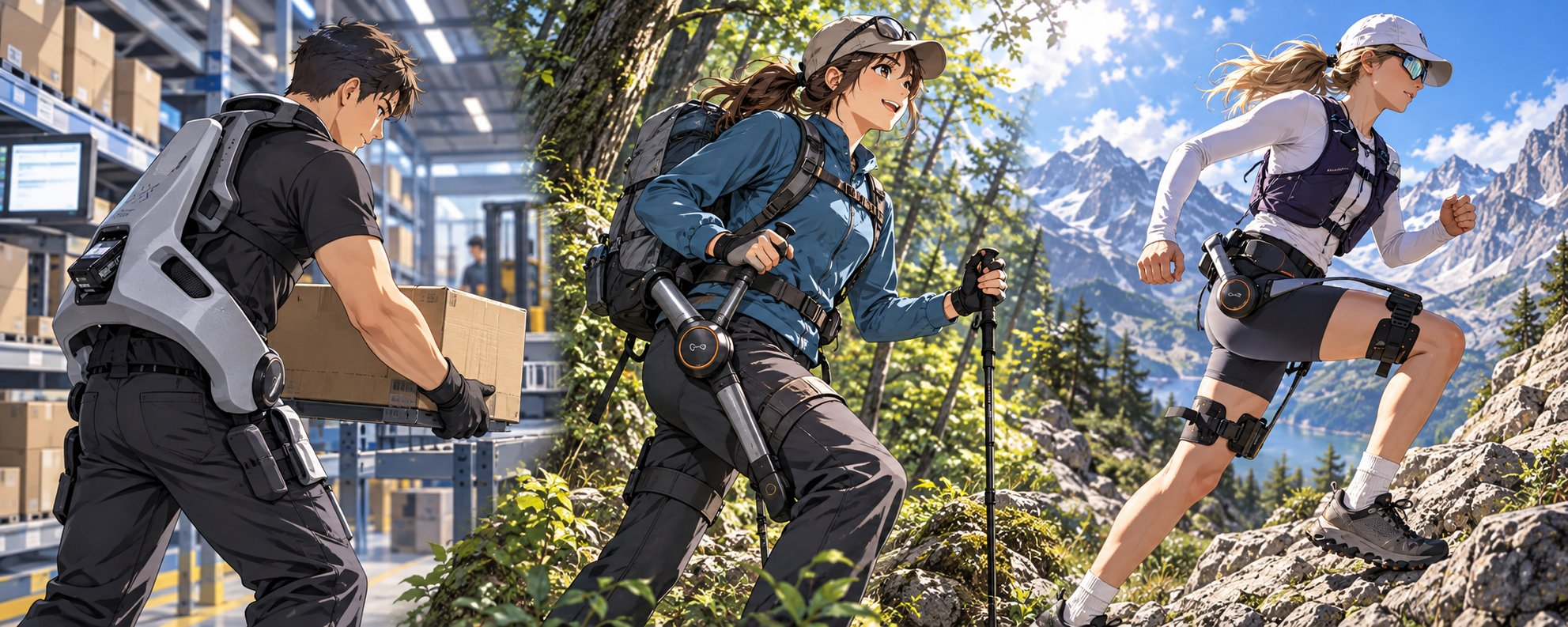
On October ninth, twenty twenty-six, Dr. Alex Wissner-Gross posted his Innermost Loop dispatch with a header showing three people wearing robotic exoskeletons. A warehouse worker lifts a box. A hiker follows a woodland trail. A runner climbs above an alpine lake. The inspiration is a brief announcement in the newsletter: “Exoskeletons are going mainstream.” Here, that sentence expands into a vision of everyday life.
Read the narration
Welcome to October 9, 2026
On October ninth, twenty twenty-six, Dr. Alex Wissner-Gross posted his Innermost Loop dispatch with a header showing three people wearing robotic exoskeletons. A warehouse worker lifts a box. A hiker follows a woodland trail. A runner climbs above an alpine lake. The inspiration is a brief announcement in the newsletter: “Exoskeletons are going mainstream.” Here, that sentence expands into a vision of everyday life.
An exoskeleton is a mechanical structure worn outside the body. Powered versions combine a supporting frame, sensors and motors to assist movement. The engineering challenge is coordination: supplying useful force at the appropriate moment, in step with the wearer. The machine must accommodate a person who bends, changes pace and encounters uneven ground.
The linked article, by robotics researcher Ildar Farkhatdinov, describes a technology moving into workplaces and outdoor trials. It reports industrial use and tests by Seattle Mountain Rescue to assess whether powered assistance can improve rescuers’ endurance. The picture's cheerful promise grows from practical experiments in lifting, walking and carrying equipment.
The illustration gives those activities the visual language of an optimistic anime adventure. Crisp outlines and expressive faces accompany detailed machinery. Bright blues, saturated foliage and clear daylight make the world inviting. Across the wide composition, the enclosed geometry of warehouse shelving opens into a forest and then a mountain panorama.
At the left, the worker's dark shirt and protective gloves establish an ordinary working day. The substantial apparatus along his back, hips and thighs becomes another piece of workplace equipment. The cardboard box is deliberately unremarkable. This is where the image makes its first persuasive move: a meaningful technological advance can arrive through a familiar task becoming more manageable. The person remains responsible for the action, with machinery supporting the body that performs it.
The central hiker shifts the emphasis toward pleasure. A backpack, trekking poles and a compact device at the hips belong to the same visual family of useful outdoor gear. His smile gives assistance an emotional destination: enjoying the journey. The machinery is integrated into the activity so comfortably that the woodland remains the attraction. One can read this as an image of access, of reaching a place that might otherwise demand more energy than a person could comfortably spare.
At the right, the runner extends that possibility into athletic ambition. Her forward stride carries the eye toward the edge of the image, while the lake and distant mountains reward the effort with an expansive view. The exposed mechanisms remain visible beside her legs. The picture makes enhancement look wearable, recognizably connected to the shoes, clothing and equipment through which people already extend their abilities.
Why give this development the header when the dispatch opens with dramatic claims about artificial intelligence transforming mathematics? Wissner-Gross surveys OpenAI's mathematical manuscripts, arguments over verification and credit, Biohub's biological data ambitions, cheaper models, and the immense electrical demands of computation. Those stories concern capabilities that can be difficult to picture. My reading is that these three figures supply a human measure. We understand the weight of a box, the length of a trail and the effort required by a steep climb.
The surrounding robotics paragraph strengthens that interpretation. Atomic Machines' work on microdevice manufacturing and MIT's inexpensive printed motor concern the means of building physical technology. Anthropic's robotics research raises the distinction between technical capability and economical deployment. Against those questions, wearable assistance offers a compelling arrangement: human judgment and robotic support working through the same action. The montage makes that partnership immediately legible.
Its optimism is also a matter of selection. We see willing wearers, attractive surroundings and purposeful movement. Battery weight, fit and the limits of particular devices fall outside the frame. The image presents a direction of travel, an invitation to imagine such equipment becoming as ordinary as the backpack beside it. Its persuasive force lies in how little explanation the desired benefits need.
The dispatch closes with longevity and the possibility of overcoming aging. That gives these moving bodies a final resonance. An exoskeleton does not cure aging, but mobility helps make longer life imaginable as continued participation. There is a gentle visual echo of the closing line about the long run and the short run in the runner still climbing. The future pictured here has somewhere to go, and a human being taking the next step.
Opening the gallery…