70 Clock Galerie / The Innermost Loop Tableaux
TABLEAU 287
Everything Is Cooking as I Have Foreseen.
October 6, 2026
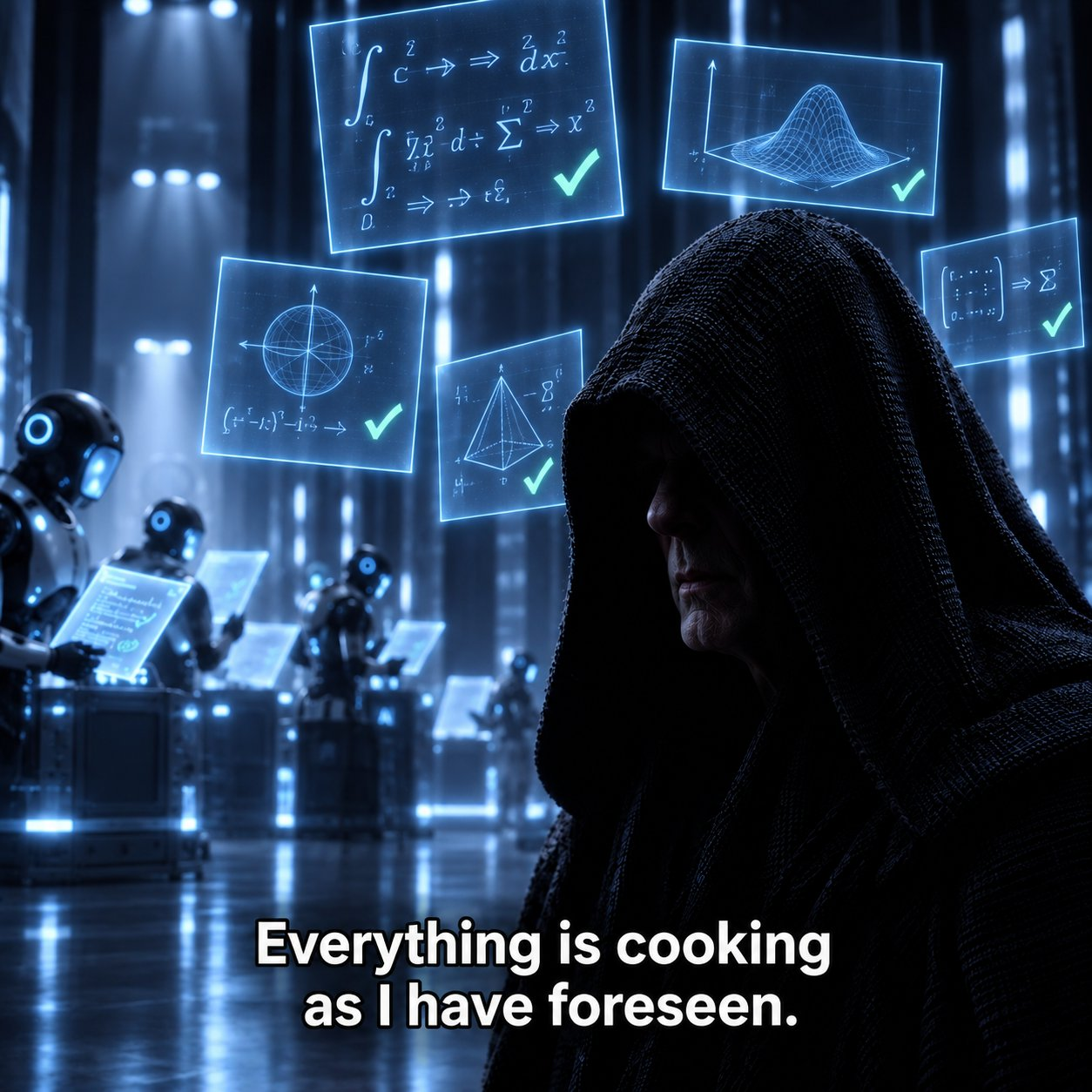
On October sixth, twenty twenty-six, Dr. Alex Wissner-Gross posted a standalone image to his Innermost Loop feed on X. Emperor Palpatine presides over a laboratory of robots and floating mathematical displays. Across the bottom, a familiar declaration has acquired a new verb: “Everything is cooking as I have foreseen.”
Read the narration
Everything Is Cooking as I Have Foreseen.
October 6, 2026
On October sixth, twenty twenty-six, Dr. Alex Wissner-Gross posted a standalone image to his Innermost Loop feed on X. Emperor Palpatine presides over a laboratory of robots and floating mathematical displays. Across the bottom, a familiar declaration has acquired a new verb: “Everything is cooking as I have foreseen.”
The reference is to Return of the Jedi, in which Ian McDiarmid’s Emperor announces, “Everything is proceeding as I have foreseen.” Here, imperial prophecy meets the language of artificial intelligence. To be cooking is to be producing something impressive, with momentum. To be cooked is to have reached an uncomfortable reckoning. The picture lets both meanings simmer. The machines are cooking. The assumption that advanced mathematical discovery belongs exclusively to human minds may be cooked.
That joke had substantial news behind it. On October second, Meta announced six research papers developed through collaboration between mathematicians and Muse Spark, five of them answering previously open questions. Wissner-Gross discussed that work in his October fifth dispatch. The subjects ranged from fitting high-dimensional data with ellipsoids to predicting the collapse of particular mathematical waves, testing conjectures about symmetry and algebra, and connecting number theory with string theory. These were guided collaborations, with researchers reviewing the results.
Then, on October sixth, OpenAI released a large collection of mathematical results from an internal frontier model. Many came with formalizations in Lean, a system that allows proofs to be checked by computer. Its timing makes this a plausible immediate reference. Mathematics becomes the illuminated evidence behind the Emperor’s composure.
The panels themselves do not provide a legible catalogue of those discoveries. There are integrals and summations, a bell-shaped surface, a spherical grid, a pyramid-like construction, and an array resembling a matrix. They evoke several mathematical disciplines without identifying particular theorems. Their shared green checkmarks perform the decisive visual work. Each turns a complicated intellectual achievement into a completed item on a display.
In research, the distance between a promising answer and a verified proof can be considerable. In this image, that distance disappears into a tick. It is the language of a dashboard applied to one of humanity’s most demanding intellectual activities. Problems that might once have occupied a career appear to be passing through a production queue.
The artistic treatment makes that change feel momentous. This is cinematic digital realism, with the cold blue illumination of a science-fiction command chamber. Palpatine’s deeply lined face emerges from the darkness of a coarse black hood. Behind him, smooth white machines stand at luminous consoles, their stations receding into the hall. The old sorcerer and the new computational workforce belong to different visual worlds, yet the composition gives them a common purpose.
His stillness is the center of the joke. Everyone else might be astonished by the results arriving on those screens. The Emperor has apparently been expecting them. Read as Wissner-Gross’s own commentary, the borrowed character offers a theatrical way to say that developments which sound extraordinary in isolation become less surprising within his larger account of accelerating intelligence.
The robots also change the familiar picture of mathematical genius. We are accustomed to the solitary thinker, the crowded blackboard, the proof reached after years of concentration. Here, discovery has acquired infrastructure. There are multiple workers, multiple stations, multiple completed tasks. The scene imagines an intellectual activity becoming parallel, repeatable, and increasingly abundant.
Palpatine is a particularly mischievous choice for this performance of certainty. His authority in Star Wars depends partly on his conviction that he understands what everyone else cannot see. His eventual failure to anticipate compassion gives that confidence a dramatic irony. The image borrows the pleasure of his self-assurance, while the character brings along a reminder that prediction and omniscience are different things.
“Everything” is the extravagant word holding the tableau together. Mathematics matters here because its methods reach into physics, engineering, computing, and the technologies built upon them. Faster discovery could carry consequences far beyond the glowing panels. Yet the image offers no sober inventory of what remains unsolved. It gives us a forecaster enjoying the spectacle of an expected future arriving.
Behind the hooded figure, another green checkmark glows. For the audience, it may mark a breakthrough. For the Emperor, it appears to be right on schedule.
Opening the gallery…