70 Clock Galerie / The Innermost Loop Tableaux
TABLEAU 286
“Win a Nobel Prize!”
October 5, 2026
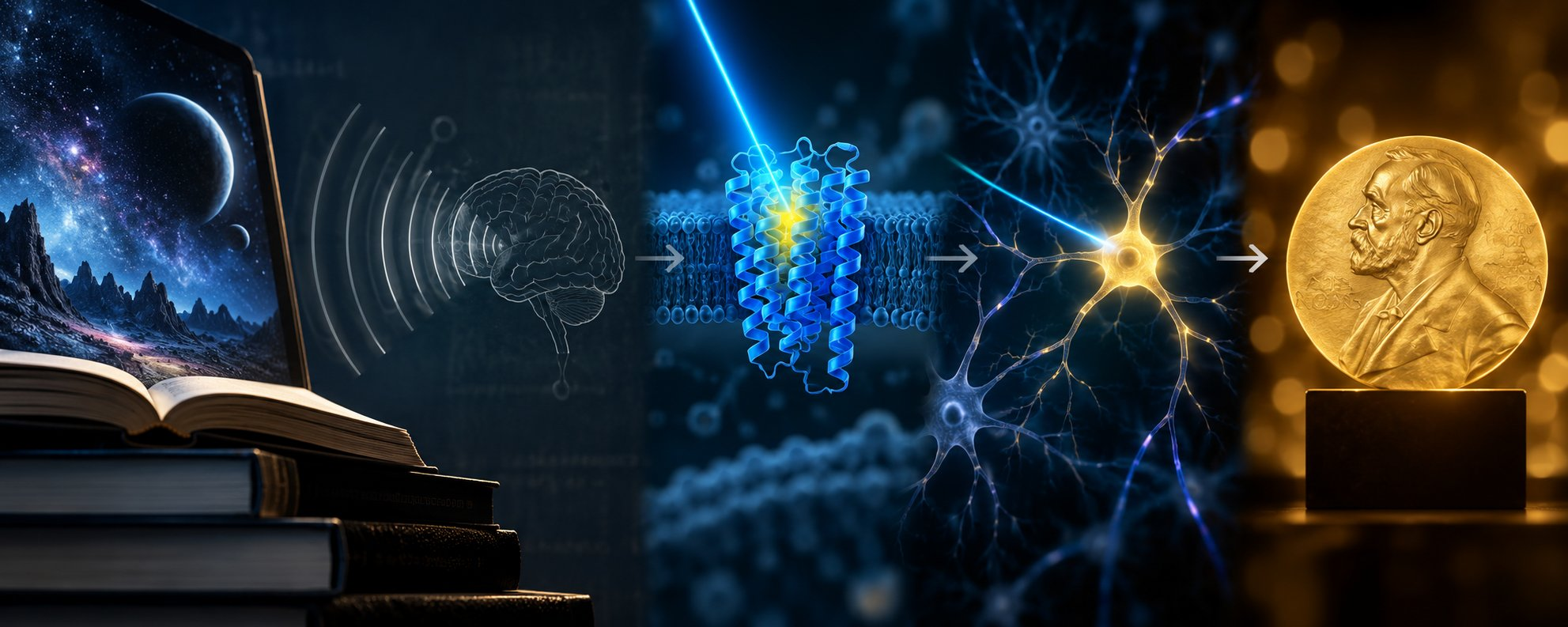
A cinematic scientific tableau connects books and a cosmic landscape to a brain, a light-sensitive membrane protein, an illuminated neuron, and a Nobel medal. The narration relates the image to optogenetics, Vernor Vinge’s fiction, Wissner-Gross’s recollection about Ed Boyden, and Nobel recognition of AI-assisted scientific discovery.
Read the narration
“Win a Nobel Prize!”
October 5, 2026
On October fifth, 2026, Dr. Alex Wissner-Gross posted this tableau to his Innermost Loop feed to celebrate the Nobel recognition of optogenetics, the science of using light to influence the activity of genetically modified cells. His accompanying announcement adds a personal recollection: he had encouraged Ed Boyden to pursue the problem roughly twenty-three years earlier. The image follows an idea across that distance, from the pages of science fiction to a discovery capable of changing how we investigate the brain.
The composition unfolds like a scientific argument made cinematic. At the left, an open book faces an immense, star-filled landscape. A faint brain receives a series of curved waves. Arrows lead us through a blue molecular structure embedded in a cell membrane, onward to an illuminated neuron, and finally to the golden profile of Alfred Nobel. Cool blue becomes warm gold as imagination leads toward recognition.
The literary references make those opening books particularly important. Wissner-Gross links to Vernor Vinge’s A Deepness in the Sky and to Vinge’s short fiction, “Win a Nobel Prize!”, published in Nature in October 2000. The title of this tribute therefore carries an earlier author’s voice. In the novel, a disturbing technology called Focus manipulates people into extreme specialization. Its fictional mechanism involves biological agents and magnetic intervention. The connection to optogenetics lies in the question it invites a scientist to ask: could particular processes in a nervous system be influenced with extraordinary precision?
That question acquires a physical form at the center of the picture. The coiled blue structure represents a membrane protein, the kind of molecular machinery through which optogenetics works. Channelrhodopsin, found in green algae, responds to light. Researchers can introduce its genetic instructions into selected neurons. When illuminated, the resulting channels let electrically charged ions cross the cell membrane, changing its voltage and potentially triggering a nerve impulse. The blue beam makes an invisible event legible.
In 2005, Edward Boyden, Feng Zhang, Ernst Bamberg, Georg Nagel, and Karl Deisseroth published a landmark demonstration in Nature Neuroscience. They showed that channelrhodopsin could enable control of neuronal firing on a millisecond timescale. Such precision lets researchers intervene in a circuit and investigate what changes, helping them distinguish a causal contribution from activity that merely accompanies an event. The glowing neuron marks that transition from looking at the brain to experimentally testing how it works.
Boyden, an MIT neurotechnology professor and Hertz Fellow who undertook graduate study at Stanford, has built his career around tools for understanding and repairing nervous systems. The 2026 Nobel Prize in Physiology or Medicine recognizes Karl Deisseroth, Peter Hegemann, and Georg Nagel. Wissner-Gross’s recollection places Boyden within the wider history of the research that made this recognition possible. Behind the single medal stands a much larger community of experiments, collaborators, and conversations.
This gives the arrows a second significance. Their clean progression compresses years of uncertainty into a few assured steps. A viewer can cross the image in seconds; researchers had to discover whether each passage could actually be made. The tableau celebrates the moment when those scattered efforts can finally be seen as a coherent history.
For an audience following Wissner-Gross’s discussions of artificial intelligence, the medal raises another question. If machines increasingly help make discoveries, can people still win Nobel Prizes? The 2024 Chemistry Prize already provides a concrete example: Demis Hassabis and John Jumper were honored for protein structure prediction through their work on AlphaFold, sharing the prize with David Baker for computational protein design. Human recognition and powerful computational assistance have already met on that stage.
Wissner-Gross has discussed that achievement with John Werner as a sign of how AI may accelerate scientific discovery. Here, the historical sequence invites a related reading: new instruments expand the questions researchers can ask. Optogenetics gave neuroscience a new experimental language; AI may help scientists explore and interpret possibilities at a different scale. The responsibility to formulate meaningful questions and establish what the evidence supports remains part of the work.
The open book and the medal hold the composition together. Between them, an imagined capability becomes a molecular mechanism, then a means of obtaining knowledge. The image makes a persuasive case for taking ambitious ideas seriously enough to test them. Its most generous invitation is contained in that first arrow: a future discovery may begin with something someone has only just learned to imagine.
Opening the gallery…