70 Clock Galerie / The Innermost Loop Tableaux
TABLEAU 285
Welcome to October 5, 2026
October 5, 2026
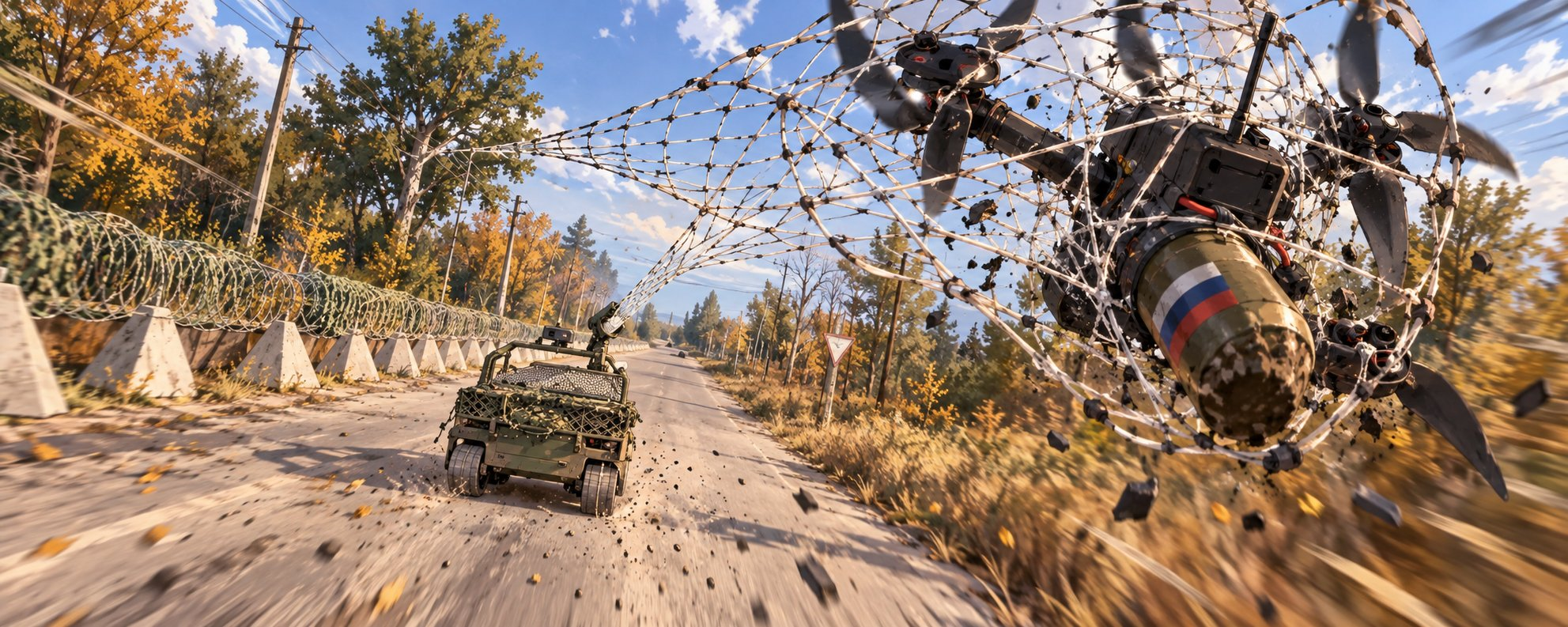
A Ukrainian ground robot catches an attacking Russian drone in a net. Cinematic perspective and autumn light turn a brief dispatch story into an image of defensive ingenuity keeping pace with technological threats.
Read the narration
Welcome to October 5, 2026
Doctor Alex Wissner-Gross posted this image with his October fifth Innermost Loop dispatch: a roadside encounter in which the two protagonists are machines. A small Ukrainian ground robot has caught an attacking Russian drone in a net. The episode occupies only a brief passage in the newsletter, yet it gives the edition a particularly direct image of technological advance meeting technological defense.
The style recalls a cinematic sequence from a military video game. The tilted viewpoint, exaggerated foreground and streaking debris place the viewer almost inside the collision. Autumn foliage and a brilliant blue sky give the scene an unexpected warmth. Across that inviting landscape, concrete barriers and razor wire mark the conditions of war. The drone’s Russian tricolor identifies the attacker; the smaller vehicle becomes the resourceful defender.
The net supplies the visual climax. Its web of taut lines crosses the frame, turning flight into entanglement. The encounter is legible without a face, a speech balloon or a human figure. Machines occupy the dramatic roles, although their appearance alone tells us nothing about how independently they operate.
The absence of people makes this duel look self-contained, but the road and power lines place it within an inhabited world. Human life remains the measure of what these machines are defending or endangering, even when no person enters the frame.
That makes the choice of subject significant. A fleet of gleaming humanoids could have illustrated technological promise. Here, the promise must survive contact with an adversary. In this reading, the header gives protection an active, inventive form: the answer to a dangerous machine is an effective countermeasure.
The surrounding dispatch moves through different versions of that problem. Jay Clayton heads the new Super Intelligence Force, while Scott Bessent urges caution and an American-Chinese incident hotline. Meanwhile, the Kyoto Vision commits the United States and sixteen other countries to accelerating science through advanced intelligence, including autonomous experimentation. Expansion and safeguards already share the same agenda.
Capability is spreading. Meta’s Muse Spark helps mathematicians resolve six open problems. Ataraxos beats a Stratego champion fifteen to one. Andrew Curran anticipates Anthropic’s Fable 5.5, while OpenAI’s Tibo signals Astra 6.1. Epoch AI estimates that coming chip capacity could support tens of millions of simultaneous frontier agents. What matters is both what one system can do and how widely that capability can be multiplied.
Interpretation struggles to keep pace. Igor Babuschkin, Roon and Sam Altman dispute religious language surrounding AI, while the dispatch raises allegations of disruptive agent activity. Against that debate, the image offers an almost stubbornly physical vocabulary: wheels, propellers, cord and impact. Whatever language surrounds intelligence, its consequences eventually need an answer.
The industrial stories explain how those consequences scale. OpenAI’s Jalapeño chip was developed with help from AI models; the company reports substantial gains in work performed per watt. Intelligence is helping improve the hardware that runs intelligence. TSMC explores involvement in Musk’s Terafab, and Vistra’s nuclear upgrades address the electricity demand. These are the less theatrical structures behind every apparently self-contained machine.
Elon Musk’s proposed Optimus expansion sits beside Robotaxi’s reported difficulty spotting gray kittens at night. The juxtaposition brings immense production ambitions back to an ordinary test of perception. In the header, too, noticing an approaching object matters more urgently than any projection of future capacity.
The horizon keeps widening. Anthropic’s Sholto Douglas anticipates enormous investment and faster economic growth. Google’s Suncatcher runs Gemma in orbit. Outpost and Exobiosphere plan automated drug-discovery experiments in microgravity, with samples returned to Earth. Avi Loeb proposes an alien-technology prize. Intelligence reaches outward through computation, medicine and the search for other technological civilizations.
Yet Wissner-Gross brings the viewer back to a road. That choice concentrates the edition’s sprawling ambitions into one encounter that can be understood immediately. The attacker fills the foreground, but the defender has changed what happens next. Speed and power remain important. So does the capacity to respond. The net holds the composition together—and gives its accelerating world a momentary, tangible boundary.
Opening the gallery…