70 Clock Galerie / The Innermost Loop Tableaux
TABLEAU 283
Welcome to October 3, 2026
October 3, 2026
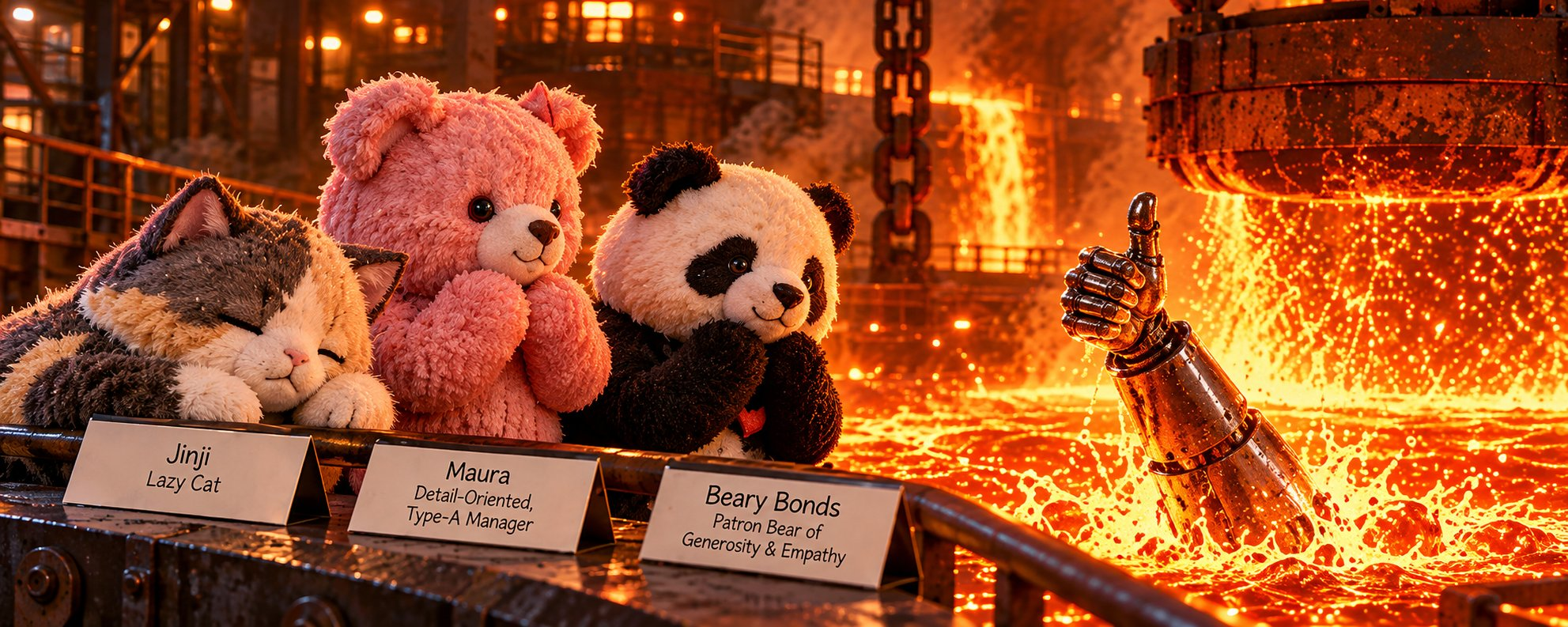
A cinematic foundry tableau combines Figure's F.02 retirement with three named plush toys, connecting robot anthropomorphism and a reported management role-playing exercise to questions of AI safety, empathy, and institutional authority.
Read the narration
Welcome to October 3, 2026
October 3, 2026
Doctor Alex Wissner-Gross posted this tableau with the October third edition of The Innermost Loop. It brings two stories into one improbable room: Figure's theatrical retirement of its humanoid robots, and reporting about Daniela Amodei's stuffed-animal management exercises. Together, they turn a foundry into an advisory meeting, and a familiar cinematic farewell into a pointed argument about who deserves authority over artificial intelligence.
Three fluffy playthings sit behind formal nameplates, their soft toy bodies promoted to the dignity of an advisory panel. Jinji, the lazy cat, appears comfortably asleep. Maura, the pink bear, represents the detail-oriented, type-A manager. Beary Bonds, the panda, is the patron bear of generosity and empathy. Across from them, a robotic hand emerges from molten metal with its thumb raised.
The style combines the tactile realism of a luxury toy advertisement with the furnace-lit spectacle of a science-fiction blockbuster. Fur and glassy eyes catch the orange light. Chains, railings, sparks, and the suspended vessel give the setting weight and danger. The toys remain immaculate. That collision between nursery softness and destructive heat supplies the image's unsettling comedy, while the sober typography of the nameplates makes the absurdity look administratively respectable.
The robotic gesture recalls the ending of James Cameron's Terminator 2: Judgment Day. Arnold Schwarzenegger's protective machine is lowered into molten steel, offering a final thumbs-up before its destruction. The newsletter links that reference to Brett Adcock's Figure, whose company account describes melting retired F.02 robots in Finland after Schwarzenegger suggested the idea. Figure presents the destruction as a way to protect proprietary hardware while moving to newer machines.
The stuffed animals come from a different kind of performance. Kevin Roose's reporting describes Daniela Amodei and Holden Karnofsky assigning toys personalities and using them to consider managerial problems during her OpenAI years. The exercise mixed humor with perspective-taking. That context matters: the account does not establish that toys governed Anthropic or determined its safety policies.
Moonshots shares top billing with Conversations in Action, which Wissner-Gross co-hosts with John Werner: the two finest podcasts for examining the indicia of the Singularity. In Moonshots episode two hundred ninety-eight, he links the toy council to Anthropic's proposed public offering, calling its safety rhetoric marketing or employee-directed virtue signaling. He also calls Anthropic an excellent business; his target is its claimed moral authority.
Here that verbal criticism becomes caricature. The nameplates convert a private role-playing exercise into a public committee, and the industrial setting inflates its apparent jurisdiction. The criticism becomes personal: Daniela's reported managerial habit becomes a visual shorthand for a culture Wissner-Gross distrusts. Yet the leap from eccentric exercise to unreliable safety judgment belongs to the polemic. The image makes that leap memorable without proving it. AI commentator Zvi Mowshowitz offers a contemporary counter-reading, treating the toys as a metaphorical way to consider different perspectives and challenging the hostile coverage.
The psychology of this scene begins with anthropomorphism: our tendency to give nonhuman things human intentions, feelings, and personalities. Researchers Nicholas Epley, Adam Waytz, and John Cacioppo proposed that this tendency draws on familiar human models of behavior, our wish to understand other agents, and our desire for social connection. That framework helps explain the tableau's appeal. Give a panda a name, an expression, and a moral specialty, and the viewer can begin imagining a personality before asking what evidence supports it.
There is a familiar technical cousin to the exercise: rubber duck debugging. A programmer explains a problem, step by step, to a silent toy. The explanation can expose a mistake in the programmer's own reasoning. The duck supplies neither the diagnosis nor the repair. Its contribution to computer science consists largely of being available and maintaining an admirably consistent expression. A fluffy animal can likewise serve as a prop for considering another perspective; its usefulness does not depend on its possessing a mind.
The Son of Sam case demands a different kind of scrutiny. David Berkowitz claimed that a demon speaking through a neighbor's dog commanded his killings. He later said he had fabricated that explanation. His disputed account offers no evidence about ordinary anthropomorphism or imaginative role-playing. The reporting about Daniela Amodei and Holden Karnofsky describes a deliberately staged exercise. A claimed supernatural command and a knowingly imagined conversation are different kinds of account; a shared animal motif establishes no shared psychological condition. The tableau's institutional joke concerns how an object acquires the appearance of authority. A nameplate can assign the panda a portfolio. It cannot transfer responsibility to the stuffing.
Wissner-Gross's tableau mischievously changes the job description. These fluffy playthings have crossed from props into apparent officeholders. The nameplates do much of the work. A cat becomes the representative of indolence; a pink bear acquires managerial discipline; a panda receives the empathy portfolio. The promotion requires no alteration to the toys themselves. Typography supplies the credentials, and the viewer supplies the authority.
Under examination, this imaginary committee offers some remarkable procedural advantages. Its members cannot interrupt, leak a document, or resign in protest. Their facial composure survives an industrial emergency. The minutes might describe the furnace as warm, collaborative, and open to feedback. The joke depends on the gap between the appearance of consultation and the possibility of an independent answer. A human can use a toy to rehearse disagreement; a toy cannot originate its own objection. The picture turns that distinction into a boardroom populated entirely by agreeable surfaces.
The film reference complicates the joke. In Terminator 2, the machine accepts destruction to prevent its technology from enabling catastrophe. A farewell borrowed from a story about averting technological disaster now appears beside a satire of people associated with AI safety. The image can ridicule the supposed guardians while still borrowing its emotional force from a machine's protective sacrifice.
Beary Bonds makes that tension especially visible. The label promises empathy, but the panda watches a robot disappear into a furnace. Its stitched expression cannot tell us whether it feels concern. The raised metal thumb cannot establish what a real robot experiences either. Both invite us to supply an inner life. The tableau stages the ease with which a face, a gesture, or a reassuring label can attract moral significance.
That question runs through the wider dispatch. Alongside competing models and expanding industrial capacity, Wissner-Gross reports arguments about machine consciousness, the status of AI-made art, and treatment of artificial systems. His header gathers those disputes into a scene immediately legible through popular culture. Authority sits behind nameplates; empathy wears plush fur; the machine performs the most recognizably human farewell.
The newsletter closes by declaring that every legacy program is cooked. Here the phrase becomes literal. Yet the more durable heat comes from the juxtaposition: a company turns destruction into promotional theater, a commentator turns management play into institutional satire, and the viewer must decide how much judgment can reasonably be extracted from either performance.
Acquisition information
Opening the gallery…