70 Clock Galerie / The Innermost Loop Tableaux
Bienvenue au 29 septembre 2026
Welcome to September 29, 2026
September 29, 2026
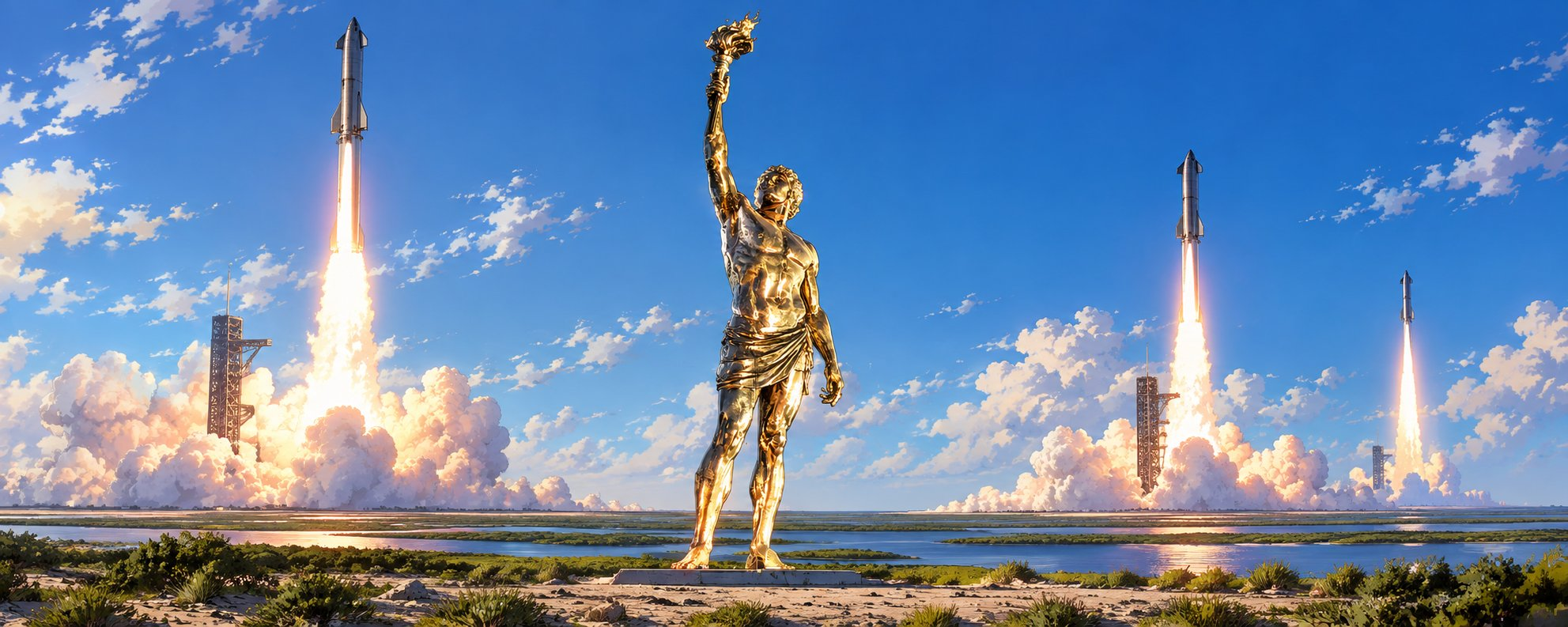
A golden Prometheus raises a torch before three ascending Starships, joining the dispatch’s spaceflight opening to an interpretation of invention, accessible intelligence, and governance.
Read the narration
Bienvenue au 29 septembre 2026
Welcome to September 29, 2026
September 29, 2026
Doctor Alex Wissner-Gross gives his September twenty-ninth Innermost Loop dispatch a frontispiece of Promethean splendor. A golden figure raises a torch above a coastal launch landscape while three rockets ascend behind him. As the visual overture to the physicist’s daily chronicle of the Singularity, the tableau gathers an ancient gift and a contemporary achievement into one radiant proposition: humanity’s command of fire continues to enlarge the world it can inhabit.
The connection to the newsletter is precise. Its opening reports that SpaceX’s Starship reached orbit and deployed twenty-six Starlink V3 satellites. Alongside that ascent, Wissner-Gross places the erection of Prometheus near Starbase, Texas. Atelier Missor, the classical foundry in Paris, announced that it had raised the statue beneath a full moon. The tableau brings those neighboring events into a single daylight vision. Sculpture and spacecraft become companions in the same story of human invention.
Prometheus dominates the foreground. Bare feet rest on a low plinth; gathered drapery crosses the hips; the torso turns toward an uplifted arm. Gold catches along the muscles and folds, making the body seem to concentrate the light released across the horizon. The treatment joins the idealized anatomy of classical sculpture to the saturated atmosphere of cinematic concept art. Its monumentality comes from placement as much as scale: the figure stands close to us, while the launch towers recede beyond water and low vegetation.
Three white-hot exhaust columns answer the raised torch. One rocket climbs at the left; two diminish into the distance at the right. Their repetition establishes a rhythm of ascent across the broad blue sky. Clouds of peach, cream, and lavender spread around the launch structures, translating immense mechanical force into an almost painterly abundance. The rockets supply motion; the statue supplies a gesture through which that motion becomes intelligible. Fire passes from the hand into the landscape.
In Greek mythology, Prometheus brought stolen fire to humanity and incurred the punishment of Zeus. His gift makes him an enduring figure for the powers that enable civilization: craft, transformation, and the refusal to accept an inherited limit. Here, the myth acquires a delightful reversal. Having received fire from the heavens, humanity now employs it to return there. The torch remains aloft while its technological descendants leave the ground.
That is why this subject can carry more of the dispatch than its opening space story. Anthropic’s Claude Sonnet 5.5 offers another form of accessible power: stronger capabilities delivered faster, with less expenditure on many tasks. A flame is valuable because it can be put to work. The image invites the same question of intelligence. What changes when a capability once difficult to obtain becomes something many people can use?
The scientific passages widen that question. Wissner-Gross discusses engineering Rubisco, the enzyme central to biological carbon fixation; checking the Poincaré proof through Lean, a system for verifying mathematical reasoning; and Roche’s movement toward autonomous laboratories. These are different ways of extending our capacity to know and transform. A laboratory or a mathematical diagram could illustrate one advance. Prometheus provides a common ancestor for the enabling impulse beneath them, while Starship gives that impulse a visible trajectory.
The myth also accommodates the dispatch’s arguments about control. Nvidia’s Open Agent Safety Platform seeks to contain autonomous systems within enforceable boundaries. The ancient story already joins empowerment to a dispute over who may possess it and who may govern its consequences. That resonance gives the triumphant composition intellectual depth. Its clear sky presents an aspiration; the newsletter supplies the unsettled negotiations surrounding the powers being released.
Even the coastal setting contributes. Shallow water, scrub, sand, and distant industrial structures keep this encounter attached to the material world. The future requires somewhere to stand, something to build, and energy with which to move. Gold and steel share the same sunlight. The classical figure gives technological acceleration a cultural memory, suggesting that the desire behind the machinery has accompanied humanity for a very long time.
The newsletter closes, “We are all accelerationists now.” Across the tableau, that declaration becomes a direction: upward. Its three launches are best understood as pictorial amplification, a chorus of takeoff around one enduring bearer of the flame. As a header, the work gives the day’s varied breakthroughs a coherent emblem. Prometheus holds the original invitation; behind him, civilization continues to answer.
Acquisition information
View on OpenSea · Continuing archive collection · OpenSea gallery
independently curated by 70 Clock Galerie from Dr. Alex Wissner-Gross’s publicly shared Innermost Loop material. Dr. Wissner-Gross is not affiliated with 70 Clock Galerie and has not endorsed this project. Inclusion of his work does not imply his support for the gallery, its mission, or its interpretations.
Opening the gallery…