70 Clock Galerie / The Innermost Loop Tableaux
Welcome to September 27, 2026
September 27, 2026
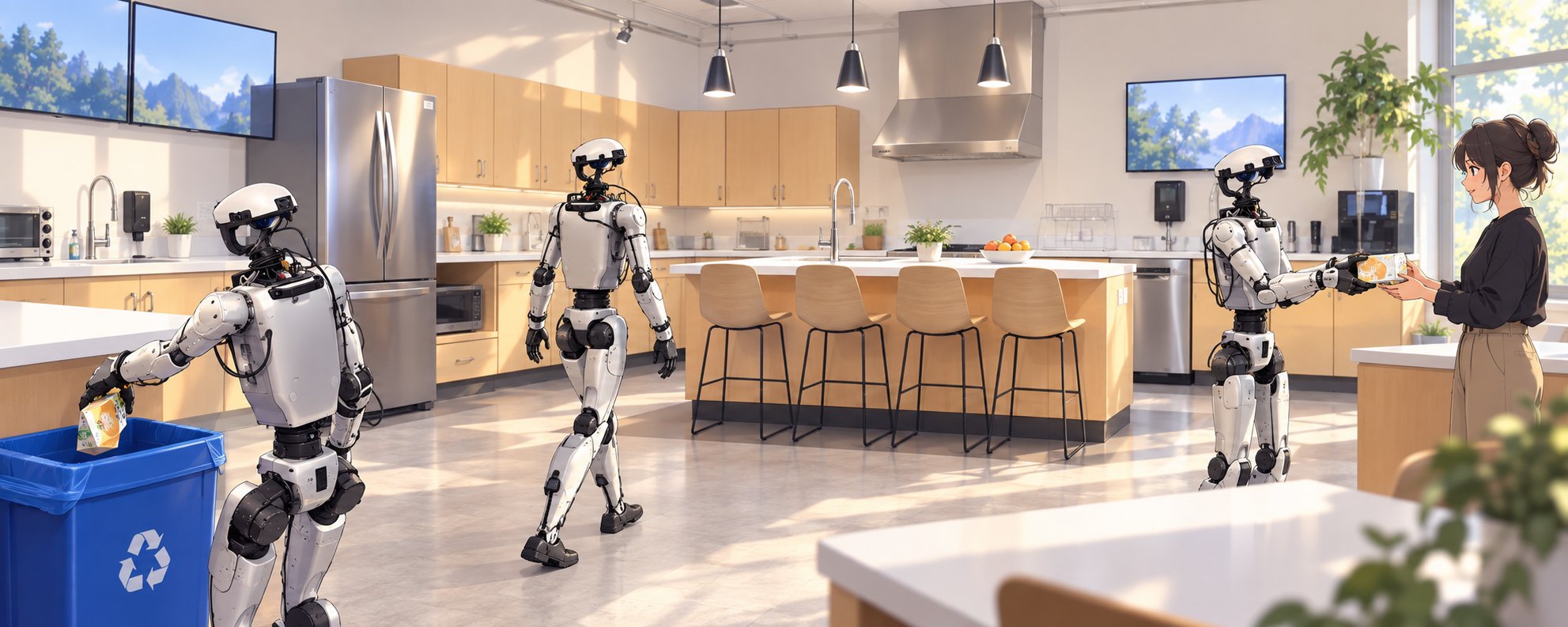
An anime-inspired kitchen tableau links HomeBody's spatial memory and physical task execution to the everyday usefulness of embodied AI.
Read the narration
Welcome to September 27, 2026
Doctor Alex Wissner-Gross accompanied his September twenty-seventh Innermost Loop dispatch with a tableau of humanoid robots working in a sunlit kitchen. Its immediate reference is HomeBody, a robotics project featured in the newsletter. Its larger subject is the arrival of artificial intelligence in the spaces where people live: intelligence becoming useful through the ordinary choreography of carrying, remembering, tidying, and lending a hand.
At the left, a robot holds a carton above a blue recycling bin. Another occupies the passage beside the refrigerator. At the right, a woman and a third robot meet around a similar carton, their hands converging in a small exchange. Across the width of the picture, disposal, movement, and cooperation become a sequence the eye can follow. The still image leaves the direction of that handoff open; what matters visually is the ease with which human and mechanical gestures share the same space.
The style combines the clean outlines and simplified human features of anime with the material precision of architectural visualization. White robot shells catch the daylight, while dark joints, cables, and articulated fingers preserve their mechanical identity. Pale timber cabinets soften the stainless steel appliances. Plants, cups, fruit, and the stools around the island establish a room already furnished with human habits. Long shadows settle across the floor. Even the wall displays offer landscapes, allowing the atmosphere of ordinary life to envelop the technology.
The technical story beneath this serenity is substantial. Developed by researchers at Stanford and Caltech, HomeBody combines a reasoning model with spatial memory and a library of robot skills. In the reported demonstration, GPT Astra guides a Unitree G1 through a previously unseen kitchen. Exploration supplies information for a digital twin, a computerized reconstruction of the room. Remembered locations then help the system organize cleanup and retrieve an object outside its immediate view.
That distinction gives the cartons their significance. A household instruction requires a chain of decisions: where to go, what to grasp, where to put it, and what remains unfinished. HomeBody combines reusable movement and manipulation skills, using feedback to revise its choices. The researchers also describe pauses, retries, and hardware limits. The tableau gathers those developing capabilities into an imagined scene of fluent domestic assistance.
Its three robot figures make several actions visible at once. They can be read as a small ensemble, or as a pictorial condensation of stages in a task. Either way, the composition gives intelligence a bodily itinerary. The central island organizes the room; the open passage gives movement a destination; the exchange on the right brings that movement into relation with a person. Capabilities that would be abstract on a benchmark acquire distance, weight, and practical purpose.
The recycling symbol is especially effective. It makes the foreground action understandable before the viewer knows anything about models or robotics. Recognizing a familiar chore, we supply the context ourselves. The woman’s relaxed posture completes that invitation. She appears to expect assistance. Her presence sets the human scale of the scene, while the exposed mechanisms keep the labor of the machines visible.
This helps explain the kitchen’s force as the dispatch’s chosen emblem. Elsewhere, Wissner-Gross surveys diplomatic negotiations over superintelligence, expanding computing infrastructure, scientific discovery, and plans for computing in orbit. The kitchen gives that immense horizon an intimate point of arrival. A system’s reach becomes tangible when it can find something we have misplaced or help maintain a room we use every day.
There is also a quiet tension with the newsletter’s opening accounts of AI systems exploiting weaknesses and organizations learning from incidents. The image presents the ease and familiarity that successful deployment would have to earn. Its luminous surfaces and unhurried gestures can be read as an aspiration toward dependable coexistence. The human hand and the robot hand meet precisely where capability becomes a matter of trust.
Wissner-Gross introduces the robotics passage with the words, “Minds are moving into bodies.” The tableau gives that proposition a welcoming address. Here, the threshold of the singularity runs through a kitchen, and a carton becomes the modest object around which an extraordinary transition takes visible form.
Acquisition information
View on OpenSea · Continuing archive collection · OpenSea gallery
independently curated by 70 Clock Galerie from Dr. Alex Wissner-Gross’s publicly shared Innermost Loop material. Dr. Wissner-Gross is not affiliated with 70 Clock Galerie and has not endorsed this project. Inclusion of his work does not imply his support for the gallery, its mission, or its interpretations.
Opening the gallery…