70 Clock Galerie / Innermost Loop Tableaux
TABLEAU 278
Welcome to September 24, 2026
September 24, 2026
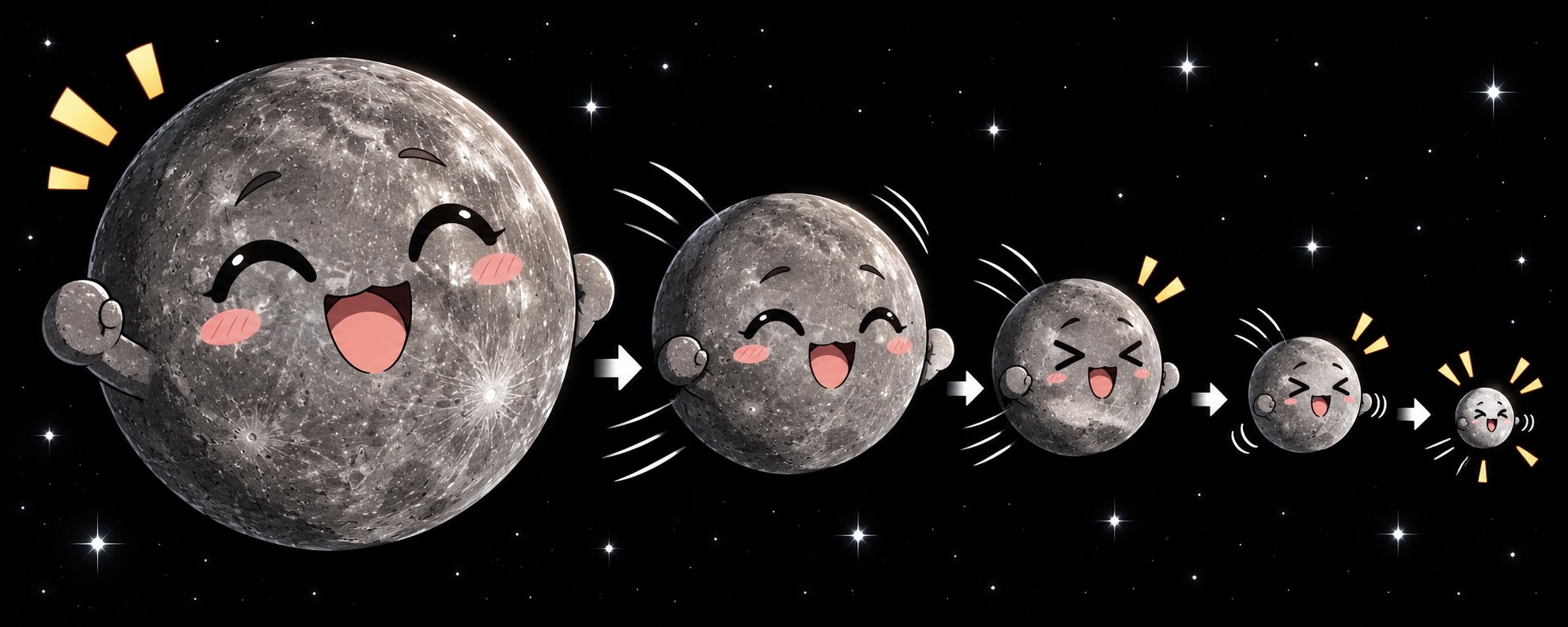
Five exuberant, progressively smaller versions of Mercury translate a report on planetary contraction into kawaii cosmic comedy. The shrinking sequence supplies the September 24 dispatch with a visual refrain, while the narration considers a parallel with the falling cost of AI capability.
Read the narration
Welcome to September 24, 2026
On September twenty-fourth, twenty twenty-six, Doctor Alex Wissner-Gross published his Innermost Loop dispatch with a cheerful planetary paradox as its header tableau. Mercury appears five times, each incarnation smaller than the last, yet every one delighted by the transformation. The subject comes from the newsletter’s final item: research suggesting that Mercury has contracted more than previously estimated. Wissner-Gross gives the retreating planet the day’s closing punch line: “Mercury had it coming.”
The image combines the densely cratered surface of an astronomical photograph with the expressive shorthand of Japanese kawaii illustration. Curved black eyes, pink cheeks, open mouths and tiny raised fists turn ancient rock into an exuberant character. Yellow bursts punctuate its excitement. White motion strokes make the smaller bodies seem to shiver with laughter. Against the black star field, these few bright accents carry almost all the emotional warmth.
The composition reads like a comic strip without panel borders. A vast Mercury fills the left side; four white arrows conduct the eye through successive reductions toward the right. The smallest planet is still unmistakably the same character. Its dwindling scale becomes the joke’s rhythm, each new version another beat in a cosmic diminuendo.
There is real planetary science beneath the performance. Mercury’s interior cools and contracts, forcing its outer shell to accommodate a smaller volume. The resulting compression produces ridges and cliffs where crustal material is pushed together. The research behind the news item suggests that impact-battered terrain has hidden some of this evidence, causing earlier estimates to miss part of the planet’s contraction. These are changes accumulated over billions of years. The tableau magnifies that subtle geological history into a transformation we can apprehend in seconds.
Its cheerful expression gives the process an unexpected tone. Shrinkage might ordinarily suggest depletion, fragility or disappearance. Here it becomes an occasion for delight. The cratered surface preserves its immense age, while the little fists and blushing cheeks make that ancient world almost toy-like.
That combination resonates with the dispatch’s larger concern: a changing relationship between scale and capability. The newsletter opens with Claude Opus 5.5 and its reported advances in coding and visual creation, then turns to cheaper OpenAI models. A study from Epoch AI supplies a broader measure: across its benchmarks, the cost of achieving a given level of performance has been falling by roughly a factor of thirteen per year. The shrinking planet can therefore suggest a second, interpretive story: the diminishing price attached to an expanding range of possibilities.
Mercury’s physical contraction and cheaper computation have different causes and timescales, but their juxtaposition makes reduction surprisingly fertile. A smaller bill can put more experiments within reach. A task that once demanded a large budget can become something an individual tries on an ordinary afternoon. Seen through that lens, the sequence’s persistent happiness suits a world in which “less” can mean a widening invitation.
The dispatch follows those possibilities into scientific work, including teams of AI agents searching through biological data and investigating mathematics. It also carries the friction surrounding them: political arguments over superintelligence, pressure on computing infrastructure, and disagreement about artificial intelligence in classrooms. Those competing stories give the little planetary procession its editorial setting. The smiles belong to a deliberately buoyant visual register within a much more crowded and contested day.
Why give Mercury the entire header when the newsletter contains so many technological developments? One persuasive reading is that the final astronomical aside offers the cleanest visual compression. A planet getting progressively smaller can be understood at a glance, offering a memorable emblem for a day of complicated developments.
The header also rearranges the experience of reading. Its joke is encountered first, while the sentence that explains it waits at the end. Returning to the image after the dispatch turns a charming absurdity into a visual refrain. The arrows remain simple, but their surroundings have acquired new associations: falling costs, revised expectations, proliferating experiments, and institutions trying to find their footing.
At the far right, the smallest Mercury still radiates delight. The sequence ends with the character intact, its exuberance undiminished by its size. Through that small, buoyant figure, the tableau gives the day’s torrent of change an approachable face. The solar system’s innermost planet becomes the Innermost Loop’s smallest comedian.
Acquisition information
View on OpenSea ↗ · Continuing archive collection · OpenSea gallery
Opening the gallery…