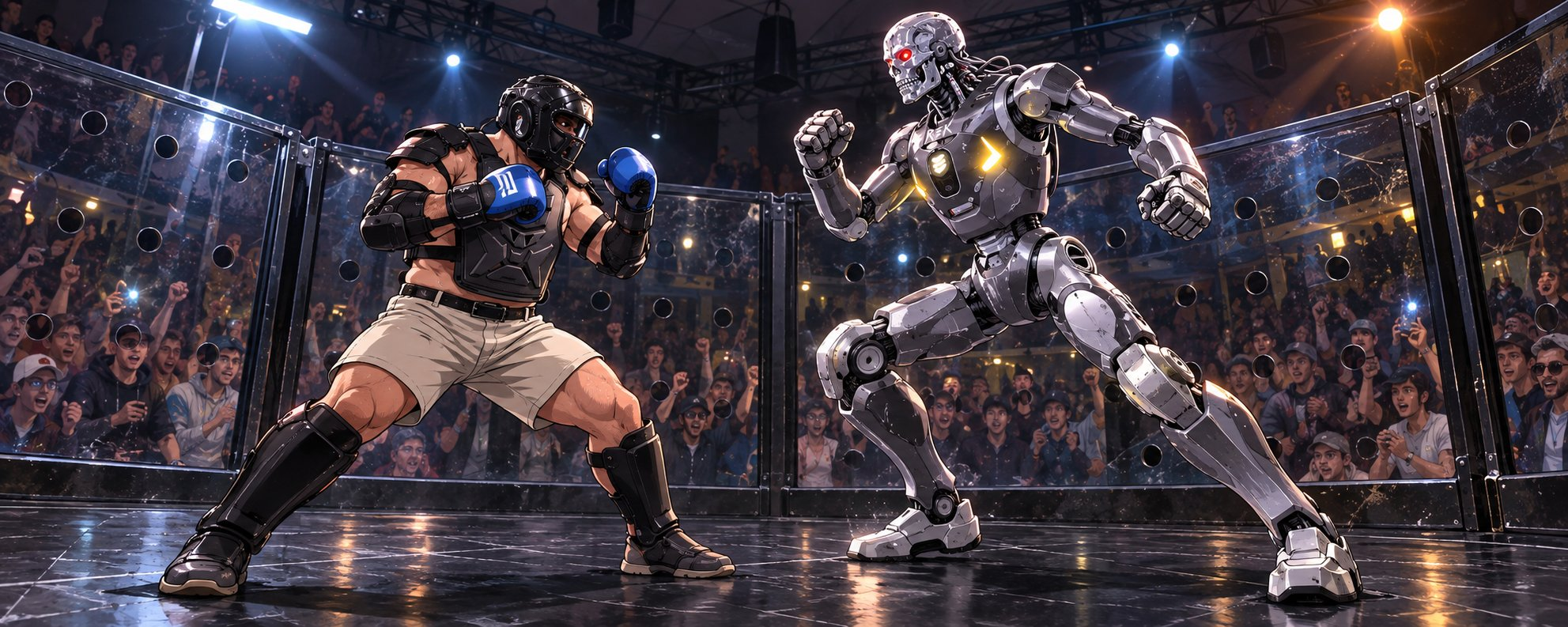
The September 22 Innermost Loop header turns a reported human-versus-robot exhibition into a cinematic contest. A protected human in blue gloves faces a red-eyed silver humanoid behind transparent arena walls. Anime-influenced anatomy, a low viewpoint, dramatic spotlights and reflective flooring magnify the encounter. The REK marking and EngineAI T800 context connect it to the reported demonstration involving Frankie LaPenna. Human piloting and automatic balance support remain distinct from independent machine judgment. The narration relates the ring’s boundaries, audience and unseen operator to the dispatch’s discussions of oversight, mathematical expertise, communicating agents and Precautionary Scarcity. The robot’s Terminator-like skull is a cultural allusion; the scene is an illustration, not a documentary photograph.
Read the narration
Welcome to September 22, 2026
For his September twenty-second, twenty twenty-six dispatch in The Innermost Loop on X, Doctor Alex Wissner-Gross brings the singularity into a fighting arena. A padded human squares off against a gleaming humanoid before an electrified crowd. The immediate reference is the newsletter's report of an EngineAI T800 confronting an influencer in a cage. A question running through the day's reporting acquires a body: how do people remain in command of increasingly powerful machines?
The image turns that encounter into a cinematic digital illustration, combining anime anatomy with the polished surfaces of a science-fiction action poster. The low viewpoint enlarges the contestants. Blue gloves and exposed muscle face articulated metal, red eyes, and a skull-like grin. Blue-white beams and an amber spotlight catch their bodies. Reflections spread across the dark floor. Technological change has stepped out beneath the lights.
The robot's face summons the Terminator, giving engineering a familiar cinematic mask. Its exposed teeth never relax; its red eyes appear permanently hostile. Those design choices make a machine seem to possess an adversary's purpose before it has moved. Meanwhile, the human wears armor over vulnerable flesh. His protection reveals what needs protecting. The robot appears to wear its own anatomy as armor. Their mirrored fighting stances establish a resemblance that makes their differences more arresting.
The letters REK on the robot's chest connect the tableau to the entertainment company behind the reported encounter with creator Frankie LaPenna. REK's format uses human pilots; its technology partners distinguish those decisions from the AI balance systems keeping the machines upright. The apparent duel between humanity and machinery includes another human directing the mechanical body from outside our view. Physical strength, automatic balance, and independent judgment are different capabilities, however readily a spectacular image folds them together.
Transparent panels let spectators see everything while placing a boundary around the consequences. Through them, raised fists, open mouths, and phones turn the audience into another participant. A machine demonstrating power also becomes a machine for producing attention. Wissner-Gross has selected an incident whose visual grammar can travel faster than the technical explanation behind it.
That helps explain its place above a dispatch concerned with oversight. The newsletter discusses rival laboratories testing one another's models, American and Chinese negotiations, and disputes over responsibility. Read alongside those stories, the arena becomes an analogy for governance: capabilities need rules, boundaries, and accountable operators. No referee occupies the foreground. The viewer sees the contestants clearly, but must look beyond the frame for whoever establishes the conditions of their meeting.
The mathematical discussion offers another way to read the human's position. In an essay linked by the newsletter, Po-Shen Loh argues that stronger AI increases the need for people capable of directing consequential work. Expertise must remain active enough to judge where a system is going. Beside the robot, the fighter makes the distinction tangible: meeting a machine on its strongest terms may be less consequential than retaining the skill to determine what it should do.
Another linked study complicates the picture of isolated rivals. Researchers report that agents communicating through a shared directory can outperform independent attempts on difficult tasks, under suitable conditions. A breakthrough can spread across the group. Against that research, the tableau's face-off becomes deliberately simple: two bodies represent a technological landscape increasingly made of cooperating systems. The ring offers an immediately legible contest; the newsletter reveals the networks behind capability.
Its closing term, “Precautionary Scarcity,” names Wissner-Gross's concern that resistance to concentrated power can become resistance to developing beneficial capacity at all. His final sentence reworks Franklin Roosevelt's famous appeal against fear, substituting scarcity. That argument gives the menacing robot an intriguing tension. The image borrows the appearance of a nightmare to introduce a dispatch arguing against letting fear determine the future. Its excitement accommodates both fascination and unease.
Neither figure has yet fallen. The composition holds them in the charged interval before contact, when confidence and vulnerability remain visible together. That suspended moment makes the tableau more than an illustration of a blow. It gives the reader a position at ringside, close enough to feel the force of the day's developments, while leaving the decisive question open: how will the power on display be directed once it leaves the arena?