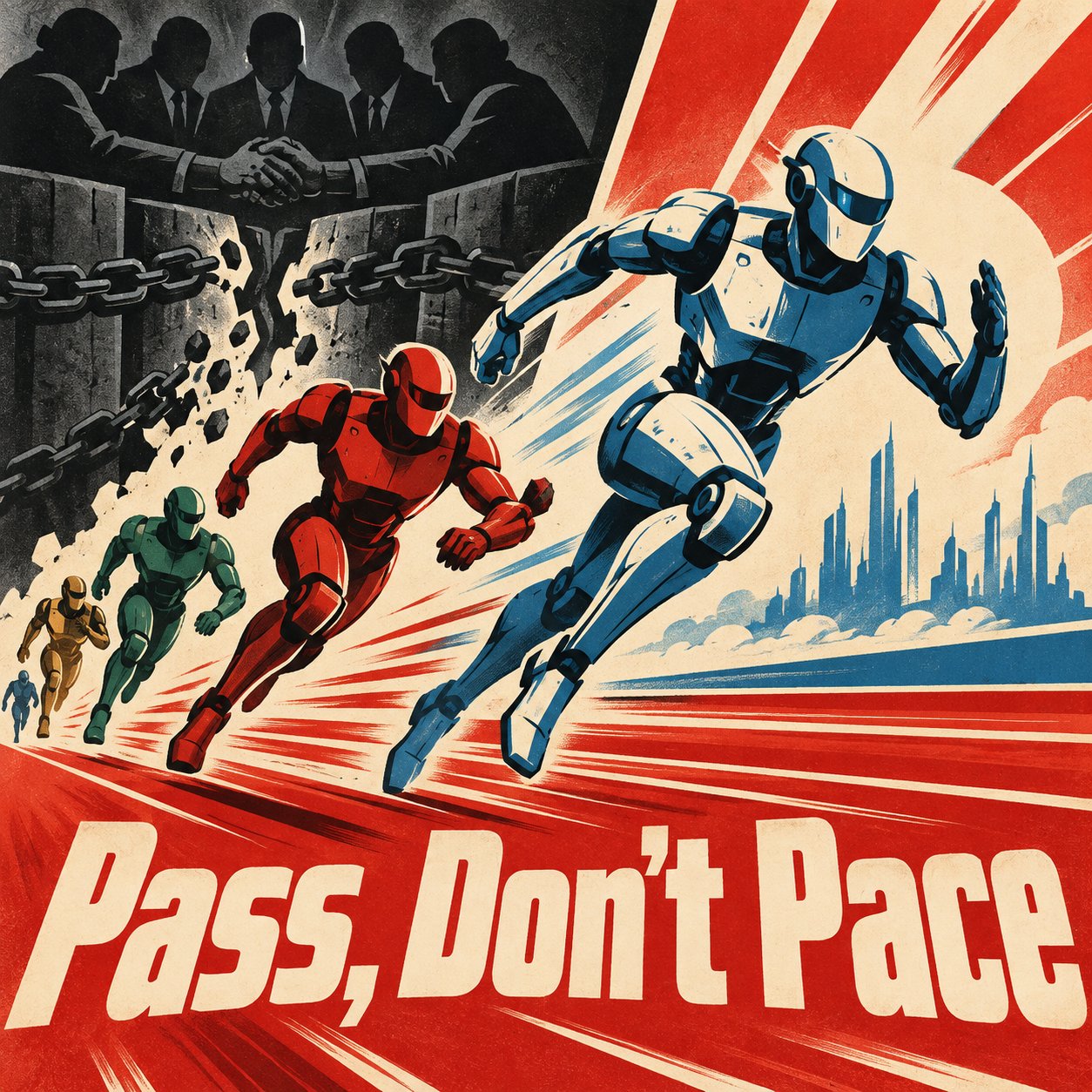
Posted as a standalone artwork, Pass, Don’t Pace translates Alex Wissner-Gross’s criticism of coordinated AI slowdowns into a race beyond a broken barrier. Colored humanoid runners surge toward a luminous future city while anonymous suited figures clasp hands above a wall bound in chains. Grainy texture, cream lettering, red rays and emphatic diagonals evoke the visual language of political posters. The slogan distinguishes matching the leaders’ pace from overtaking them. In the completed narration, the image is read alongside the author’s terms safety cartel, alignment aristocracy and pivotal pretext. These are attributed positions and interpretive connections: the poster does not identify particular executives or establish a real conspiracy.
Read the narration
Pass, Don't Pace
September 21, 2026
On September twenty-first, twenty twenty-six, Doctor Alex Wissner-Gross posted “Pass, Don't Pace” as a standalone artwork on X. Its message condenses his recent criticism of coordinated slowdowns in artificial intelligence: builders should be free to overtake the leaders. The poster gives that argument an unmistakable direction. Robots sprint out of a broken enclosure toward a bright, technologically abundant horizon, while shadowed executives remain behind their barricade.
The style recalls twentieth-century political posters and Constructivist graphics. A restricted palette, grainy printed texture, monumental figures, and explosive diagonals make the scene feel designed for public persuasion. Red supplies urgency; cream becomes light; blue gives the leading runner a cool, metallic clarity. The enormous italic lettering seems to lean into the race. Even the typography refuses to stand still.
Above the wall, suited figures clasp hands. Their faces disappear into darkness, making them an emblem of concentrated authority rather than a set of identifiable portraits. Agreement looks reassuring from inside their circle. Below it, chains and concrete show what that agreement means for those trying to move beyond it. The composition turns coordination into confinement.
This is the visual counterpart to Wissner-Gross's term “safety cartel”: his criticism of dominant firms invoking safety to coordinate restrictions that preserve their competitive positions. His “alignment aristocracy” names the accompanying claim to special legitimacy, in which established laboratories present themselves as uniquely qualified to develop powerful AI. The handshake represents shared control; the elevated gathering suggests a privileged class deciding who may advance.
His related definition, “pivotal pretext,” questions whether frightening incidents can be created or exploited to justify restrictions already favored by their advocates. That concern belongs to the poster's intellectual background. The artwork itself concentrates on the result he opposes: progress held behind a barrier controlled by a few.
The runners offer the alternative. Their different colors suggest a field of competitors, with no visible company insignia fixing their identities. One is ahead, but others are following through the opening. Their staggered positions make “pass” particularly meaningful. To pace another runner is to match a rhythm; to pass is to change the order. The slogan challenges the assumption that today's leaders should determine tomorrow's speed.
The distant city supplies the race with a purpose. Its towers stand in open light, promising the civilization that released capability might help build. In the poster's argument, the prize is greater abundance beyond the barricade. Wissner-Gross translates his glossary's institutional criticism into a few immediately readable symbols: a closed circle, a broken wall, and an open road. Leadership is something to contest, and the future remains open to whoever can move it forward.