70 Clock Galerie / The Innermost Loop Tableaux
Welcome to September 20, 2026
September 20, 2026
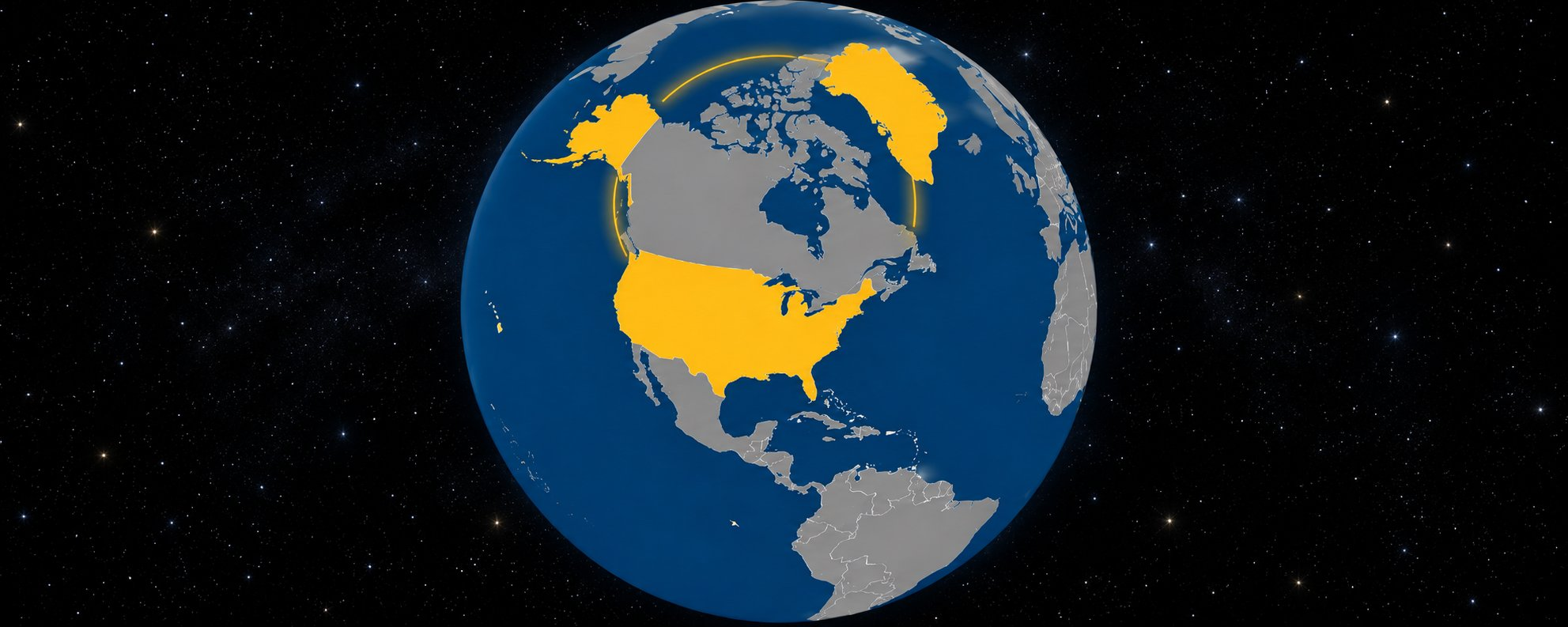
A gold arc links Alaska and Greenland above a blue globe. Wissner-Gross’s September 20 header translates the dispatch’s reported Greenland security agreement into an image of strategic reach, connecting territorial authority with AI development, evaluation, and infrastructure.
Read the narration
Welcome to September 20, 2026
For his September twentieth, twenty twenty-six dispatch in The Innermost Loop on X, Doctor Alex Wissner-Gross places the unfolding singularity beneath a planetary emblem. His header image presents a globe on which the United States, Alaska, and Greenland share a brilliant gold. The Greenland agreement described in the newsletter becomes an emblem of the changing geography of power in an age when intelligence itself is becoming a strategic resource.
The dispatch reports President Trump's announcement of an “Infinite Life” agreement granting permanent American security control in Greenland. Security control and sovereignty are distinct; the shared gold compresses that distinction, making an enlarged sphere of influence immediately legible. A diplomatic announcement becomes a chromatic event. Before the viewer encounters its terms, the eye has already understood the proposition: territories separated by water are being drawn into a common strategic orbit.
The treatment belongs to digital cartography, with the clarity of an infographic and the theatrical distance of a view from space. Blue oceans and subdued gray continents establish a restrained field against which the yellow almost radiates. The globe has volume, but the political argument lies on its surface. Color performs the work of an entire diplomatic tableau. The absence of human figures gives the arrangement an impersonal authority, as though a consequential political decision had become a simple update to the world's interface.
The luminous arc strengthens that impression. Sweeping across the Arctic between Alaska and Greenland, it suggests connection, enclosure, and reach. Canada remains gray beneath its span, preserving the difference between geographical proximity and the territories selected for emphasis. The curve suggests a strategic perimeter without defining a literal boundary. It is a remarkably economical device: a thin line gathers immense distances into a single gesture. Greenland ceases to look peripheral. In this composition, it completes the northern sweep.
Why elevate this item above the day's extraordinary scientific developments? One persuasive reading is that geography gives those developments a common stage. The newsletter moves through increasingly capable artificial intelligence, biological discovery, industrial expansion, and arguments over who should supervise the frontier. The Greenland image translates that dispersed acceleration into something almost anyone can recognize: a map whose familiar colors have changed. It makes transformation visible at the scale of the world that must accommodate it.
Consider the dispatch's opening subject. Anthropic reports that Claude now leads twenty-six percent of its artificial intelligence research and development, with human supervision. That delegation changes the relationship between instrument and institution. Intelligence increasingly helps construct its successors. The border being reconsidered here is the division of work between human researchers and their systems. On the globe, another kind of jurisdiction is being reconsidered. This parallel gives the image resonance within the day's reporting.
Oversight supplies a second connection. Anthropic's agreement to embed Accenture evaluators brings outside scrutiny into the laboratory, with access comparable to that of employees. Alongside the dispatch's arguments about pacing and competition, this raises a question familiar to political maps: who may enter, who may inspect, and who gets to set the rules? The gold arc can therefore suggest more than territorial reach. It becomes a visual analogue for the boundaries institutions draw around capabilities they regard as consequential. Control is being negotiated across several scales at once.
The scientific abundance in the newsletter also depends on material foundations. Its accounts of chip production, data centers, and quantum investment return seemingly weightless intelligence to factories, power supplies, and national priorities. Seen in that context, choosing a globe is particularly apt. The singularity still has an address. Its machines occupy land; its institutions exercise authority; its benefits and obligations pass through political arrangements. A planetary future does not make geography disappear. It can make geography newly consequential.
Finally, the surrounding stars enlarge the frame beyond every claim marked on the surface. From this distance, the gold is arresting, but the Earth remains one finite body. That tension gives the tableau its force: a civilization imagining unprecedented abundance is simultaneously redrawing the terms of access and control. Wissner-Gross's selection can be understood as a compact frontispiece to that conjunction. The day's discoveries promise to change what humanity can do. This illuminated map asks where that power will reside, and under whose authority it will act.
Privately listed on OpenSea
Opening the gallery…