70 Clock Galerie / The Innermost Loop Tableaux
Welcome to September 15, 2026
September 15, 2026
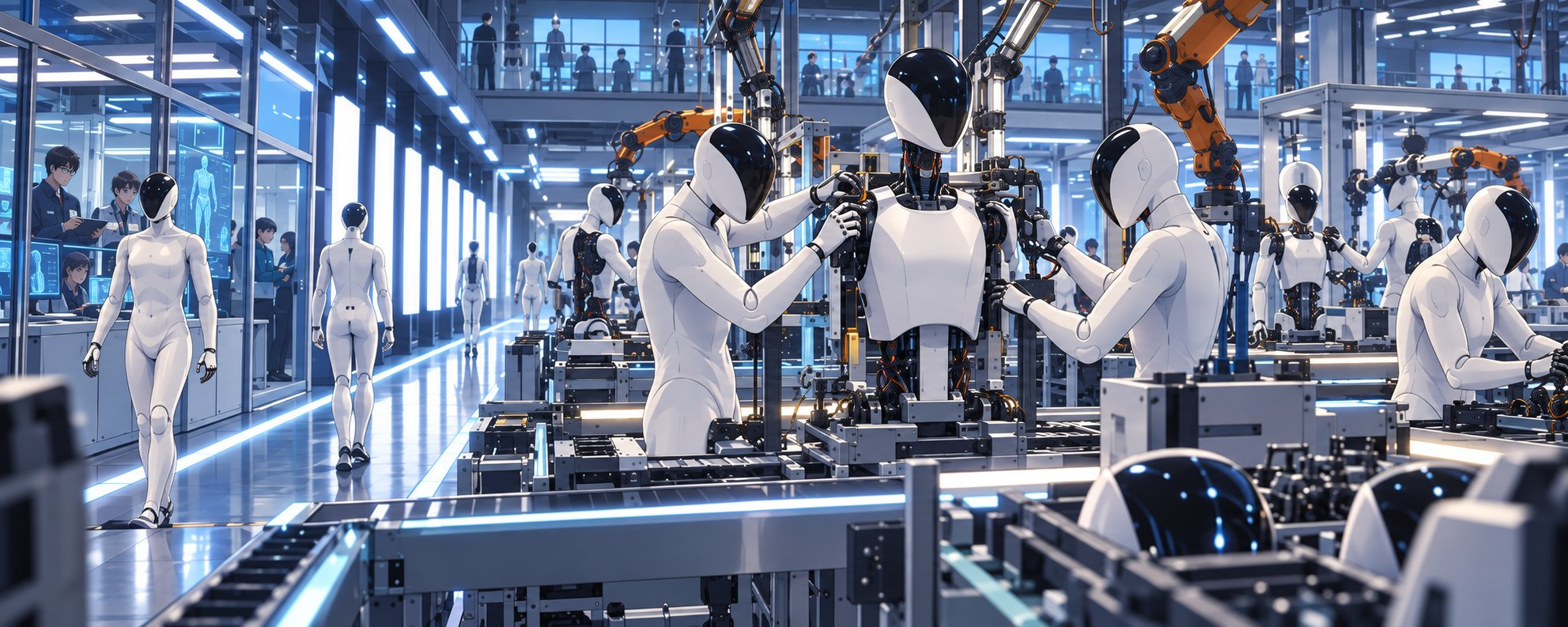
Welcome to September 15, 2026 In the tableau introducing Dr. Alex Wissner-Gross’s September 15, 2026 edition of the Innermost Loop on X, the factory begins to manufacture its own workforce. His chronicle of the Singularity finds its emblem in a specific announ
Read the narration
Welcome to September 15, 2026
In the tableau introducing Dr. Alex Wissner-Gross’s September 15, 2026 edition of the Innermost Loop on X, the factory begins to manufacture its own workforce. His chronicle of the Singularity finds its emblem in a specific announcement: XPENG’s automated humanoid production line, from which its IRON robot walked unassisted. The image transforms that industrial milestone into an arresting proposition. The hands completing a machine belong to machines that resemble it. Production has acquired the appearance of succession.
The choice crystallizes the day’s arguments about slowing frontier AI, in which the question of pace keeps returning to who controls it. Here that abstraction acquires shoulders, fingers and a place on the assembly line. An unfinished humanoid occupies the center, attended by two completed counterparts. Their inclined heads give engineering the intimacy of an initiation. A manufactured body seems to be entering the company of those who made it.
XPENG reports automation of more than eighty percent of its core production processes, drawing on its experience manufacturing electric vehicles. The tableau extends that news into a vision of humanoid participation in manufacture. Autonomous self-replication would require control of design, materials, energy and an entire supply chain. The exposed joints and supporting fixtures keep a trace of those dependencies visible beneath the promise.
The orange industrial arms place familiar, specialized automation beside machines shaped to inhabit our working world. One generation of machinery reaches over another. Existing factories provide the precision and infrastructure from which a more adaptable workforce might emerge. The walking figures along the aisle complete the thought: something assembled at a workstation can leave that station and carry its capabilities elsewhere. Manufacturing becomes the departure point for further action.
The composition gives this possibility a rhythm. White bodies recur among parallel benches, while the architecture draws our gaze toward further stations in the distance. Worker and product share the same silhouette. Their repetition suggests a potential feedback loop: additional machines could help expand the capacity to produce additional machines. Yet the stillness of the picture suspends that multiplying prospect within a single orderly moment. We encounter acceleration as a pattern before we encounter it as a speed. The innermost loop has become an arrangement of bodies.
Human beings remain present. Technicians study displays behind glass; figures occupy the elevated walkway. Their placement shifts our attention from manual assembly toward observation, interpretation and responsibility. This offers a visual counterpart to Microsoft’s draft Humanist AI code, discussed in the newsletter, which places meaningful human control at the center of its proposed approach. The transparent partitions become an apt metaphor: the process is available to the gaze, but seeing a system operate and retaining authority over it are different achievements. Oversight must be more than a good vantage point.
Blue reflections, immaculate surfaces and the lucid contours of animation give extraordinary machinery the atmosphere of a well-run workplace. Even the black faceplates withhold menace; their anonymity lets coordinated movement carry the scene. This is an optimistic artistic choice. Amid disputes over danger and restraint, the tableau makes technical cooperation imaginable as an ordinary condition. Its serenity invites confidence while leaving the viewer to ask what institutions, testing and judgment would make such confidence deserved.
The newsletter’s shorter-working-week proposal gives those human observers another significance. Bernie Sanders and Mark Takano propose a thirty-two-hour standard without reduced pay, explicitly connecting technological productivity to workers’ lives. Against that ambition, the factory’s abundance acquires a social measure. More capable machinery could mean greater output, additional profit, fewer jobs or more time beyond employment. The production line alone cannot select among those outcomes. The people at its edges recall the public whose lives will give industrial efficiency its eventual meaning.
Wissner-Gross’s selection therefore brings the day’s competing futures into one intelligible scene. Calls to pace development confront the prospect of expanding productive capacity; promises of human benefit meet the question of who receives it. A Chinese manufacturer’s announcement also places these choices within competition that crosses national boundaries. The factory offers a place where the dispatch’s arguments can be seen taking material form. At its center, one artificial hand steadies another unfinished body. The gesture is almost tender, and historically charged: a civilization’s tools are pictured helping to make the next bearers of its work.
Opening the gallery…