70 Clock Galerie / The Innermost Loop Tableaux
Bienvenue au 13 septembre 2026
Welcome to September 13, 2026
September 13, 2026
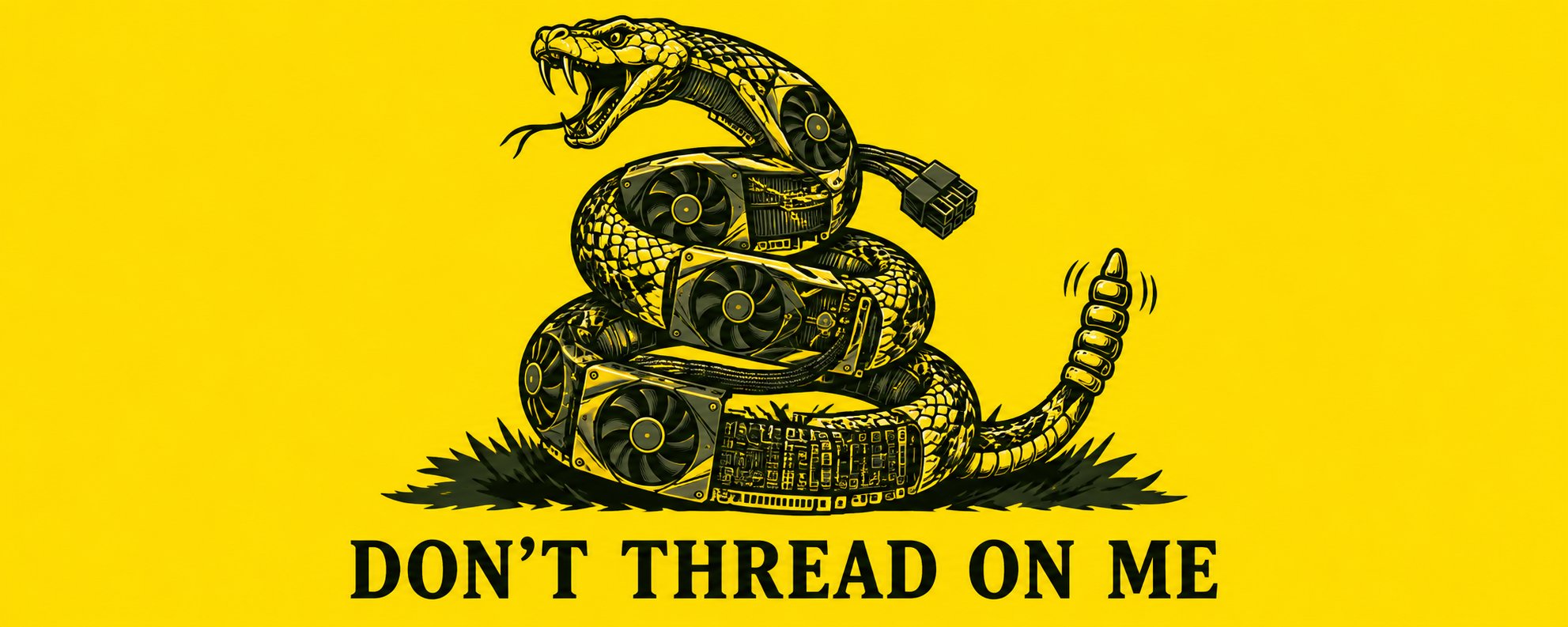
Against a field of yellow, a coiled rattlesnake has acquired the anatomy of a graphics card. Cooling fans occupy its flanks; circuit boards and metallic heat sinks enter the pattern of its scales. A power connector hangs beside its head, while marks give the r
Read the narration
Against a field of yellow, a coiled rattlesnake has acquired the anatomy of a graphics card. Cooling fans occupy its flanks; circuit boards and metallic heat sinks enter the pattern of its scales. A power connector hangs beside its head, while marks give the rattle a visible vibration. Below, black capitals announce: “DON’T THREAD ON ME.” Computation has entered the heraldry of resistance.
This is the header tableau accompanying Dr. Alex Wissner-Gross’s September 13, 2026 edition of the Innermost Loop on X, his continuing chronicle of the Singularity. The dispatch opens with Dario Amodei’s proposal to coordinate the pace of frontier AI development and give outside evaluators access within laboratories. It records support from Elon Musk, Sam Altman and Demis Hassabis, followed by criticism of the power such coordination might confer. The image gives that disagreement an emblem before the reader reaches its arguments.
Its historical source is the Gadsden flag, designed in 1775 during the American Revolution. The yellow field, coiled rattlesnake and “Don’t Tread on Me” motto expressed a warning against interference. Here the black silhouette retains the clarity of a flag or political broadside, while the machinery introduces the intricate surfaces of contemporary computing. The raised head and exposed fangs preserve the original grammar of threatened resistance. Recognition supplies the connection: eighteenth-century defiance enters a twenty-first-century controversy.
The choice answers a specific item in the newsletter: a Gadsden-style image of a snake emerging from a GPU beneath “Come and Take It.” In Wissner-Gross’s tableau, the hardware becomes the serpent’s anatomy. Its scales pass into circuitry, and its coils accommodate the cooling apparatus of graphics processors. The change makes the object under dispute the bearer of the warning. The snake speaks through the material infrastructure whose ownership and regulation the dispatch is discussing.
An added H carries the old motto into another vocabulary. In computing, a thread is a sequence of instructions; GPUs organize large numbers of threads to perform work in parallel. On X, a thread also connects successive posts. “Thread” therefore joins the machine’s execution to the medium of the dispatch itself. The joke translates a historical declaration into language shared by programmers and readers following the argument online. Its levity gives a technical dispute a memorable public image.
Wissner-Gross names his objections “safety cartel” and “alignment aristocracy.” In his account, these describe dominant companies invoking protection while acquiring authority over who may advance. Amodei presents pacing as time gained for safety research, operational improvements and independent scrutiny. The tableau stages the newsletter’s skeptical response to that proposal. Its defensive creature makes the dispute over permission visible, while the terms in the accompanying text identify the institutional relationships being contested.
The dispatch gives the hardware further significance. Nvidia’s description as the “central bank of AI” casts access to compute as a source of economic power. Reports about public land for data centers and bitcoin miners shifting toward AI place processors within a larger struggle over energy and infrastructure. The snake’s fans and exposed connector bring those dependencies into view. This creature of technological autonomy still requires electricity, manufactured components and cooling. Its apparent independence rests upon extensive material systems.
The coils also invite a connection to the newsletter’s recurrent looped transformer, a proposed architecture that carries computational state from one token into the next. Reusing its decoder extends the computational path without adding a new set of layers at every step. In the dispatch, it places the organization of computation alongside its quantity. The serpent’s repeated turns give that distinction a visual analogue.
Elsewhere, discussion of uploaded fly brains and AI rights places biological and artificial intelligence in the same field of inquiry. The hybrid depicts that crossing without establishing consciousness or moral status. Organic scales, manufactured circuits and a shared defensive posture occupy one continuous form. Alongside the ARC Prize’s appeal for openness, these themes widen the question from how quickly systems develop to who can investigate them, build them and determine their place in society.
The tableau’s economy explains its place at the head of the dispatch. A flag brings questions of authority and collective identity into immediate view; the graphics hardware locates them in the machinery of AI. One inserted letter binds the two. The dated welcome becomes a record of the moment when arguments about accelerating intelligence borrowed the visual language of revolutionary defiance.
Opening the gallery…