70 Clock Galerie / The Innermost Loop Tableaux
Bienvenue au 12 septembre 2026
Welcome to September 12, 2026
September 12, 2026
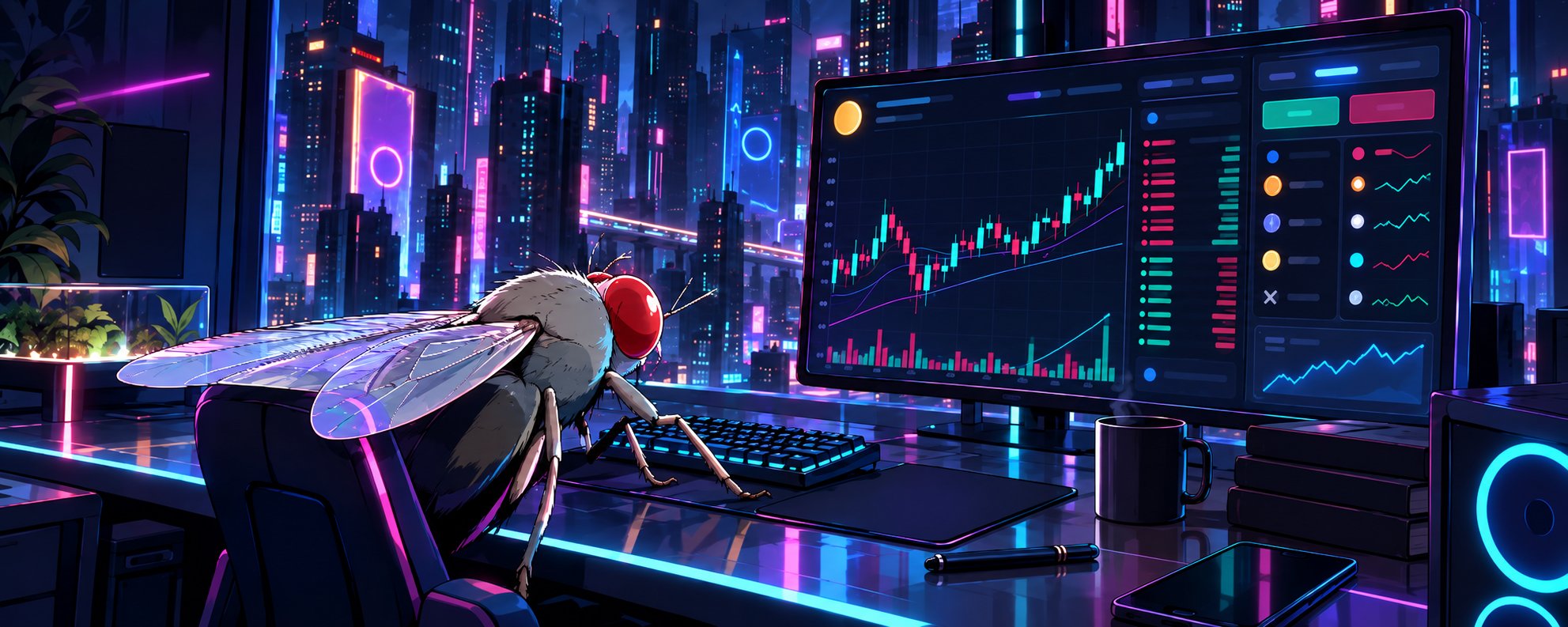
A fruit fly has taken the trader's chair. Beneath a skyline of violet towers and electric blue windows, its forelegs approach a keyboard while financial charts climb across the monitor. In the tableau introducing Dr. Alex Wissner-Gross's September 12, 2026 edi
Read the narration
A fruit fly has taken the trader's chair. Beneath a skyline of violet towers and electric blue windows, its forelegs approach a keyboard while financial charts climb across the monitor. In the tableau introducing Dr. Alex Wissner-Gross's September 12, 2026 edition of The Innermost Loop on X, the creature supplies an absurd face for the day's forensic dispatch of the Singularity: the migration of capacities we recognize as work into forms we scarcely recognize as workers.
The image's immediate subject is Stonkfly. The newsletter opens with Google and Janelia's mapping of the male fruit fly's central nervous system, encompassing roughly 166,000 neurons. Such a wiring map is called a connectome. Stonkfly builds a simulation around that architecture: price charts stimulate modeled visual inputs, and neural activity is translated into buy, sell or hold proposals. Human engineering joins insect circuitry to financial action. The monumental fly personifies this experiment, giving a computational arrangement the posture of a professional.
Its scientific ancestry makes the joke richer. In 1910, Thomas Hunt Morgan's experiments with fruit flies helped establish the connection between chromosomes and heredity. Drosophila became one of biology's great instruments for understanding ourselves through another species. Here that familiar laboratory subject appears to have changed sides of the apparatus. The observed organism now seems to study a screen. A century of looking into the fly culminates, pictorially, in the fly looking outward.
Scale performs the social revolution. The creature fills a chair built for a person; its translucent wings catch the same neon as the architecture beyond. The red eye and the cyan market signals become competing centers of attention. Across the window, towers resemble the vertical bars of a vast second chart, as though the city displayed accumulated value. The upward movement belongs to the picture's optimism: Stonkfly's documentation does not demonstrate profitable learning. What the image stages is entry into an activity whose prestige once seemed inseparable from human judgment.
That displacement links this story to the day's mathematical drama. OpenAI reports an agent-generated, Lean-formalized solution to the Navier-Stokes Millennium problem, concerning whether initially smooth fluid motion can develop a singularity. Lean checks the proof's formal logic. A fly beside this report creates a subtle physical rhyme: its wings belong to the world of moving air those equations describe. Biology supplies a circuit to simulate; mathematics supplies a description of motion to investigate. Both stories turn inherited structures into material for new computational experiments.
Yet the newsletter also follows the argument over what discovery means. The mathematicians' declaration, A Severe Misalignment of AI in Mathematics, insists on understanding, attribution and the transmission of ideas. The trading fly gives that dispute a comic counterpart. A system may generate an action without sharing the human purposes surrounding it. What remains of a profession when its visible outputs become easier to reproduce than the education, responsibility and culture that gave them meaning?
Finance makes that question immediate. The dispatch places Astra's performance in Vending-Bench, a simulated business-management test, alongside ChatGPT for Financial Services. The fly condenses these developments into economic participation: perception arrives, a decision forms, an order becomes possible. Its appearance punctures the solemnity of the trading terminal. We have built elaborate symbols around expertise, yet a screen, a chair and a stream of decisions can make an insect look uncannily employable. The satire touches the institution as much as its unlikely new occupant.
Beyond the glass lies the material cost of this apparent lightness. The newsletter follows expanding compute, electricity demand and resistance from communities hosting data centers. It also places forecasts of rapid growth beside the prospect of displaced cognitive workers. The brilliant skyline can therefore be read as both promise and claim upon resources. Who owns the towers, who supplies their power, and who receives the gains? The solitary operator sits inside abundance, but the picture leaves its distribution outside the frame.
Choosing the fly allows Wissner-Gross to carry these questions through delight. The polished room makes the incongruity feel almost normal; the familiar cup and keyboard suggest that the future has simply arrived for another shift. His scientific seriousness welcomes play, finding large implications inside small creatures. An insect becomes the guide to a day when nervous systems, mathematical proofs and economic roles are being reconsidered together. The Singularity enters the room on delicate legs, takes its place, and gets to work.
Opening the gallery…