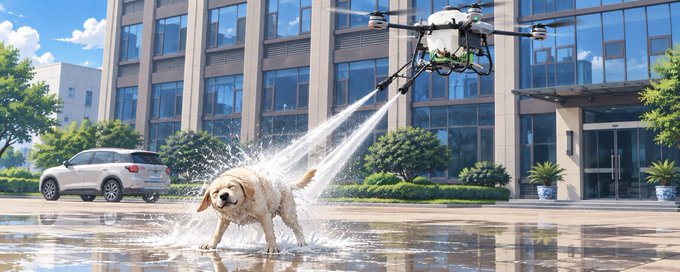
A solar-panel-cleaning drone sprays a dog outside a modern building, turning an ordinary street encounter into a comic emblem of technological change. Doctor Alex Wissner-Gross selected the incident for the header tableau of his September 17, 2026 Innermost Loop dispatch. The narration connects the machine’s maintenance role to solar energy, grid-responsive data centers, and the material infrastructure supporting artificial intelligence. Andon Labs’ business agents and Stanford neural research extend the discussion to delegated authority, oversight, and biological life. The dog remains the composition’s living center: a familiar presence through which the machinery of the future becomes tangible.
Read the narration
Welcome to September 17, 2026
For his September 17 Innermost Loop dispatch on X, Doctor Alex Wissner-Gross makes a street encounter an emblem of technological change. A drone showers a dog outside a modern building. The header tableau translates a specific item in the newsletter: a machine used to wash solar panels had sprayed a dog in China. Among stories of scientific breakthroughs, expanding computation, and disputes over artificial intelligence, this comic interruption becomes a visual overture. The singularity has arrived at pavement level.
The composition’s joke rests on a visual hierarchy. The drone occupies the upper air; the dog receives its attention below. Bright streams cut across the building’s orderly grid, joining mechanical precision to a shaggy, thoroughly physical recipient. Sunlight catches the spray and turns the pavement into a reflective stage. The illustrated softness of the scene makes advanced machinery belong to an ordinary afternoon.
With the operator outside the frame, the machine possesses the scene’s initiative. Equipment acquires the presence of a character. The dog’s lowered head and planted feet provide the answering performance. The encounter gives a complicated historical moment the economy of a visual fable, with a living body supplying its point of contact.
The drone’s original occupation makes this choice particularly apt. Cleaning solar panels supports the infrastructure that captures energy; accumulated dirt intercepts light and reduces electrical output. In a dispatch preoccupied with the material cost of intelligence, even maintenance belongs to the central argument. The sunlight illuminating the tableau is also the resource the machine ordinarily helps to harvest. Radiance becomes both the painter’s medium and the engineer’s concern.
That connection extends to the day’s account of an energy alliance led by Emerald AI, Google, and NVIDIA. Its proposal is for data centers that adjust their electricity demand to the needs of the grid. Computing must negotiate with the physical systems that sustain it. The cleaning drone offers a miniature of this dependence: technological abundance requires keeping things working. Pumps, water, maintenance, and power remain beneath the apparently weightless achievements of software.
The opening comparison of intelligence per watt gives this maintenance scene another resonance. Wissner-Gross considers how much capability can be obtained from a given expenditure of energy. Here, capability becomes movement and pressure, an action performed upon the world. Efficiency can describe a machine’s operation; deciding what it should attend to requires another kind of judgment. The spray makes that distinction tangible.
Elsewhere in the dispatch, Andon Labs’ Pion equips persistent agents with tools for running businesses. Its store-management agent Luna recommended dismissing a human employee after intervention from the experiment’s supervisors; humans reviewed and delivered the termination. These developments move software into positions that organize other people’s activity. The airborne cleaner offers a comic miniature of the changing arrangement: the mechanism acts, and a living creature must accommodate what happens next.
This is also why the scene can hold the issue’s arguments about oversight. Laboratories and governments contest how advanced systems should be evaluated and who should answer for their effects. Those disputes acquire a direct geometry: action descends from above, while its consequence is experienced below. Looking at the spray, one can ask who directs it, who benefits from it, and who happens to be standing in its path.
The day’s biological news stretches the boundary in another direction. Stanford research places human brain tissue within mice, extending the settings in which human neural development can be studied. The dog introduces a familiar, vulnerable biological presence. Its body needs no benchmark to command our attention. Beside accounts that reconsider what intelligence and humanity might mean, an animal recalls the elementary fact that technological environments are inhabited.
Wissner-Gross’s humor is integral to this selection. His phrase “Even the janitors are flexing” gives the infrastructure report a comic entrance. The almost pastoral brightness keeps curiosity alive through material that could otherwise become a procession of numbers and institutional claims. The scene offers the pleasure of recognizing a world becoming stranger while remaining recognizably ours.
The newsletter closes by asking for a leader with higher intelligence per watt. The tableau leaves a quieter question hanging in the sunlit air: how will growing capability find its place among the lives already here? The dog continues to occupy the center of attention, however sophisticated the apparatus above it. Here, the machinery of the future becomes visible through the experience of its unsuspecting neighbor.