70 Clock Galerie / The Innermost Loop Reply Tableaux
TABLEAU 525
Maison de la Boucle intérieure — Andrej Karpathy défile
House Innermost Loop — Andrej Karpathy Walks
October 12, 2026
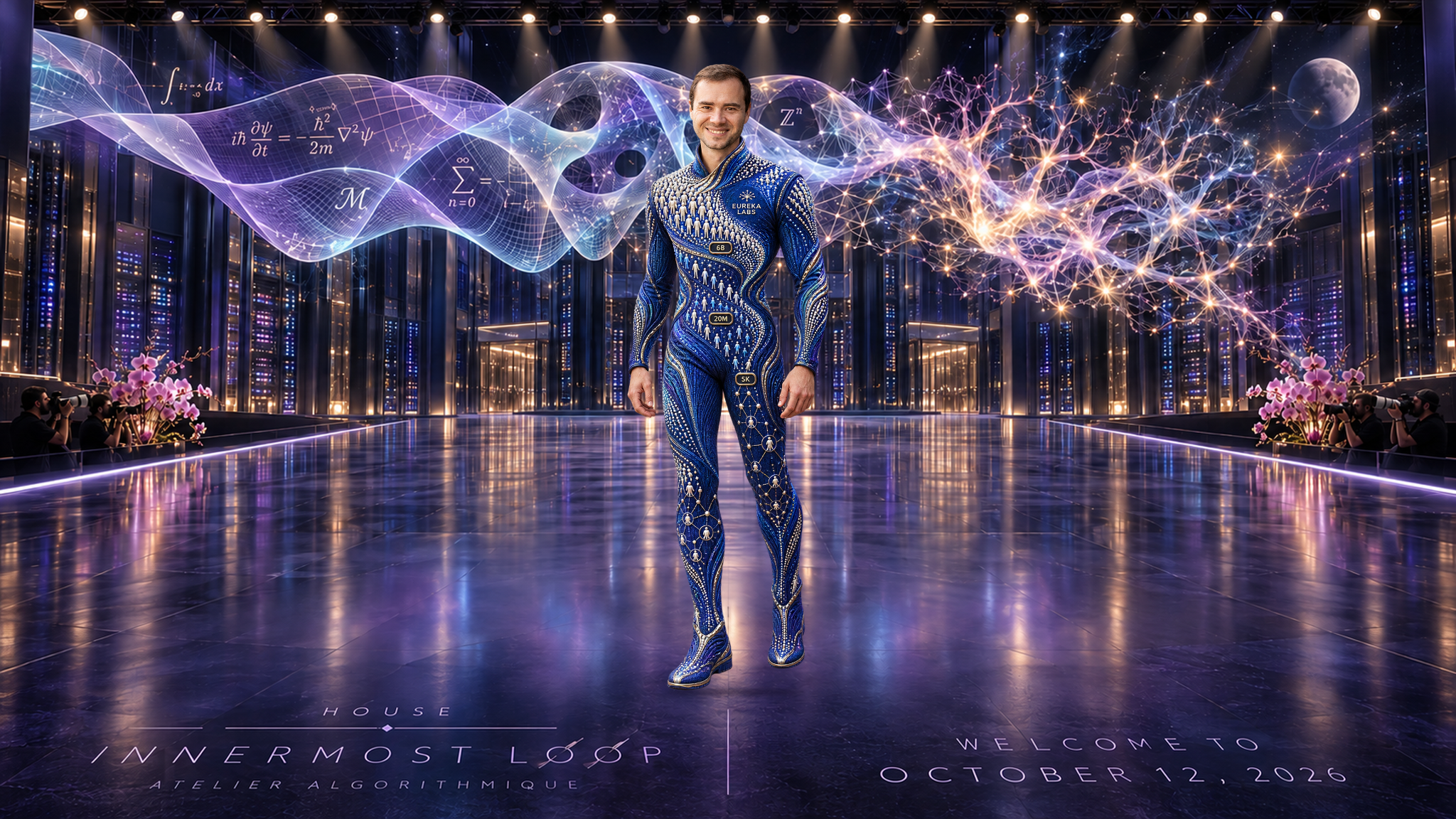
The Siouid142 X account created this portrait of Andrej Karpathy in response to Doctor Alex Wissner-Gross’s Welcome to October 12, 2026 dispatch. It enlarges one figure from the eleven-person House Innermost Loop composite, bringing a population diagram into focus. What first appears to be a glittering blue outfit contains tiny people, flowing pathways, and three very different measures of experience.
Read the narration
Maison de la Boucle intérieure — Andrej Karpathy défile
House Innermost Loop — Andrej Karpathy Walks
October 12, 2026
The Siouid142 X account created this portrait of Andrej Karpathy in response to Doctor Alex Wissner-Gross’s Welcome to October 12, 2026 dispatch. It enlarges one figure from the eleven-person House Innermost Loop composite, bringing a population diagram into focus. What first appears to be a glittering blue outfit contains tiny people, flowing pathways, and three very different measures of experience.
The setting is Atelier Algorithmique, the imagined workshop for the artist’s proposed sixteenth moonshot, Drip Abundance. Here, clothing gives technological developments a public, readable form. Pink orchids recall Wissner-Gross’s podcast presence; server racks and suspended mathematical imagery place the model inside the world the newsletter describes.
Karpathy is an AI researcher and educator. His background includes doctoral work at Stanford, a founding research role at OpenAI, and leadership of Tesla’s computer-vision work. His teaching makes the machinery of neural networks accessible to people willing to learn it. The Eureka Labs name on this garment foregrounds that educational identity.
The dispatch presents his rough comparison of how differently people are encountering AI. At one end are six billion people with little exposure. Farther along are twenty million programmers using frontier models. At the narrow end are five thousand insiders watching agent swarms. The numbers are a schematic account of uneven experience, rather than a verified census of humanity.
The costume translates that account vertically. A crowd of small pale human figures gathers across the shoulders and upper chest. Curving gold paths carry the pattern downward, where the groups become smaller and more visibly connected. Dark plaques display the three quantities. Against sapphire and cobalt, the white details resemble pearls until the viewer notices that many are people.
That change in recognition is the portrait’s most effective device. At a distance, the garment is luxurious surface. Closer in, it becomes an argument about who has seen what. The same technology can appear trivial, useful, or transformative depending on the systems a person has encountered and the work they have attempted with them.
The fitted silhouette reinforces the narrowing pathways without resorting to a cumbersome prop. Gold lines wrap the torso, bend around the hips, and continue into the boots. The design has flow. It also has the confidence to turn a statistical comparison into a full look without losing the comparison in the sparkle.
Behind him, the branching network supplies a visual echo of the connections on his clothes. It recalls the dispatch’s report of research into learning mechanisms emerging from local rules. The immense mathematical surface beside it gives a sense of the intellectual territory those systems may enter. The server racks keep both visions attached to material infrastructure.
The small groups on the suit are not presented as better people than the large crowd. They occupy different positions of exposure and access. That distinction makes the educational identity on the chest especially apt. Teaching offers a way to make experiences less exclusive, to let more people understand what others are already doing.
In the full composite, Karpathy stands among those discussing discovery, authority, and industrial scale. Alone, he becomes a guide to the gap between their world and the wider public. The portrait’s exuberance serves a serious purpose: it makes unequal familiarity visible. Beneath the runway gloss is a question that belongs to everyone looking at the picture. How much of this changing world have you actually had the opportunity to try?
Opening the gallery…